Roofing sales commission structures: how to pay roofing sales reps
The six commission structures roofing companies use, from percentage of contract to 10/50/50 and margin tiers, worked on the same $18,000 roof, plus when to pay, clawbacks and W-2 vs 1099.
Quick Answer
The most common roofing sales commission structure pays reps a share of the job's profit, not its price. Most residential roofing companies use one of two profit-based plans: a straight percentage of gross profit, or a 10/50/50 split, where 10% of the contract covers overhead and the remaining profit is split 50/50 between the rep and the company.
Percentage of contract value is simpler and works when margins are steady, but it pays a rep almost the same on a discounted job as on a full-price one. Whichever base you choose, the plan that holds up is one that pays on final, collected numbers, states exactly which costs come out before the split, and has a written rule for cancellations and supplements.
The Example Job Used Throughout
To compare structures fairly, every example below uses the same residential roof:
| Line | Amount |
|---|---|
| Contract price | $18,000 |
| Direct job costs (materials, labor, permits, disposal) | $11,700 |
| Gross profit | $6,300 (35% margin) |
The rates in each example are illustrations chosen to make the math easy to follow. They are not industry benchmarks, and the right rate for your company depends on your margins, your lead costs and who generates the lead.
6 Roofing Sales Commission Structures Compared
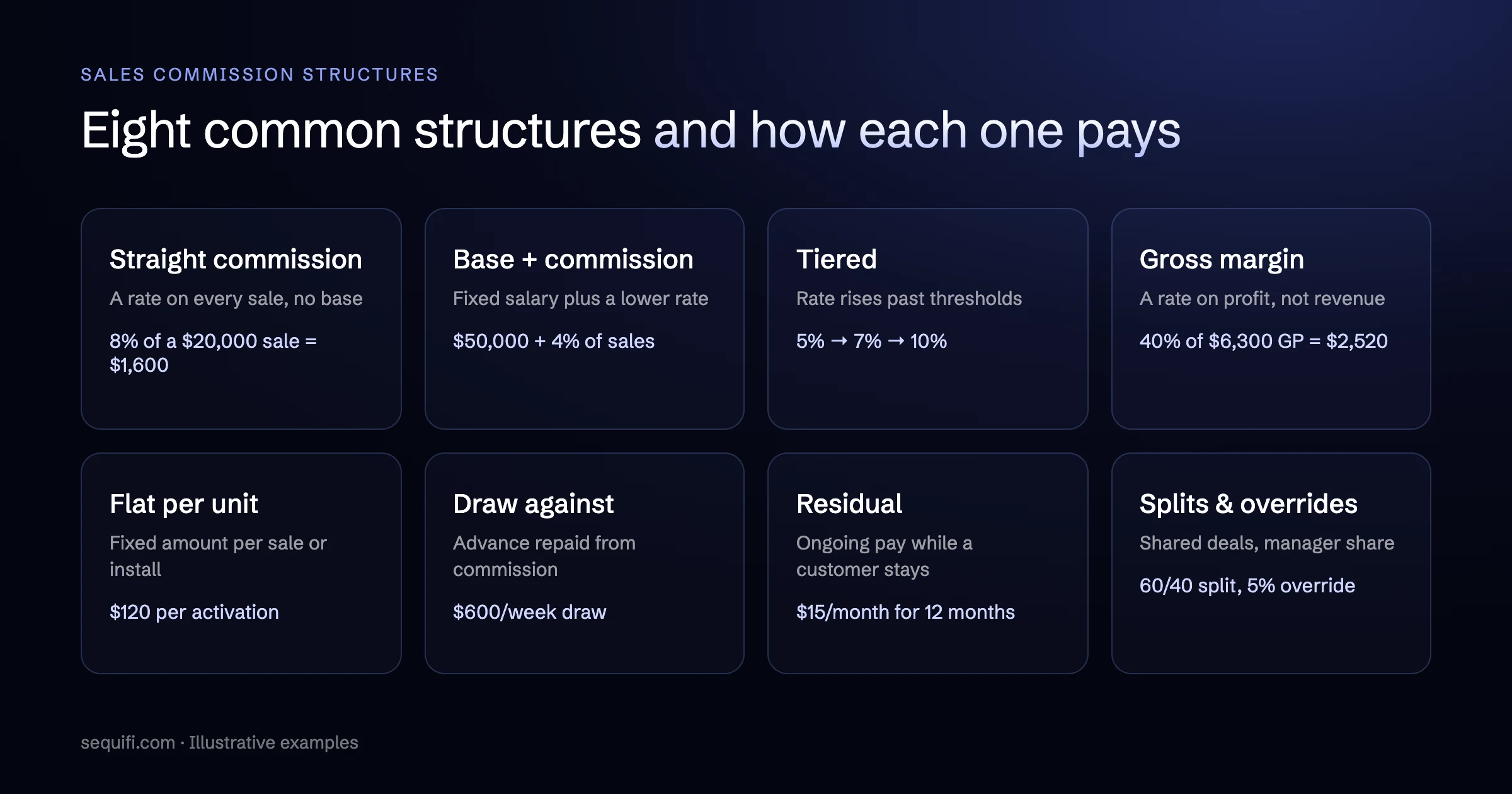
1. Percentage of Contract Value
The rep earns a flat percentage of the contract price (or of collected revenue). At 8%, the rep earns 8% x $18,000 = $1,440.
Works for: retail-focused companies with consistent pricing and margins, and owners who want a plan every rep can calculate in their head. Watch out for: it does not account for profit. A rep who discounts or misses scope still earns nearly the same commission while the company absorbs the loss.
2. Percentage of Gross Profit
The rep earns a percentage of gross profit, meaning contract price minus direct job costs. At 40% of GP, the rep earns 40% x $6,300 = $2,520.
Works for: companies that want reps to protect price, sell complete scopes and push upgrades. Watch out for: it only works if job costing is accurate and visible. If reps cannot see which costs came out of their job, every payday turns into a dispute.
3. The 10/50/50 Split
A widely used profit-based variant in roofing. The company takes 10% of the contract for overhead, subtracts direct job costs, and splits the remaining profit 50/50 with the rep:
| Step | Amount |
|---|---|
| Contract price | $18,000 |
| 10% overhead | -$1,800 |
| Direct job costs | -$11,700 |
| Profit pool | $4,500 |
| Rep's 50% | $2,250 |
| Company's 50% (plus the $1,800 overhead) | $2,250 |
Works for: storm and insurance work, where reps influence scope and supplements. Watch out for: "10/50/50" means different things at different companies. Spell out whether the 10% comes off the original contract or the final collected amount, and exactly which costs count as job costs (financing fees, setter fees, warranty reserves and so on).
4. Margin-Tiered Commission
The rep's share of gross profit steps up with the job's margin. For example: 30% of GP on jobs under a 30% margin, 40% of GP between 30% and 40%, and 45% of GP above 40%. Our job sits at a 35% margin, so the rep earns 40% x $6,300 = $2,520.
Works for: teams where discounting is the main threat to margin. Watch out for: tier edges. Define whether the higher rate applies to the whole job or only to the profit above the threshold, and round margins the same way every time.
5. Split Commissions and Manager Overrides
On many roofing teams, more than one person gets paid on a job. A typical setup: a canvasser or setter earns a flat fee for each job that gets built, the closer earns a share of GP, and the sales manager earns an override on top. On our job, a $300 setter fee, a closer at 40% of GP ($2,520) and a 5% of GP manager override ($315) add up to $3,135 in sales compensation, or about 17.4% of the contract.
Works for: canvassing and storm teams with distinct roles. Watch out for: double-counting. Decide whether the setter fee and override come out of the profit pool before the rep's split or are paid on top, and write it down.
6. Milestone Payouts
Instead of paying the full commission at one point, the company releases it in stages. Insurance roofing is the clearest case, because the final contract value often changes after a supplement:
- At signing, the estimated commission is 40% x $6,300 = $2,520.
- When the roof is built, the rep receives 50% of the estimate: $1,260.
- An approved supplement adds $1,200 to the contract and $300 to job costs, so final gross profit is $7,200 (a 37.5% margin).
- Final commission is 40% x $7,200 = $2,880. After the insurer pays, the rep receives the balance: $2,880 - $1,260 = $1,620.
Works for: protecting cash flow and avoiding clawbacks on jobs whose numbers are not final. Watch out for: long gaps between milestones. If the balance takes months to arrive, reps need to be able to see what is pending and why.
Why Profit-Based Plans Win When Reps Discount
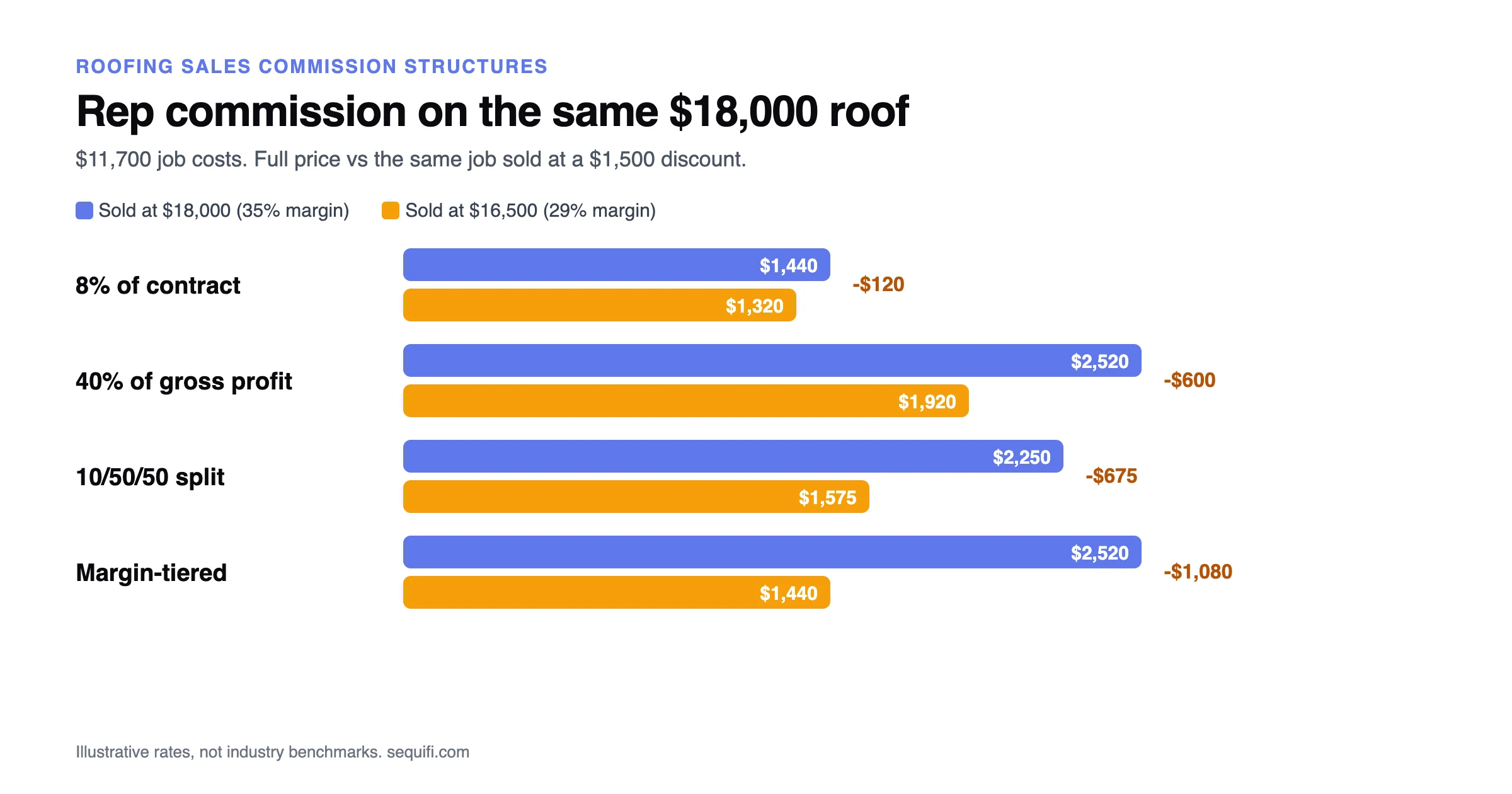
The difference between these structures shows up most clearly when a rep cuts the price. Suppose the same roof sells for $16,500 instead of $18,000, with the same $11,700 of job costs. Gross profit falls from $6,300 to $4,800, a $1,500 loss for the company. Here is what happens to the rep's commission:
| Structure | At $18,000 | At $16,500 | Rep's change |
|---|---|---|---|
| 8% of contract | $1,440 | $1,320 | -$120 |
| 40% of gross profit | $2,520 | $1,920 | -$600 |
| 10/50/50 split | $2,250 | $1,575 | -$675 |
| Margin-tiered (drops below 30% margin) | $2,520 | $1,440 | -$1,080 |
Under a revenue plan, the rep gives up $120 to win a job the company makes $1,500 less on. Under profit-based plans the rep shares the cost of the discount, which is why most roofing owners who have tried both move to GP or 10/50/50. The trade-off is transparency: a profit-based plan is only trusted if reps can see the cost lines behind every number.
When to Pay: Signature, Install or Collection
Choosing a structure is half the plan. The other half is the commission trigger:
- On signature: fastest for the rep, riskiest for the company. Jobs cancel, scopes change and supplements move the numbers after the fact.
- On install: the job is real and costs are mostly known, but insurance payments and supplements may still be outstanding.
- On collection: commission is calculated on what was actually paid. This is the safest trigger, and many companies combine it with a partial advance at install (see milestone payouts above).
Federal rules give homeowners a cancellation window on many in-home sales. Under the FTC Cooling-Off Rule, a buyer generally has three business days to cancel a sale of $25 or more made at their home, and some states add longer windows for home-improvement or insurance-funded contracts. Paying commission before that window closes guarantees some clawbacks.
Clawbacks and Chargebacks
A clawback recovers commission already paid when a job cancels, a homeowner does not pay, or the final margin comes in lower than estimated. If the rep in our example was advanced $2,520 and the homeowner cancels, the company recovers $2,520 from the rep's next commission cycle.
Write the clawback rule into the comp plan before the first job is sold: which events trigger it, how far back it reaches, and whether it comes out of future commission or is invoiced. State wage laws limit what can be deducted from an employee's pay, so check the rules where your reps work before recovering money from wages.
Draw Against Commission
A draw gives reps a predictable paycheck while their first jobs move through production, or through a slow season. For example, a rep on a $500 weekly draw receives $2,000 over four weeks. If they earn $2,520 in commission in that period, they are paid the $520 difference. If they earn only $1,500, a recoverable draw carries the $500 shortfall forward against future commission; a non-recoverable draw writes it off. For a deeper walkthrough, see our guide to draws against commission, which uses the same mechanics.
W-2 vs 1099 Roofing Sales Reps
Classification decides which payroll rules apply to every commission check:
- 1099 contractors: the IRS uses a common-law test that looks at behavioral control, financial control and the relationship of the parties. A rep who works set hours, follows your scripts, uses your leads and sells only your roofs may be an employee regardless of what the contract says. For payments made in 2026, you must file Form 1099-NEC for each contractor you pay $2,000 or more in the year (the threshold was $600 for earlier years).
- W-2 employees: commission is wages, so it is subject to withholding and payroll taxes. Reps whose primary duty is making sales away from your place of business may qualify for the federal outside sales exemption from minimum wage and overtime. Setters who work the phones from your office generally do not.
- Written plans: some states require commission agreements in writing. California, for example, requires a signed written contract that explains how commissions are computed and paid when the work is performed in the state.
How to Build a Roofing Commission Plan Reps Trust
- Pick one base (contract value, gross profit or 10/50/50) and define every term: which revenue figure, which cost lines and when numbers are final.
- Set the trigger: signature, install, collection or staged milestones.
- Write the cancellation, clawback and supplement rules before they are needed.
- Show reps the math. Every commission should trace back to a job, its revenue and its costs.
- Pay setters, closers, crew leads and managers from the same job record, so overrides and splits never get calculated twice.
Run Roofing Commissions and Payroll in One Platform
Profit-based roofing plans break down in spreadsheets because the inputs keep moving: supplements, change orders, cancellations and overrides all change someone's check. Sequifi's roofing commission software pulls job and margin data from roofing systems including JobNimbus and Proline, calculates margin splits, per-job rates, overrides, spiffs and clawbacks by rule, and moves approved commission straight into payroll. Reps see how each commission was built from the job, before payday.
See how it fits your team on the roofing industry page, or read why operators are replacing payroll workarounds with commission tracking software.
How Much Do Roofing Sales Reps Make?
Most roofing sales reps are paid mainly or entirely on commission, so earnings depend on how many roofs they sell, the price, and the margin on each job. There is no single salary figure. Using the $18,000 roof from this guide, with a rep earning 40% of the $6,300 gross profit, or $2,520 per job:
- 2 roofs a month: $5,040 a month, about $60,480 a year
- 4 roofs a month: $10,080 a month, about $120,960 a year
- 6 roofs a month: $15,120 a month, about $181,440 a year
These are illustrations, not averages. Storm seasons, territory, lead flow, whether the rep self-generates, and clawbacks on cancelled jobs all move the real number. Reps paid a base salary plus a lower commission trade some of that upside for stability. Model your own plan with the commission calculator.
Frequently Asked Questions
What is the most common commission structure for roofing sales reps?
Most residential roofing companies pay reps on profit rather than contract price: either a straight percentage of gross profit or a 10/50/50 split, where 10% of the contract covers overhead and the profit left after job costs is split 50/50 between the rep and the company. Percentage of contract value is simpler and is still common for retail teams with steady margins.
How does the 10/50/50 roofing commission split work?
Take 10% of the contract price for company overhead, subtract the direct job costs (materials, labor, permits, disposal), and split what remains 50/50 between the rep and the company. On an $18,000 roof with $11,700 of job costs, overhead is $1,800, the profit pool is $4,500 and the rep earns $2,250.
Should roofing reps be paid when the contract is signed or when the job is paid?
Paying on signature gets reps paid fastest but means clawing money back when jobs cancel or margins change. Most roofing companies pay all or part of the commission once the job is built and the balance when the homeowner or insurer has paid, so commission is calculated on the final, collected numbers.
How are insurance supplements handled in roofing commissions?
An approved supplement raises the contract value and usually some job costs, so the commission should be recalculated on the final numbers. A common approach is to pay part of the commission at install and true up the balance after the supplement is approved and the insurer has paid.
Can roofing sales reps be paid as 1099 contractors?
Only if they are genuinely independent under the IRS common-law test, which looks at behavioral control, financial control and the relationship between the parties. Reps who work set schedules, use company scripts and sell only your jobs often look like employees. For payments made in 2026, a Form 1099-NEC is required once you pay a contractor $2,000 or more in the year.
What is a draw against commission in roofing?
A draw is a regular advance, for example $500 a week, that is later subtracted from the commission a rep earns. It smooths income for new reps and slow seasons. A recoverable draw carries any shortfall forward to future commissions; a non-recoverable draw does not. Put the terms in the written comp plan and check your state wage rules before recovering a deficit.
How much do roofing sales reps make?
It depends mainly on volume and margin, because most roofing reps are paid on commission. As an illustration, at $2,520 commission per $18,000 roof, a rep selling four roofs a month earns about $120,960 a year.
Sources
- IRS - Independent contractor (self-employed) or employee?
- IRS - About Form 1099-NEC, Nonemployee Compensation
- 29 CFR 541.500 - Outside sales employees (FLSA exemption)
- FTC - Rule Concerning Cooling-Off Period for Sales Made at Homes or Certain Other Locations
- California Labor Code 2751 - Written commission agreements
See Sequifi run your kind of pay.
Commissions, payroll and HR in one platform, built for teams where every paycheck is different.
Book a demo