What is a draw against commission? Recoverable vs. non-recoverable, with examples
How a draw against commission works, the difference between recoverable and non-recoverable draws worked over four weeks, what happens when a rep leaves owing a balance, and the wage-law basics.
Quick Answer
A draw against commission is an advance a company pays a commissioned rep on a regular schedule, then subtracts from the commission the rep actually earns. If the rep earns more than the draw, they are paid the difference. If they earn less, what happens depends on the type of draw. With a recoverable draw, the shortfall becomes a balance the rep pays back out of future commission. With a non-recoverable draw, the company absorbs the shortfall and the rep starts the next period at zero. Draws are most common when reps are ramping up, in seasonal businesses, and in field sales, where commission arrives in uneven bursts.
How a Draw Against Commission Works
Every pay period, the rep receives the draw amount whatever they sold. At the end of the period, the company compares the draw with the commission the rep earned:
- Commission is higher than the draw: the rep is paid the difference on top of the draw (after any balance they owe is cleared, on a recoverable draw).
- Commission is lower than the draw: the rep still gets the full draw. On a recoverable draw, the gap is recorded as a balance owed. On a non-recoverable draw, it is written off.
The draw is not extra pay. Over time, on a recoverable draw, the rep earns exactly their commission; the draw only changes when the money arrives.
Recoverable vs. Non-Recoverable Draws: A Worked Example
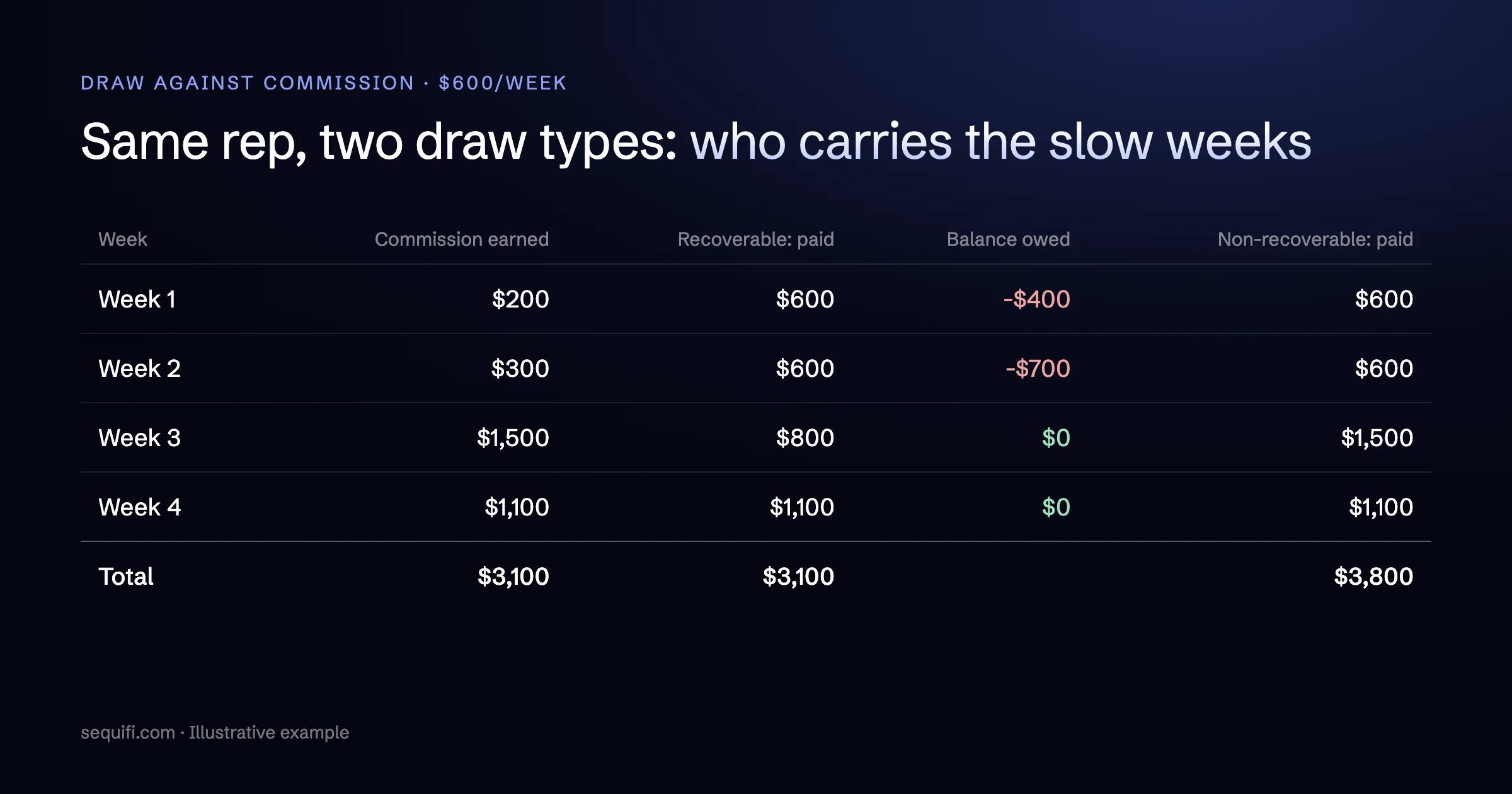
Take a rep on a $600 weekly draw who earns $200, $300, $1,500 and $1,100 in commission over four weeks, $3,100 in total.
Recoverable draw
- Week 1: earns $200, paid the $600 draw. Balance owed: $400.
- Week 2: earns $300, paid $600. Another $300 shortfall, so the balance owed is $700.
- Week 3: earns $1,500. That is $900 more than the draw; $700 clears the balance and the rep receives the other $200 on top of the $600 draw, $800 in total. Balance: $0.
- Week 4: earns $1,100, paid the $600 draw plus $500. Balance: $0.
Total paid: $3,100, exactly the commission earned. The draw smoothed out the slow start; it did not add to the rep's pay.
Non-recoverable draw
Same weeks, but shortfalls are forgiven. The rep is paid $600, $600, $1,500 and $1,100: $3,800 in total. The extra $700 is the cost the company accepted to guarantee the rep a floor while they ramped.
That is the trade-off in one line: a recoverable draw protects the company's cash, and a non-recoverable draw protects the rep's income.
When Companies Use Each Type
Non-recoverable draws are usually short and deliberate: the first few weeks or months for a new hire, a new territory, or a product launch where nobody expects full production yet. Many plans put an end date on them in writing.
Recoverable draws suit experienced reps whose income is lumpy rather than low, such as in solar, roofing or mortgage, where a deal can take weeks to install, fund or close before commission is earned. The draw keeps a steady paycheck coming while the pipeline converts.
In door-to-door and field sales the choice matters more than usual, because pay is both seasonal and milestone-based. Our guides to draws for solar sales reps and fiber rep pay walk through industry-specific examples.
What Happens if a Rep Leaves Owing a Draw Balance?
This is where most draw disputes start. A rep on a recoverable draw quits with a $700 negative balance. Can the company collect it?
It depends on the written agreement and on state law. Many states restrict deductions from wages, and some limit what can be taken from a final paycheck in particular. In practice, companies often cannot simply deduct a negative draw balance from final pay, and pursuing it afterwards is rarely worth the cost. Some plans state that any unrecovered balance is forgiven at separation, which is clearer for everyone. Have employment counsel review this clause before reps sign.
Draws, Minimum Wage and Classification
A draw interacts with wage law in a few ways worth knowing:
- Non-exempt employees must receive at least minimum wage for all hours worked, and overtime where it applies, whatever their commission. A draw often serves as that floor, but a recoverable draw cannot be clawed back in a way that drops a week's pay below minimum wage.
- Outside sales employees, whose primary duty is making sales away from the employer's place of business, are exempt from federal minimum wage and overtime under the FLSA (29 CFR 541.500). State rules can differ.
- Independent contractors (1099) are not covered by wage-and-hour law in the same way, but a draw is still a contract term and should be written down. See our guide to paying 1099 and W2 reps.
- Written agreements: some states require commission plans to be in writing. California, for example, requires a signed written contract for commission pay (Labor Code §2751).
How to Set Up a Draw Program That Does Not Cause Disputes
- Write down the type. Recoverable or non-recoverable, in plain words, signed before the first paycheck.
- Set an end date or review point for non-recoverable draws, so a ramp guarantee does not become permanent by default.
- Cap the balance on recoverable draws, or forgive it after a set period, so a rep is never buried under a balance they cannot realistically earn back.
- Say what happens at separation, including whether any balance is forgiven.
- Show the running balance on every statement. Reps who can see their draw, earnings and balance each period rarely dispute the math.
How Sequifi Handles Draws
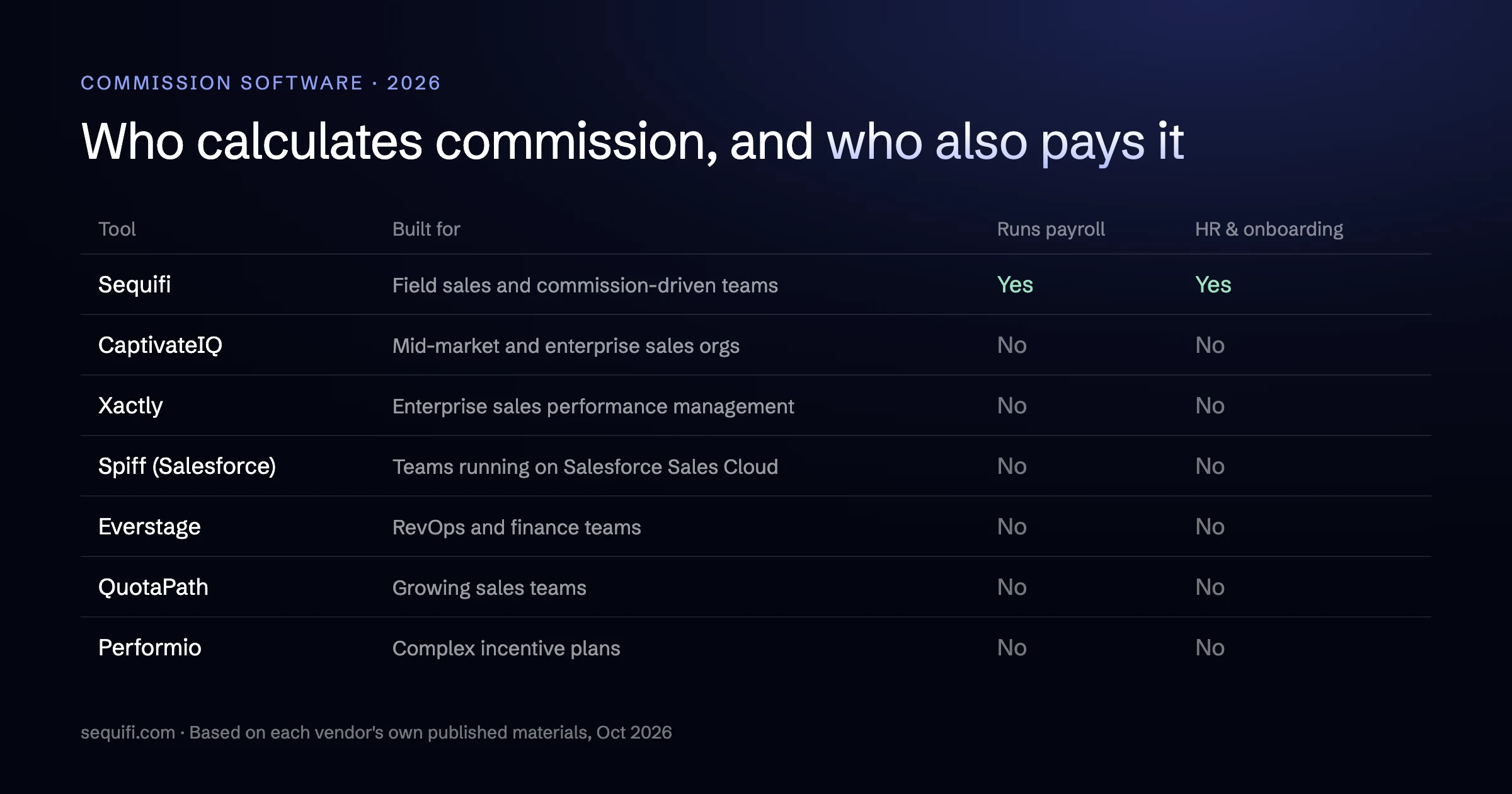
Sequifi applies draws, along with tiers, splits, overrides and clawbacks, from the rules in your comp plan, and carries the result into payroll. Reps can see every commission and how it was calculated, so the draw and what they have earned against it are never a mystery. See Sequifi commissions or book a demo.
Frequently Asked Questions
What is a draw against commission?
An advance paid to a commissioned rep on a regular schedule and later subtracted from the commission they earn. It gives the rep a predictable paycheck while their commission arrives unevenly.
What is the difference between a recoverable and a non-recoverable draw?
With a recoverable draw, any period where commission falls short of the draw creates a balance the rep repays from future commission. With a non-recoverable draw, the shortfall is forgiven and the rep starts the next period at zero.
Do I have to pay back a draw if I quit?
It depends on your written agreement and your state's wage laws. Many states restrict deductions from final pay, and some plans forgive any balance at separation. Check your plan document and, if needed, your state labor department.
Is a draw the same as a base salary?
No. A base salary is paid in addition to commission. A draw is an advance against commission, so on a recoverable draw it is ultimately paid out of the rep's own earnings.
How much is a typical draw?
There is no standard amount. Companies usually set it near what a ramping rep could realistically earn, so the balance does not grow faster than the rep can repay it.
Related Reading
- How Does a Draw Against Commission Work for Solar Sales Reps?
- Roofing Sales Commission Structures: How to Pay Roofing Sales Reps
- How Do Door-to-Door Fiber Sales Reps Get Paid?
- What Is a Mortgage Commission Clawback?
- How do you eliminate commission disputes?
Sources
See Sequifi run your kind of pay.
Commissions, payroll and HR in one platform, built for teams where every paycheck is different.
Book a demo