What is a mortgage commission clawback and when can a lender take back pay?
When a lender can recover paid LO commission after an early payoff, rescission or early payment default, how the amount is calculated, and how to build a clawback policy that holds up.
Quick Answer
A mortgage commission clawback is a provision in a loan officer's compensation agreement that lets the lender recover all or part of a commission it already paid when a defined post-close event occurs. The most common triggers are an early payoff, a rescission, an early payment default that forces a repurchase, or fraud. The CFPB's LO Comp Rule does not ban clawbacks. What it prohibits is compensation based on the terms of the loan, so a clawback must never be triggered by rate, term, product or down payment. In practice a clawback also needs to be written into the comp plan before the loan closes, applied consistently, and processed in line with state wage laws on paycheck deductions. The hard part is usually not legality. It is reconstructing the calculation, telling the LO before the deduction, and recovering the money without starting a pay dispute.
What Triggers a Mortgage Commission Clawback?
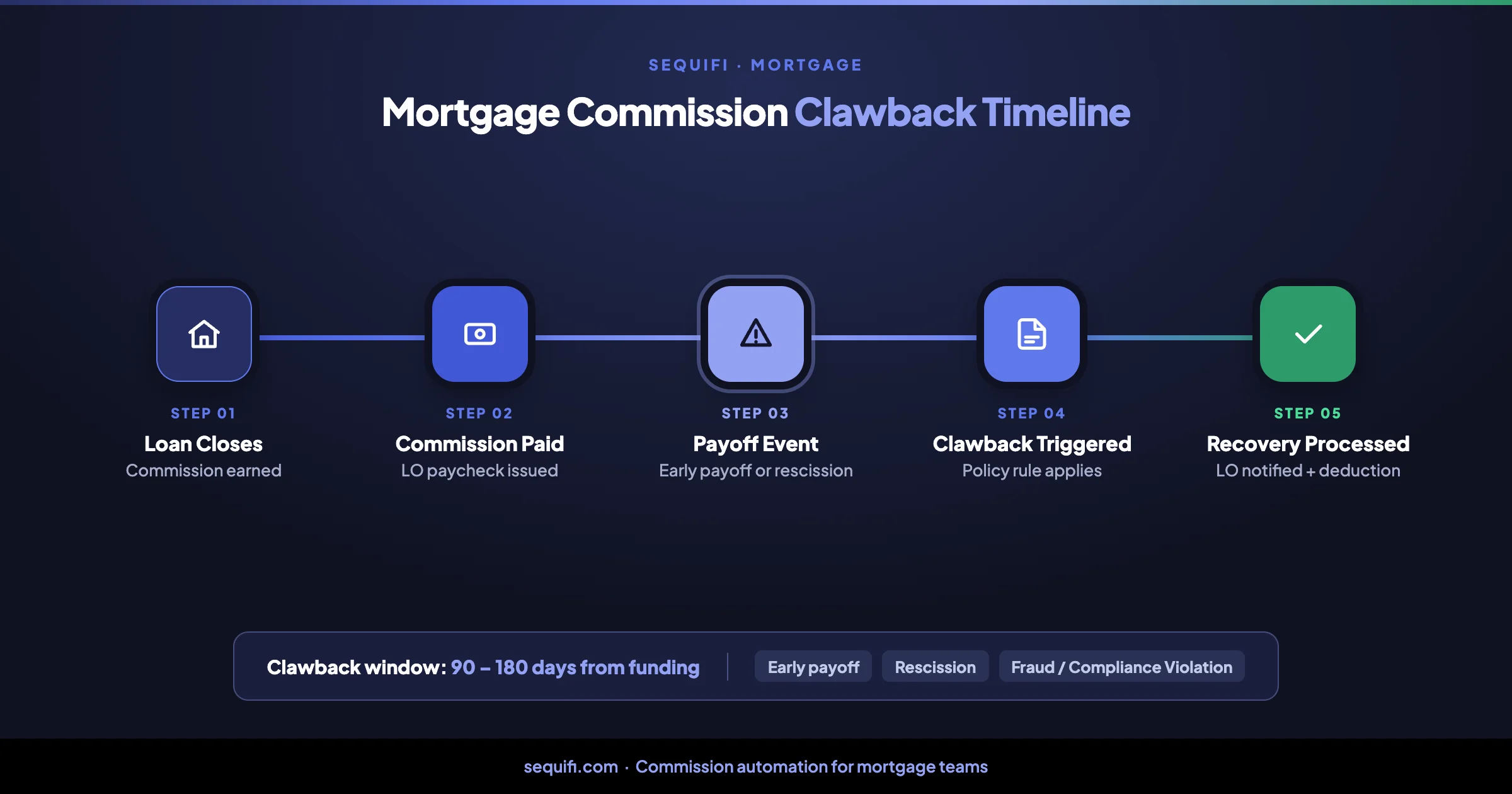
A clawback is triggered by an event that happens after the loan closes and the commission is paid, and that the comp plan names as a recovery event. The trigger should be defined in writing before the loan closes. Adding a clawback clause after a problem appears invites a dispute the lender is unlikely to win.
The most important design constraint is the LO Comp Rule: a clawback cannot be tied to the terms of the loan. You cannot claw back commission because a borrower chose a higher rate, a shorter term or a specific product. What lenders do claw back is commission on a loan that did not perform as expected: one that was rescinded, paid off too early, defaulted early, or involved misrepresentation.
The Four Most Common Clawback Events
1. Early payoff
An early payoff clawback applies when a borrower pays off or refinances the loan within a set period after funding, commonly somewhere between 90 and 180 days. The reason is secondary market economics: lenders usually sell loans at a premium, and investors can recapture that premium when a loan pays off inside their early payoff window. The lender passes part of that loss back through the comp plan.
Schedules vary. One plan might recover 100% of the commission on payoffs within 90 days, 50% between 91 and 180 days, and nothing after that. Another might use a sliding scale by month.
2. Early payment default and repurchase
Some comp plans recover commission when a loan is repurchased after an early payment default (EPD), typically defined by the investor as a missed payment within the first few months. This is more common at correspondent lenders and brokers that carry EPD repurchase risk.
3. Rescission
Under the Truth in Lending Act, borrowers refinancing or taking a new lien on their primary residence with a lender other than their current one generally have a three-business-day right to rescind. If the borrower rescinds, the loan unwinds and no commission is earned. Because funding usually waits until the rescission period ends, this is normally a reversal of an advance rather than a recovery of paid commission.
4. Fraud or compliance violation
If a post-close audit or quality control review shows the loan closed on misrepresentation, such as inflated income, undisclosed debts or property fraud, and the LO knew or was negligent, the comp plan may allow recovery of the commission. These cases involve HR and legal review and are handled differently from routine early payoff clawbacks.
How Clawback Amounts Are Calculated
The calculation follows the structure of the original commission.
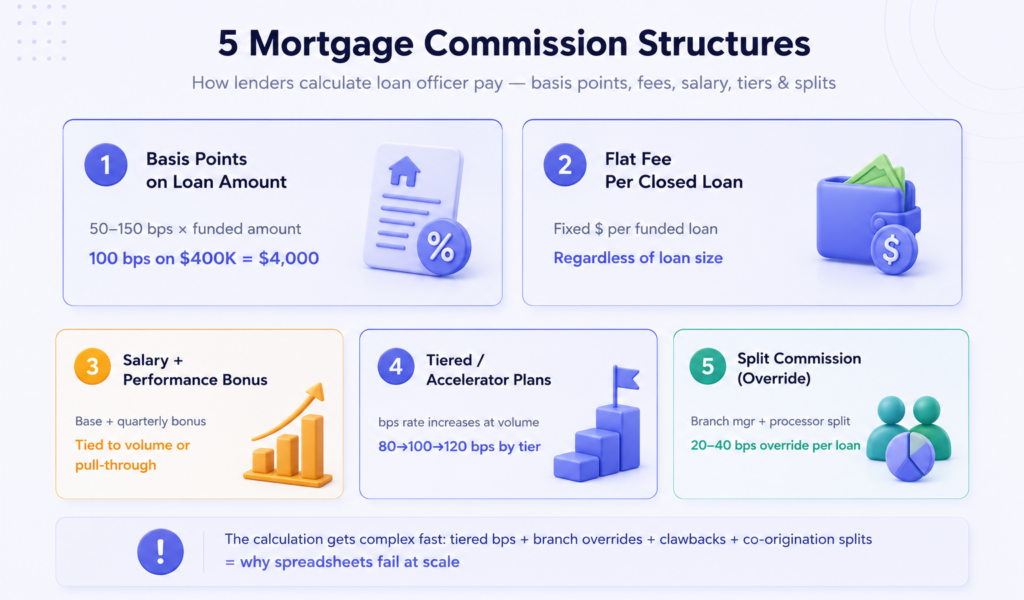
For a flat-dollar commission (for example, $1,500 per funded loan), the clawback is the percentage of that amount set out in the plan's schedule.
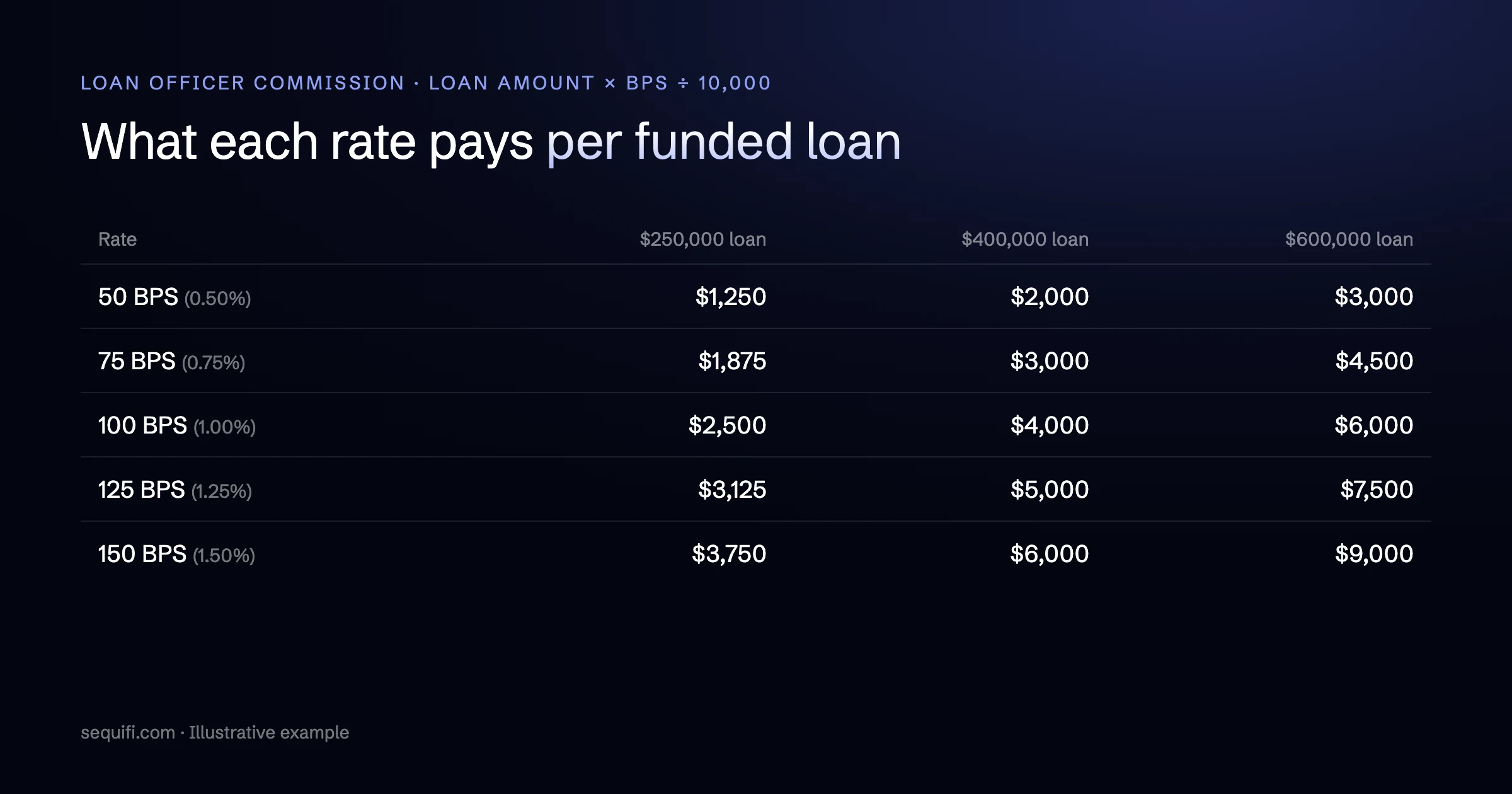
For a basis-point commission (for example, 100 BPS on a $400,000 loan, which is $4,000), the clawback is the original commission multiplied by the recovery percentage for that trigger and timing window. At 50%, that is $2,000.
For a draw paid ahead of funding, which is uncommon in mortgage but used in some branch models, the clawback recovers only the portion of the draw attributable to the loan that did not fund.
The practical standard: the amount should be calculable from the comp plan document alone, with no discretion. If the lender decides after the fact how much to recover, the LO has every reason to dispute it.
Clawback vs. Charge-Back: What Is the Difference?
The terms are often used interchangeably in mortgage, but they describe different mechanics.
A clawback usually means recovering money that was already paid. The commission was on the LO's paycheck, and the lender now takes it back by deducting from future pay or asking for repayment.
A charge-back more precisely means reversing a commission before it is paid. If a loan unwinds before the commission cycle closes, the commission is removed from that cycle instead of recovered afterwards.
Most comp plans use "clawback" for both. The difference matters for payroll: a charge-back needs no recovery, while a true clawback needs a documented recovery process that complies with state wage payment laws on deductions.
What the CFPB LO Comp Rule Says About Clawbacks
Regulation Z (12 CFR 1026.36(d)) prohibits paying a loan originator based on a term of the transaction or a proxy for a term, and prohibits an LO from being paid by both the consumer and another party on the same loan. Separately, 12 CFR 1026.25(c)(2) requires lenders to keep records of LO compensation agreements and payments.
The rule does not contain a list of permitted clawbacks. Recovering pay because a loan did not close, was rescinded or paid off early is not based on a term of the loan, which is why those triggers are widely used. A clawback that varies with rate, term, product type or down payment is a term-based adjustment, and so is prohibited. That includes structures that do not name a loan term but work as a proxy for one.
Sequifi applies clawbacks from the rules in your comp plan, so each recovery traces back to the original loan and the rule that applied, and LOs can see every commission and clawback and how it was calculated. See how it works in our mortgage commission software, or browse our integrations.
How Clawbacks Affect Loan Officer Retention
A clawback that is poorly communicated, inconsistently applied or calculated in a way the LO cannot follow is a fast way to lose a loan officer.
LOs who do not know their clawback exposure, meaning which loans are still at risk, what the formula is and how they will be told, carry extra uncertainty on top of an already variable income. Picture an LO who closes a $500,000 loan, earns $3,500, and five months later sees a deduction with no notice and no itemized explanation. That LO is likely to start looking elsewhere, and commission transparency is a big reason loan officers leave.
Transparency does not remove clawbacks. It removes most of the dispute that follows. An LO who knew from day one that payoffs within 90 days trigger a 100% recovery, who can check which loans are still in the window, and who is told before a recovery is processed has far less reason to contest it.
Building a Clawback Policy That Holds Up
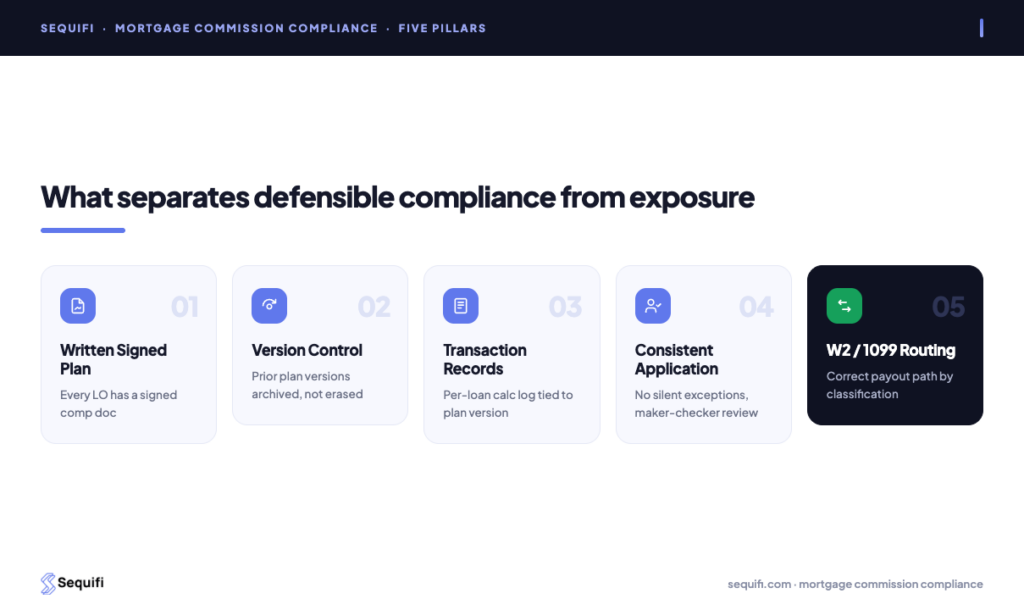
A defensible mortgage commission clawback policy has five parts.
Written comp plan with explicit clawback terms. Triggers, timing windows and recovery formulas belong in the compensation plan, signed by the LO before they originate under it. A verbal policy is not a policy.
Consistent application. If a trigger applies to one LO, it applies to every LO on the same plan. Selective enforcement invites disputes and discrimination claims.
Advance notice before deduction. Notify the LO in writing before a clawback is deducted, identifying the loan, the trigger, the calculation and the amount. Some states also require written authorization for deductions.
Traceable calculation. Every recovery should be calculable from the plan version in force when the loan closed. If the plan was amended later, the original version governs that loan.
State wage law review. Paycheck deductions are regulated differently by state. Some require written consent; federal and state minimum wage rules limit deductions for non-exempt employees. Have counsel review the mechanics before the policy goes live. Our guide to mortgage commission compliance covers the wider picture.
How Automation Reduces Clawback Disputes
As with commission disputes generally, most clawback disputes come from the process, not the policy. Manual tracking means someone has to notice the early payoff, look up what the LO was paid, apply the formula and enter the deduction, often weeks later and with no audit trail linking the recovery to the original commission.
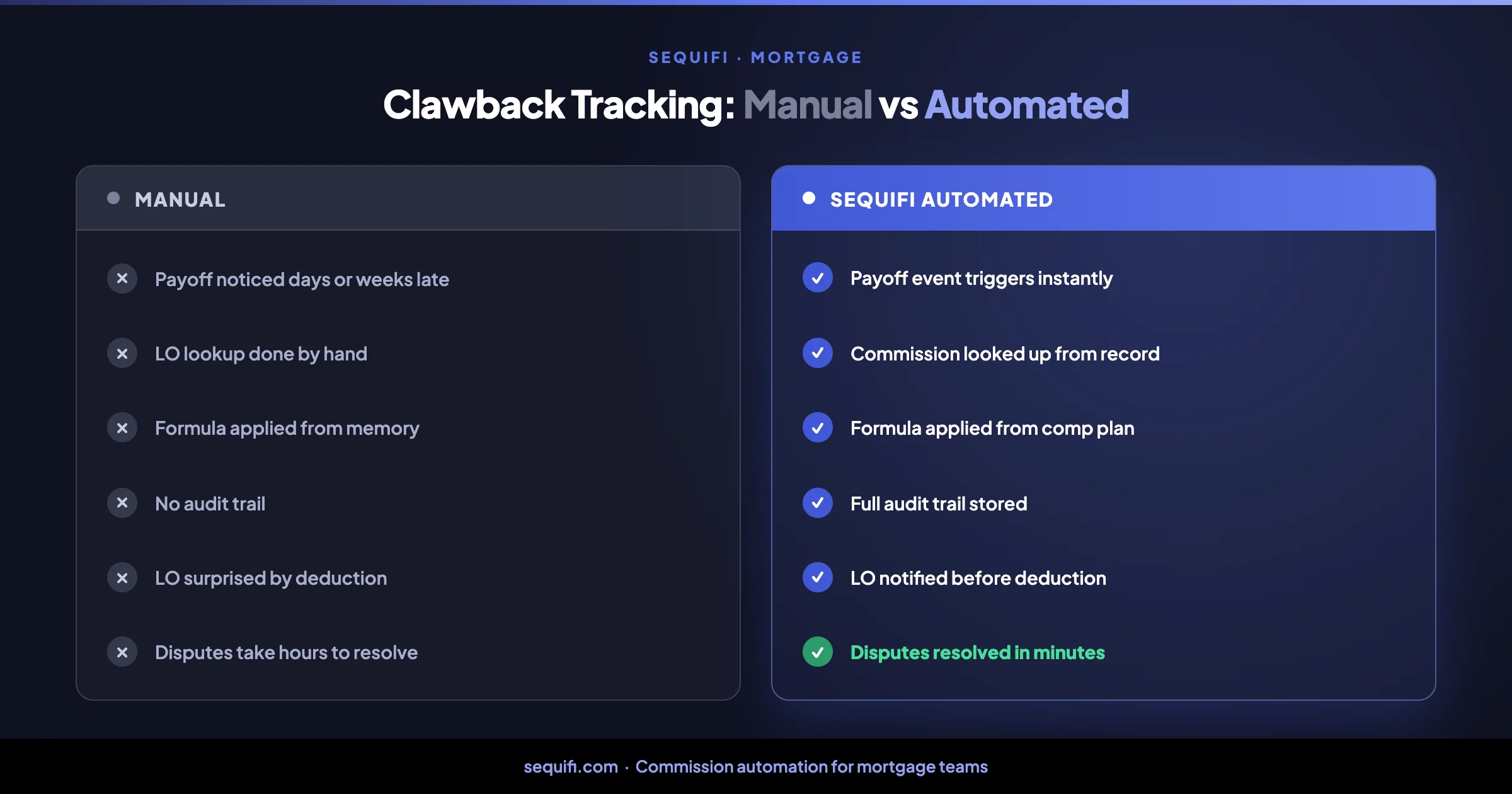
Sequifi applies the clawback against the comp plan rule that governed the loan, records it against the original commission, and carries it into payroll. LOs can see each clawback and how it was calculated, so a recovery arrives with its explanation attached. The result is a faster, more consistent process with far fewer surprises. See how Sequifi works for mortgage teams, or book a demo.
Getting Started
For mortgage operations teams reviewing their clawback policy:
- Audit your current comp plan. Does it define clawback triggers, windows and recovery formulas explicitly? If not, that is your first gap.
- Check LO Comp Rule compliance. Confirm no trigger varies with loan terms, directly or by proxy. Have compliance review it.
- Review state wage law. Know the notice, consent and deduction limits in every state where you employ LOs.
- Build a notification step. LOs should get written notice before any clawback deduction, with the calculation shown.
- Get payoff data to your commission system quickly. The sooner you know a loan paid off early, the sooner the recovery can be processed correctly.
- Give LOs visibility into their exposure. An LO who can see which loans are still in the window is rarely surprised by a deduction.
See how Sequifi handles mortgage clawbacks in our mortgage commission software.
Frequently Asked Questions
Is a mortgage commission clawback legal?
Federal law does not prohibit them. A clawback is generally enforceable when it is written into the comp plan before the loan closes, is not triggered by the terms of the loan (which the CFPB LO Comp Rule prohibits), and complies with state wage payment laws on paycheck deductions. A policy that fails any of these may be unenforceable or create regulatory exposure.
How long do early payoff clawbacks typically last?
It depends on the investor and the comp plan. Windows of 90 to 180 days from funding are common. The specific window should be stated in the comp plan.
Can a lender claw back commission because a borrower chose a higher interest rate?
No. The LO Comp Rule prohibits compensation based on the terms of the loan, including rate, term, product type and down payment. A clawback tied to loan terms, directly or through a proxy, violates Regulation Z.
What is the difference between a clawback and a charge-back in mortgage?
A charge-back removes a commission before it is paid, for example reversing it in the current cycle because the loan unwound. A clawback recovers commission that was already paid. Plans often use the terms interchangeably, but a true clawback needs a documented recovery process and may be subject to state wage law notice and consent rules.
How should we notify a loan officer before deducting a clawback?
Send written notice that identifies the loan, the trigger event, the comp plan provision, the calculation and the amount, before the deduction appears on the paycheck. Check consent requirements in every state where you have LOs on payroll.
Conclusion
A mortgage commission clawback is a standard way to manage lender exposure after a loan closes, but its legal, operational and retention consequences depend on how it is documented, communicated and administered. A policy that is in writing, applied consistently and explained before LOs originate under it rarely produces a dispute. A clawback that shows up as an unexplained deduction months after closing almost always does.
The goal is not to avoid clawbacks. It is to make them transparent, traceable and fast.
See how Sequifi automates mortgage commission clawbacks in our mortgage commission software.
Related Reading
- How Do Mortgage Companies Calculate Commissions?
- How Does the LO Comp Rule Affect the Way You Pay Loan Officers?
- Per-Loan vs. BPS vs. Tiered: How to Structure LO Comp Plans
- How Do Mortgage Branches Split Commissions Between LOs and Branch Managers?
- How Mortgage Companies Manage Team Compensation, Payroll, and People Operations
Industry Resources
- CFPB - Regulation Z, 12 CFR 1026.36 (loan originator compensation)
- CFPB - Regulation Z, 12 CFR 1026.25(c)(2) (compensation record retention)
- CFPB - Regulation Z, 12 CFR 1026.23 (right of rescission)
- Mortgage Bankers Association (MBA)
- National Association of Mortgage Brokers (NAMB)
- SHRM - Society for Human Resource Management
See Sequifi run your kind of pay.
Commissions, payroll and HR in one platform, built for teams where every paycheck is different.
Book a demo