How mortgage companies manage team compensation, payroll, and people operations
LO commission, branch overrides, processor pay, W2 vs 1099 routing and the CFPB LO Comp Rule: how mortgage team compensation fits together, and where it breaks.
Quick Answer
Mortgage team compensation is one of the most structurally complex pay environments in any industry. A single mortgage office may have loan officers on BPS-based commission, a branch manager on override plus personal production, processors and underwriters on salary with discretionary bonuses, and a mix of W2 employees and 1099 independent contractors - all subject to the CFPB's LO Compensation Rule, state wage laws, and the operational challenge of connecting deal events from a LOS to a payroll run. Managing mortgage team compensation correctly requires a documented comp plan for every role, a classification review for every worker, and a commission engine that connects the loan pipeline to the payroll system without a manual step in between.
How Mortgage Teams Are Structured for Compensation Purposes
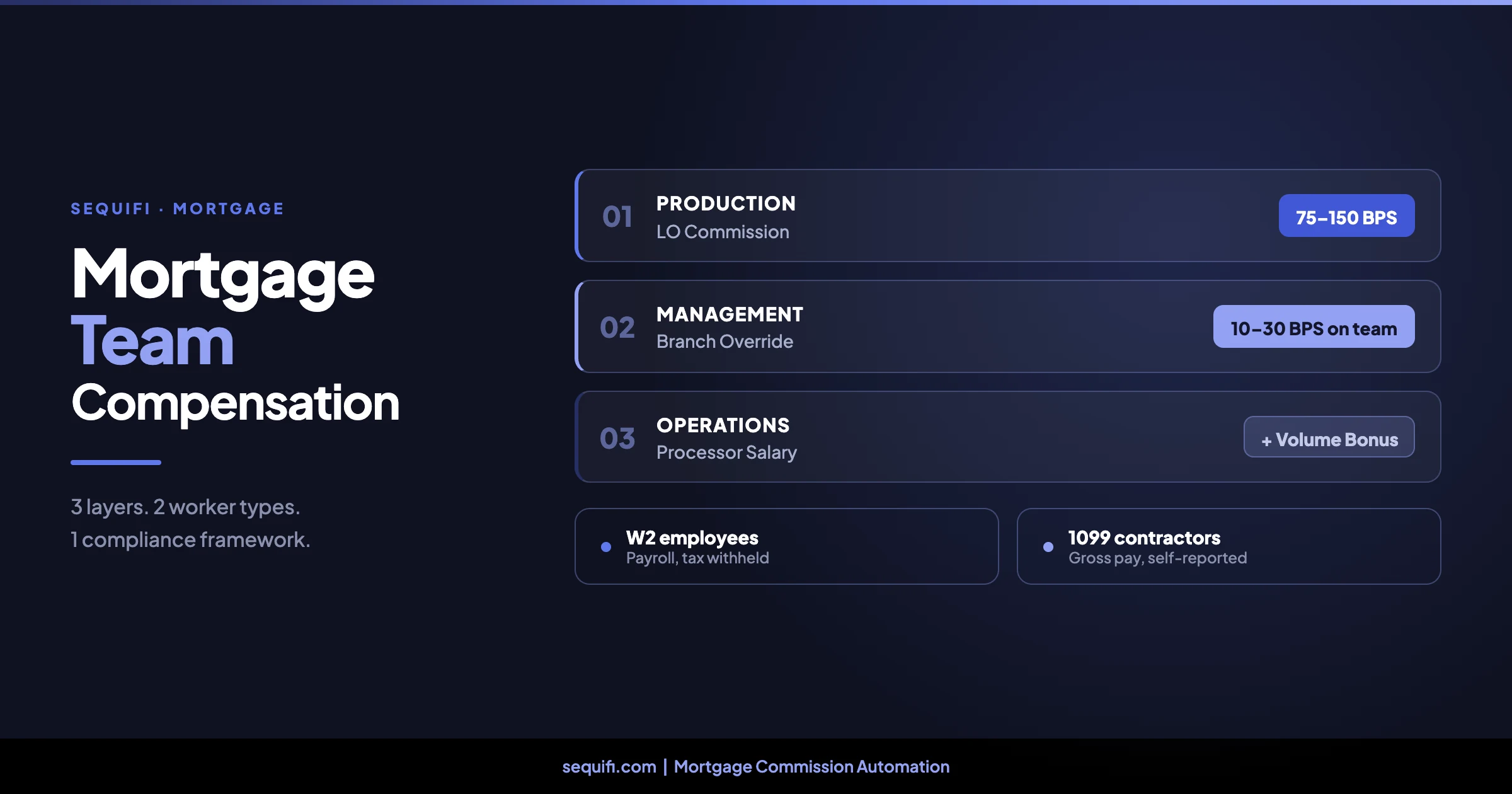
Mortgage companies come in many forms - independent mortgage banks, credit unions, bank-owned mortgage divisions, net branches, and wholesale brokers - but their compensation structures share a common architecture built around three functional layers: production, management, and operations.
Production: Loan officers, mortgage brokers, and originators who are directly responsible for bringing in and closing loans. Their compensation is primarily commission-based, tied to loan volume or specific loan events.
Management: Branch managers, sales managers, and regional directors who oversee production teams. Their compensation typically combines personal production (if they still originate loans) with override pay on their team's volume.
Operations: Loan processors, underwriters, closers, compliance officers, and administrative staff who support the loan lifecycle but do not directly originate. Their compensation is typically salary-based, sometimes with discretionary or production bonuses tied to volume metrics.
Understanding which roles fall into which layer is the starting point for building a mortgage team compensation structure that is compliant, competitive, and operationally manageable.
The Three Core Compensation Layers in a Mortgage Organization
Mortgage team compensation operates in three distinct layers, each with different calculation logic, compliance requirements, and payroll routing needs.
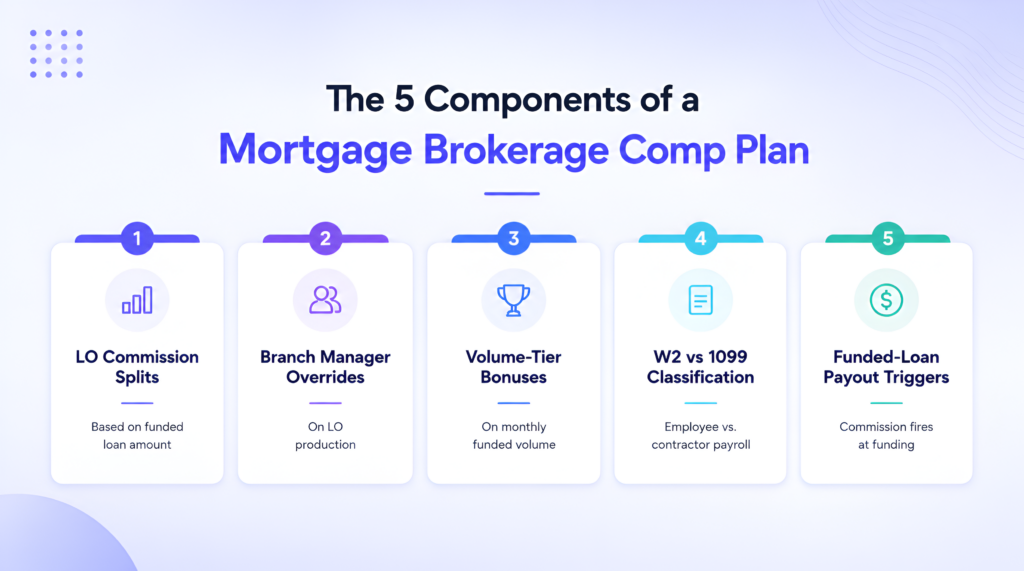
Layer 1 - LO commission: Variable, tied to loan events (application, closing, or funding), calculated as basis points on loan amount or as a flat fee per transaction. Governed by CFPB Regulation Z and the LO Compensation Rule. Paid through payroll as W2 wages (for employees) or through 1099 as independent contractor income (for brokers and some net branch LOs).
Layer 2 - Manager override: Variable, calculated as a percentage of subordinate LO production or a flat override per funded loan. Subject to the same LO Comp Rule restrictions as direct LO pay - manager overrides cannot be tied to loan terms. Paid through payroll for W2 managers or through separate compensation agreements for 1099 branch structures.
Layer 3 - Operations compensation: Fixed salary with optional bonuses. Bonuses for ops staff are typically tied to volume metrics (loans closed per month, turnaround time) rather than individual loan terms - which avoids LO Comp Rule entanglement. Paid through standard payroll.
Each layer has different data requirements, different compliance exposures, and different payroll timing. Managing all three without an integrated system creates the reconciliation problems that produce most mortgage payroll errors.
Loan Officer Compensation: Commission Triggers and BPS
Loan officer compensation is the centerpiece of mortgage team compensation design. Most LO pay structures are built on one of three commission triggers and one of two rate approaches.
Commission triggers
Application trigger: Commission is earned when a complete loan application is submitted. Less practical for most lenders, because it does not account for fallout - applications that do not close.
Closing trigger: Commission is earned when the loan closes, the point at which the originator's role on a purchase typically ends.
Funding trigger: Commission is earned when the loan funds, for lenders that want the loan to actually disburse before paying commission.
Rate approaches
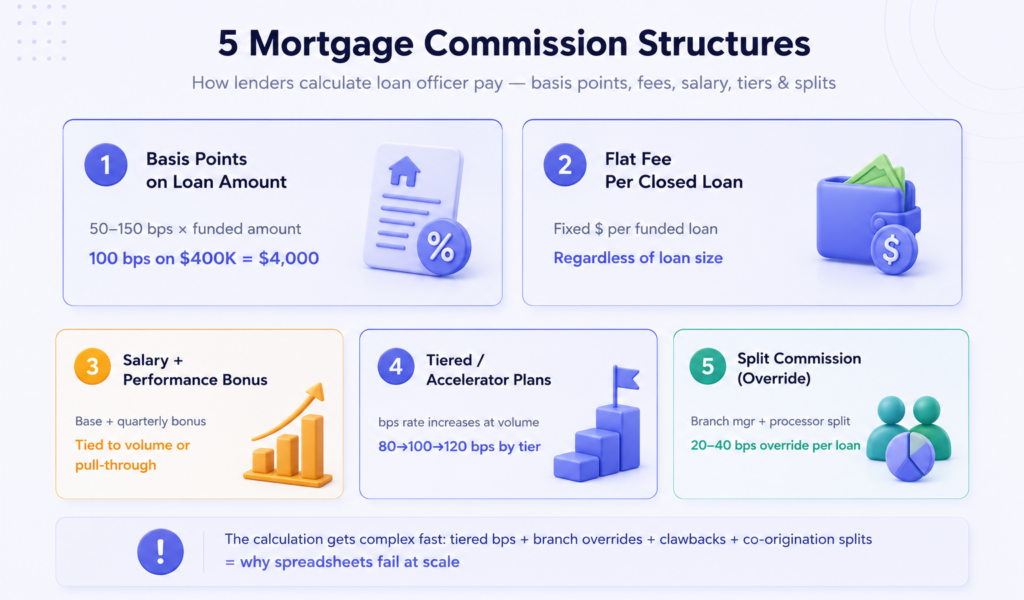
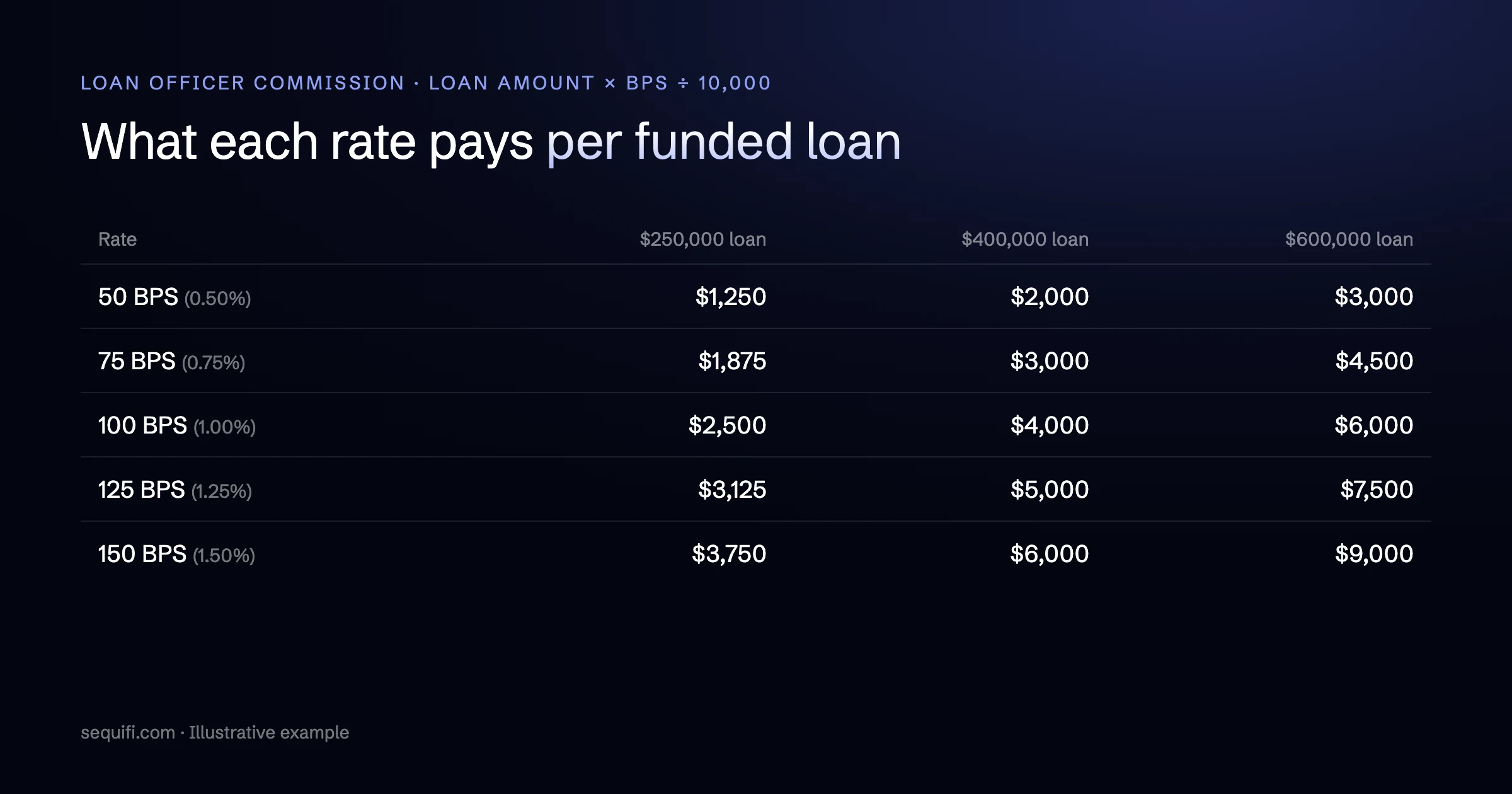
Basis points (BPS): Commission is calculated as a percentage of loan amount. 1 BPS = 0.01%, so a 100 BPS commission on a $400,000 loan = $4,000. STRATMOR's compensation research puts average retail loan officer commissions at roughly 92 to 103 basis points of production; actual rates vary by lender, channel and market.
Flat fee per loan: Commission is a fixed dollar amount per funded loan, regardless of loan size. Common in high-volume, lower-balance markets where BPS economics do not adequately compensate smaller loans.
Tiered BPS: Some mortgage companies add volume tiers - LOs who fund more loans in a month earn a higher BPS rate. Retroactive tiers recalculate all loans in the period at the higher rate when the threshold is crossed; incremental tiers apply the higher rate only above the threshold. Either approach should be spelled out in the comp plan.
Branch Manager and Override Pay
Branch managers in mortgage companies typically earn on two streams: their own personal production (if they still originate) and an override on the loans funded by LOs on their team.
Override structures
BPS override: The manager earns additional basis points on every loan funded by a team LO. It is a widely used structure and is permitted under the LO Comp Rule, provided the override is not tied to the terms of individual loans.
Revenue share: The manager earns a percentage of the branch's net revenue after LO commissions and direct costs, often in net branch structures where the branch manager takes on P&L responsibility. If the manager also originates loans, Regulation Z generally limits non-deferred compensation based on mortgage-related business profits to 10% of that person's total compensation, so revenue-share plans need careful design.
Flat override per loan: The manager earns a fixed dollar amount per funded loan. Simpler to administer but does not scale with loan size.
The LO Comp Rule constraint on manager pay: Under CFPB Regulation Z, mortgage manager compensation cannot be tied to the terms of the loans their team funds - interest rate, points, loan type, or other transaction-specific variables. An override that is a flat BPS or percentage of volume is permitted. An override that varies based on whether the team's loans were fixed vs. adjustable, or high-margin vs. low-margin, is not.
Player-coach structures: Branch managers who still originate earn on two sets of terms: personal production, which is loan originator compensation under Regulation Z, and a management override. Documenting the two separately makes each easier to administer and to audit.
Processor, Ops, and Support Staff Compensation
Mortgage processors, underwriters, closers, and compliance staff are typically compensated on salary, with discretionary bonuses that must be carefully designed to avoid LO Comp Rule complications.
What is permitted for ops staff bonuses: Volume-based bonuses tied to the number of loans processed, underwritten, or closed in a period - provided the bonus is not tied to the terms of specific loans - are generally permitted. A processor bonus for processing more than 40 loans in a month is different from a bonus for processing loans with higher margins.
What creates compliance exposure: Bonus structures for ops staff that create a financial incentive to approve specific loan types, favor certain products over others, or vary based on the loan terms of the files they handle can implicate the LO Comp Rule and related fair lending obligations. Even for staff who are not themselves "loan originators" under the rule, compensation designs that create incentives to steer borrowers toward particular products carry regulatory risk.
Payroll cadence for ops staff: Because ops staff are on salary, their base payroll is straightforward - the complexity is bonuses. For non-exempt employees who work overtime, nondiscretionary bonuses such as production bonuses must be included in the regular rate used to calculate overtime, while truly discretionary bonuses are excluded (29 CFR 778.211).
W2 vs. 1099 Classification in Mortgage Teams
One of the most consequential decisions in mortgage team compensation is how each worker is classified - W2 employee or 1099 independent contractor. The stakes are high in both directions.
W2 mortgage employees: Subject to standard employment law - minimum wage, overtime (unless exempt), workers' compensation, unemployment insurance, employer FICA contributions, and state payroll tax withholding. LO Comp Rule compliance is the employer's direct responsibility. Commission is paid through payroll with appropriate withholding.
1099 mortgage contractors: Common in net branch structures, broker shops, and some correspondent lender arrangements. Commission is paid gross without withholding. The LO Comp Rule still applies to the compensation arrangement itself - a 1099 LO is still a "loan originator" under Regulation Z. The broker or net branch must ensure the compensation formula for 1099 contractors complies with the rule even without the employer-employee relationship.
Misclassification risk: The IRS and state labor agencies apply a behavioral control test (does the company control how the work is done?), a financial control test (does the worker have an opportunity for profit/loss?), and a type-of-relationship test to classify workers. LOs who work exclusively for one company, use company systems and leads, and follow company procedures can be reclassified as W2 employees even if their agreements say "independent contractor." Misclassification produces back taxes, penalties, and retroactive benefit obligations.
Sequifi runs payroll for both classifications. The commission calculation may be identical, but W2 employees are paid with withholding and 1099 contractors are paid gross.
How Commission Connects to Payroll
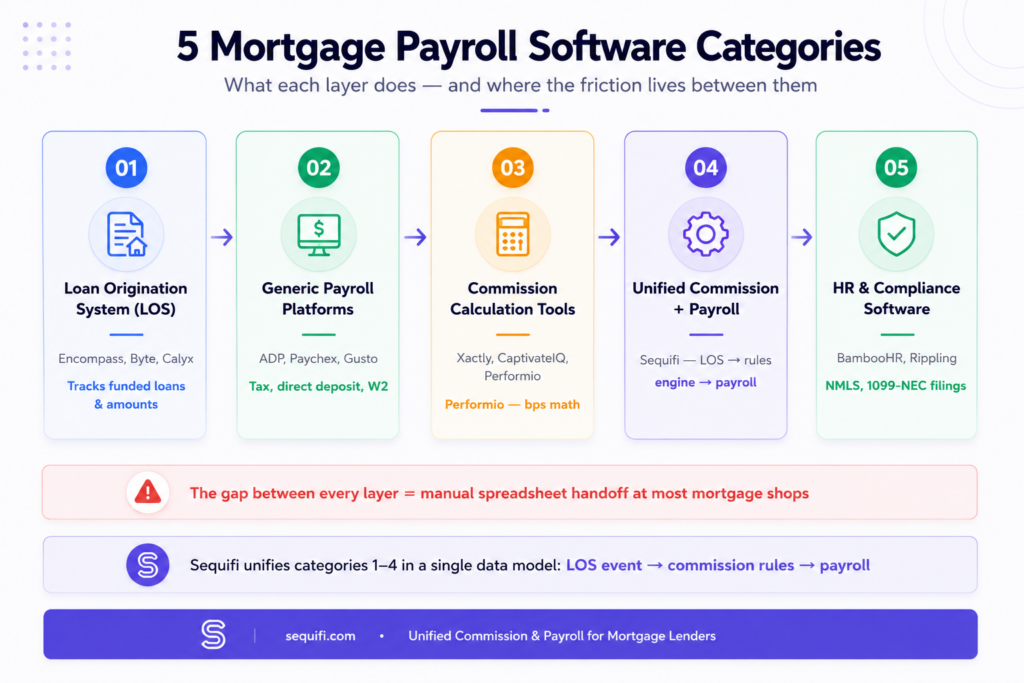
The most common operational failure in mortgage team compensation is the disconnect between the LOS (where loan events originate) and the payroll system (where wages are actually paid).
In most mortgage companies without an integrated commission engine, this connection is manual: a processor or ops manager pulls a funding report from the LOS at the end of the pay period, calculates LO commissions in a spreadsheet, reconciles with branch manager overrides, and submits the numbers to payroll. This process is slow (it can take days of work every pay cycle), error-prone (manual data entry, formula errors, missed adjustments), and completely unauditable (if a commission dispute arises, the only record is the spreadsheet).
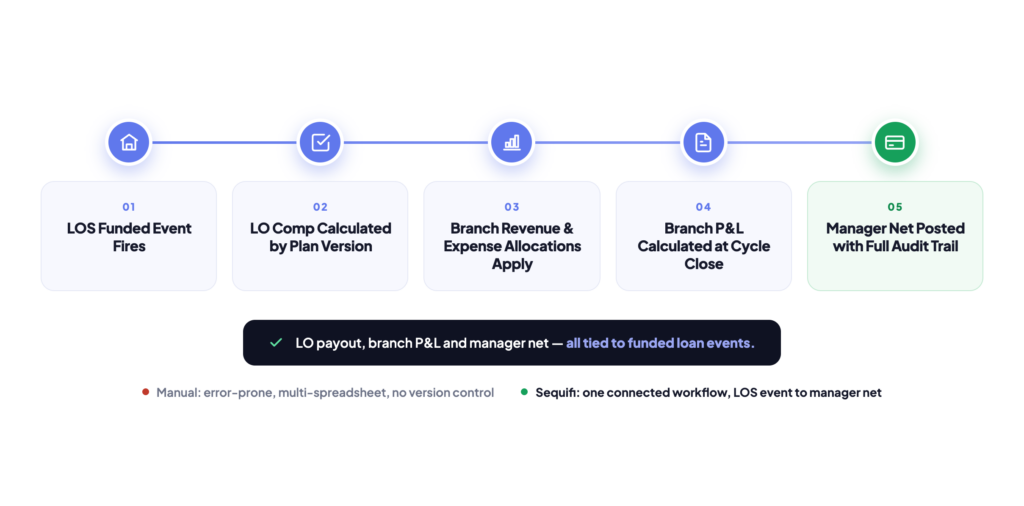
The integrated approach connects the LOS directly to the commission engine. Funding events in Encompass, Calyx, or another supported LOS flow automatically into Sequifi's commission engine, which applies the comp plan rules, calculates LO commission and branch manager override, generates itemized statements per originator, and runs payroll on the result. The manual step - the spreadsheet - is eliminated.
This connection matters for compliance as well as operations. Regulation Z requires creditors and loan originator organizations to keep records of loan originator compensation, and the agreement that governs it, for three years. Being able to produce itemized commission documentation for any loan in any period is far easier with an automated system and a complete audit trail than with a spreadsheet reconstructed after the fact.
Comp Plan Documentation and People Ops
The people operations dimension of mortgage team compensation is often underdeveloped compared to the commission calculation itself - and it is where most disputes originate.
Written comp plan requirements: Some states require commission agreements with employees to be in writing. California Labor Code §2751 requires a written contract that sets out how commissions are computed and paid, with a signed copy given to the employee, and New York Labor Law §191 requires a signed written agreement kept on file for three years. Separately, Regulation Z requires lenders to keep records of loan originator compensation and the agreement that governs it for three years. For mortgage companies operating across multiple states, this means tracking the written agreement rules for every state where an LO works.
Comp plan versioning: Commission plans change - BPS rates adjust, tier thresholds shift, trigger events are redefined. Every version of a comp plan must be documented with an effective date. When an LO disputes their commission on a loan that closed six months ago, the question is which version of the comp plan was in force on the funding date. Without version control, this becomes a reconstruction exercise that rarely ends in the company's favor.
Onboarding documentation: New LO hires should receive their compensation agreement before they begin originating. When this is delayed - and the agreement goes out weeks after the LO's first loan is in pipeline, it creates the first dispute of the employment relationship before the LO has even been paid.
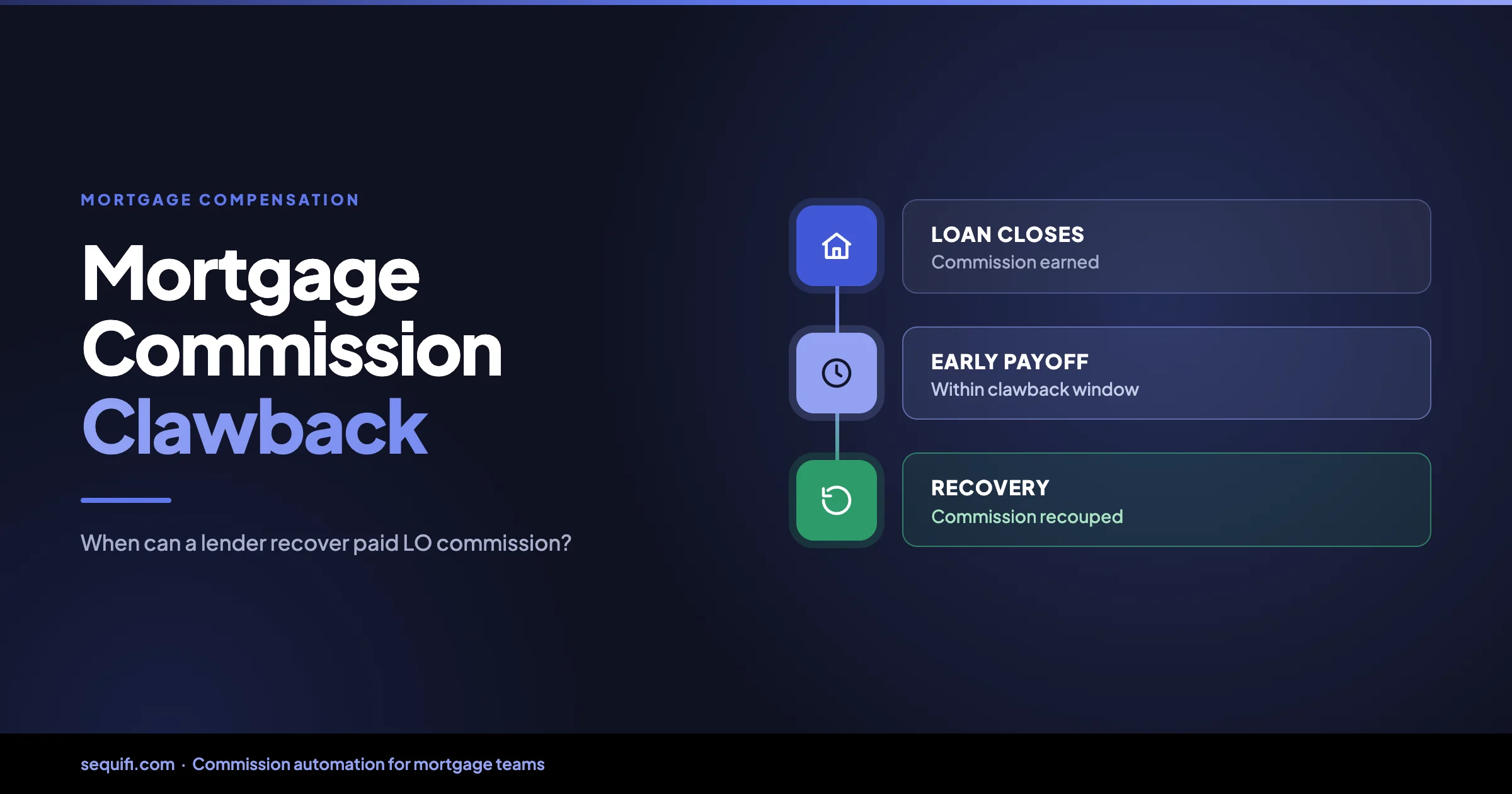
Offboarding and final pay: When an LO leaves, their pipeline does not stop immediately. Loans in process at the time of departure may fund weeks or months later. The comp plan must specify whether the LO earns commission on loans that fund after their last day, under what conditions, and within what timeframe.
The CFPB LO Comp Rule: What Every Mortgage Employer Must Know
The CFPB's Loan Originator Compensation Rule (Regulation Z, 12 CFR Part 1026) is the single most important compliance constraint in mortgage team compensation. Its core requirements affect every LO and manager compensation decision.
What the rule prohibits
Commission based on loan terms: LOs cannot be compensated based on a term of the transaction, such as the interest rate, or on a proxy for a term (12 CFR 1026.36(d)(1)). This rules out "yield spread premium" compensation and any formula where the LO earns more on higher-rate or higher-cost loans.
Dual compensation: If a loan originator is paid directly by the consumer on a transaction, no loan originator may also be paid by anyone else, such as the creditor, on that transaction (12 CFR 1026.36(d)(2)).
Steering: LOs cannot be incentivized to steer borrowers toward products that benefit the LO financially but are not in the borrower's interest.
What the rule permits
Fixed BPS or flat fee per loan: Compensation that is the same regardless of loan terms (e.g., 100 BPS on every funded loan, regardless of rate or product type) is permitted.
Volume-based tiers: Regulation Z permits compensation based on a loan originator's overall dollar volume or total number of transactions, so tiers that pay a higher rate for more volume, rather than for loan terms, are permitted.
Manager overrides on team production: Permitted, provided the override formula is not tied to the terms of individual loans funded by the team.
The documentation requirement: Regulation Z (12 CFR 1026.25(c)(2)) requires creditors and loan originator organizations to keep records sufficient to evidence all compensation paid to loan originators, and the compensation agreement that governs it, for three years after payment. The agreement can be written, oral or based on a course of conduct, but a written, versioned plan makes it far easier to show which terms applied to each funded loan.
How Automation Connects Mortgage Team Compensation End-to-End
Sequifi connects every layer of mortgage team compensation into a single automated system - from the loan funding event through payroll, with an itemized commission statement for every funded loan.
LOS integration: Loan events from Encompass, Calyx, or other supported LOS platforms flow directly into Sequifi's commission engine. No manual export, no spreadsheet.
Commission calculation: Sequifi applies the correct BPS rate for each LO based on their comp plan, calculates volume tiers if applicable, and generates the manager override based on the branch manager's plan.
Payroll: Sequifi runs payroll directly. W2 LOs are paid commission with withholding. 1099 LOs are paid gross commission as independent contractor income.
Compliance documentation: Every funded loan generates an itemized commission statement - LO name, loan number, loan amount, BPS rate applied, gross commission, and any adjustments. This documentation is stored and retrievable for audit, dispute resolution, and regulatory examination.
Sequifi's LOS integration partners include Encompass, Calyx, and other platforms where mortgage loan events originate. Sequifi's mortgage commission automation platform handles LO compensation, branch manager overrides, and payroll integration for independent mortgage banks, net branches, and bank-owned mortgage divisions.
Getting Started
For mortgage companies reviewing or rebuilding their team compensation operations:
- Map every role to a compensation layer. LOs on commission, managers on override, ops on salary. Confirm the trigger event and calculation formula for each commissioned role before the next comp plan cycle begins.
- Review W2 vs. 1099 classifications. Apply the IRS behavioral and financial control tests to every 1099 contractor. Get a classification opinion from employment counsel - misclassification can mean back taxes and penalties for past periods.
- Document every comp plan version with an effective date. Get the written agreement to the LO before the new plan period starts, and remember that states such as California and New York require commission agreements to be in writing. Build this into onboarding and plan change workflows.
- Specify comp-after-separation terms explicitly. Define whether LOs earn commission on loans that fund after their last day, the maximum window, and whether any pipeline conditions apply.
- Audit your LOS-to-payroll connection. If any step in the commission calculation requires a human to export a report, enter data into a spreadsheet, or manually match loan events to rep records, that step is a compliance and accuracy risk.
- Test your audit trail. Pick any funded loan from six months ago and ask whether you can produce the itemized commission calculation, the comp plan version that applied, and the documentation that plan was in force. If not, you have a gap that an examination would surface.
See how Sequifi automates mortgage team compensation from LOS to payroll at sequifi.com or explore Sequifi's LOS integration partners.
Frequently Asked Questions
What is the typical commission rate for a mortgage loan officer?
STRATMOR's compensation research puts average retail loan officer commissions at roughly 92 to 103 basis points of production. Rates vary by lender, channel and market, and broker and net branch arrangements are structured differently because the originator carries more of their own overhead. Some lenders pay a flat fee per funded loan instead, particularly where loan balances are low.
Can a mortgage branch manager earn commission on their team's loans?
Yes. Branch manager overrides on team production are permitted under the CFPB LO Compensation Rule, provided the override formula is not tied to the terms of individual loans. A flat BPS override (e.g., 15 BPS on every loan funded by the team) or a flat dollar override per loan is permitted. An override that varies based on whether the team's loans are fixed vs. adjustable rate, or high-margin vs. low-margin, is not.
What is the difference between a retail LO and a net branch LO for compensation purposes?
A retail LO works as a W2 employee of the lender. Their compensation is subject to standard employment law, is paid through payroll with withholding, and the lender bears direct compliance responsibility for the comp plan under the LO Comp Rule. A net branch LO typically operates under an independent contractor or net branch agreement, receiving gross commission and bearing more of their own overhead. The LO Comp Rule applies to both arrangements - the compensation formula must comply regardless of the employment structure.
What happens to a loan officer's commission when they leave mid-pipeline?
The comp plan should specify this explicitly. Two common approaches: (a) pay commission on any loan that funds within a defined window (for example, 30 to 90 days) after the LO's last day; or (b) pay commission only on loans that were in a defined stage at the time of departure (for example, application submitted and complete). Without this in the written plan, post-separation commission becomes a dispute. In New York, for example, if an employer cannot produce the written commission agreement, the terms the salesperson presents are presumed to be the agreed terms.
How does the LO Comp Rule affect processor and underwriter bonuses?
Processors, underwriters, closers, and other ops staff who do not "take a loan application, offer or negotiate loan terms, or perform other loan originator activities" are not loan originators under Regulation Z and are not subject to the LO Comp Rule's direct compensation restrictions. However, bonus structures that create financial incentives to approve specific loan types, favor certain products, or vary based on loan terms can implicate related fair lending obligations. Ops staff bonuses tied to volume (number of loans processed) rather than loan characteristics are the safer design.
Conclusion
Mortgage team compensation is not a single system - it is three overlapping compensation layers (LO commission, manager override, ops salary), a classification decision for every worker (W2 or 1099), a compliance framework (CFPB LO Comp Rule, state wage laws, written agreement requirements), and a payroll integration challenge (connecting loan events to wage payments without a manual step). Companies that manage this well treat it as an operations infrastructure problem, not just a spreadsheet exercise.
The infrastructure required to run mortgage team compensation correctly - documented comp plans, a commission engine connected to the LOS, payroll that handles W2 and 1099 workers correctly, and an audit trail for every funded loan - is what commission automation is built to provide. The alternative is a manual process that gets slower, less accurate, and harder to defend with every additional LO hired.
See how you can automate your mortgage team compensation from LOS to payroll at sequifi.com.
Industry Resources
- CFPB - Regulation Z, 12 CFR 1026.36 (loan originator compensation)
- CFPB - Regulation Z, 12 CFR 1026.25(c)(2) (compensation record retention)
- STRATMOR - Loan officer compensation research
- U.S. Department of Labor - FLSA regulations, 29 CFR 778.211 (bonuses and the regular rate)
- IRS - Worker Classification - W2 vs. 1099 classification guidance
- California Labor Code §2751 (written commission agreements)
- New York State Department of Labor - Payment of commissions
See Sequifi run your kind of pay.
Commissions, payroll and HR in one platform, built for teams where every paycheck is different.
Book a demo