Loan officer commission and salary: how loan officers are paid and how much they make
How loan officer commission is calculated in basis points, what loan officers earn, common pay structures, who pays them, and what Regulation Z allows.
Quick Answer
Loan officers on commission are usually paid a share of each loan they originate, quoted in basis points (BPS). One basis point is 0.01%, so 100 BPS is 1% of the loan amount. The formula is loan amount × BPS ÷ 10,000: at 100 BPS, a $400,000 loan pays $4,000. Many loan officers get a base salary plus commission, and some are paid a flat salary instead. The rate itself varies widely by lender, channel and market. What federal rules control is what commission can be based on: it can be a percentage of the loan amount, but it cannot depend on the loan's interest rate or other terms.
How Loan Officer Commission Is Calculated
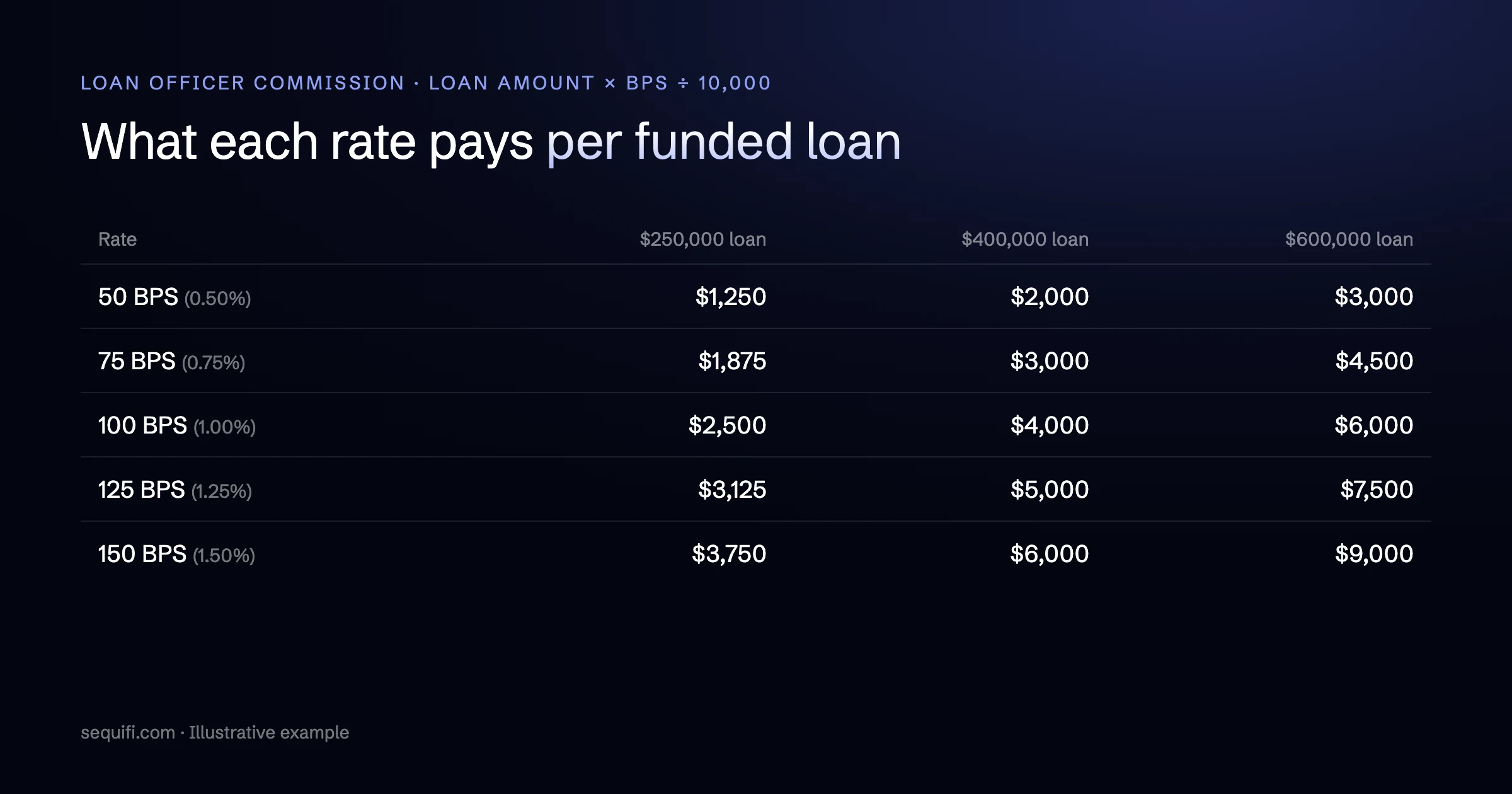
Most loan officer commission is a percentage of the funded loan amount, expressed in basis points:
- Formula: commission = loan amount × BPS ÷ 10,000
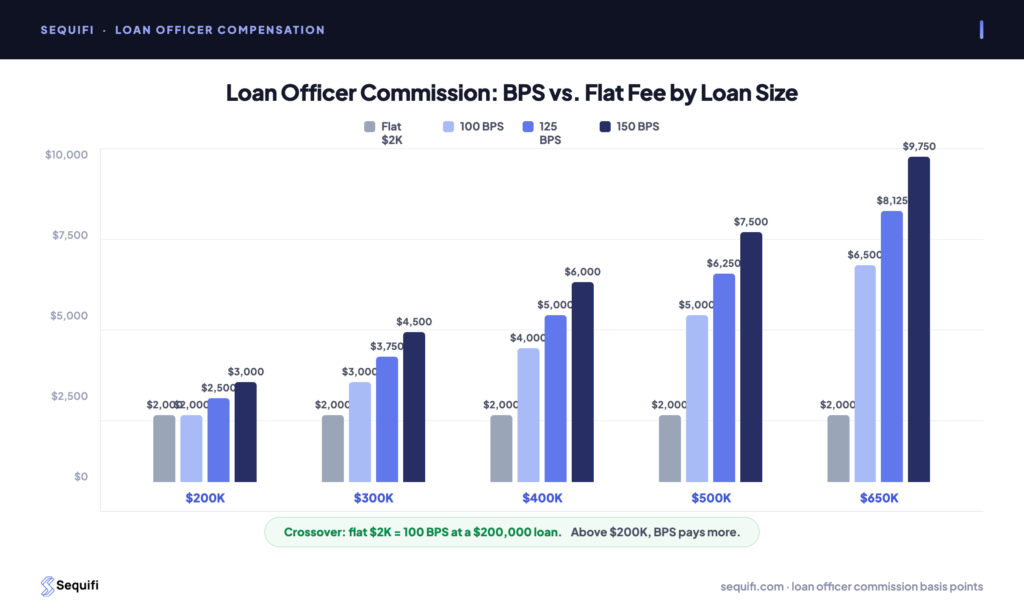
- Example: a $400,000 loan at 100 BPS pays $400,000 × 100 ÷ 10,000 = $4,000
- Same loan at 75 BPS: $3,000. At 125 BPS: $5,000
Because pay scales with loan size, the same rate pays very differently in different markets: 100 BPS is $2,500 on a $250,000 loan and $6,000 on a $600,000 loan. That is why some lenders add a minimum or maximum dollar amount per loan. For the full math, including tiered rates, see how to calculate loan officer commission in basis points.
How Much Do Loan Officers Make?
According to the Bureau of Labor Statistics, the median annual wage for loan officers was $76,690 in May 2025, across about 283,000 jobs. The range is wide: the lowest 10% earned less than $39,430 and the highest 10% earned more than $153,180.
Mortgage loan officer salary vs. commission
The BLS figures cover all loan officers, including salaried consumer and commercial lenders at banks. For loan officers working in credit intermediation, the industry that includes mortgage lenders and brokers, the median was $76,070. A commissioned mortgage loan officer's income depends mainly on how many loans they fund and how large those loans are, so two LOs on the same plan can earn very different amounts.
An illustrative example: an LO who funds three $350,000 loans a month at 100 BPS earns $3,500 per loan, $10,500 a month, or $126,000 a year before any base salary or bonuses. At two loans a month the same plan pays $84,000; at five, $210,000.
Common Loan Officer Pay Structures
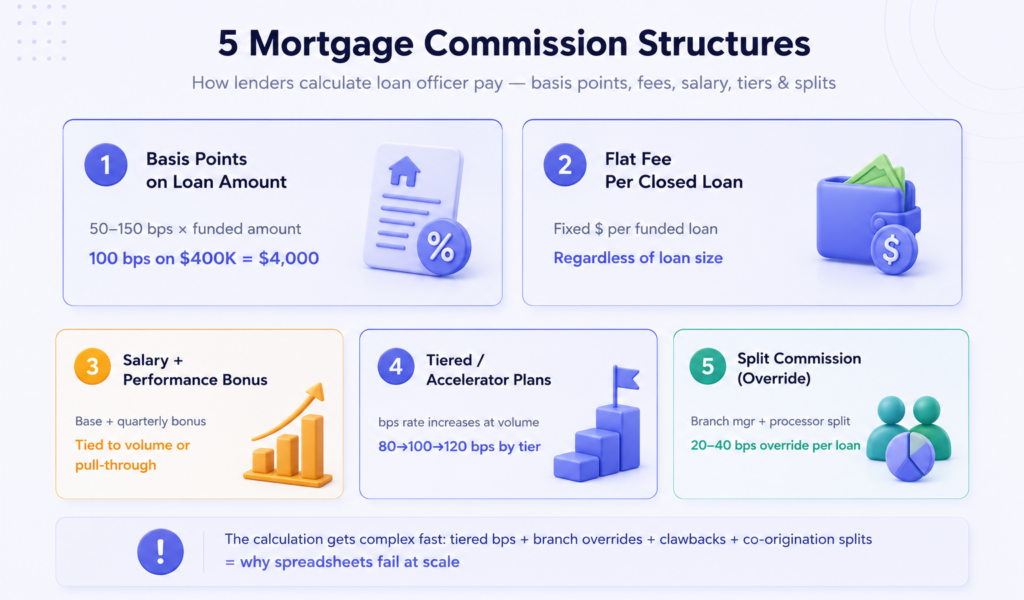
The Bureau of Labor Statistics describes the range: some loan officers are paid a flat salary, while those on commission are usually paid a base salary plus commission on the loans they originate, and may earn extra commission or bonuses based on loan count or how well loans perform. In practice, plans tend to fall into a few shapes:
- Base salary plus BPS commission: common in retail lending, where the base gives stability while the pipeline builds.
- Commission only: higher BPS, no base. More common for experienced, high-volume originators.
- Flat fee per loan: a fixed dollar amount per funded loan, regardless of size. Simple, but it pays the same on a small loan as on a large one.
- Tiered BPS: the rate steps up at monthly or quarterly volume thresholds. Compared side by side in per-loan vs. BPS vs. tiered LO comp plans.
- Salary only: typical of call-center or bank roles, sometimes with a volume bonus.
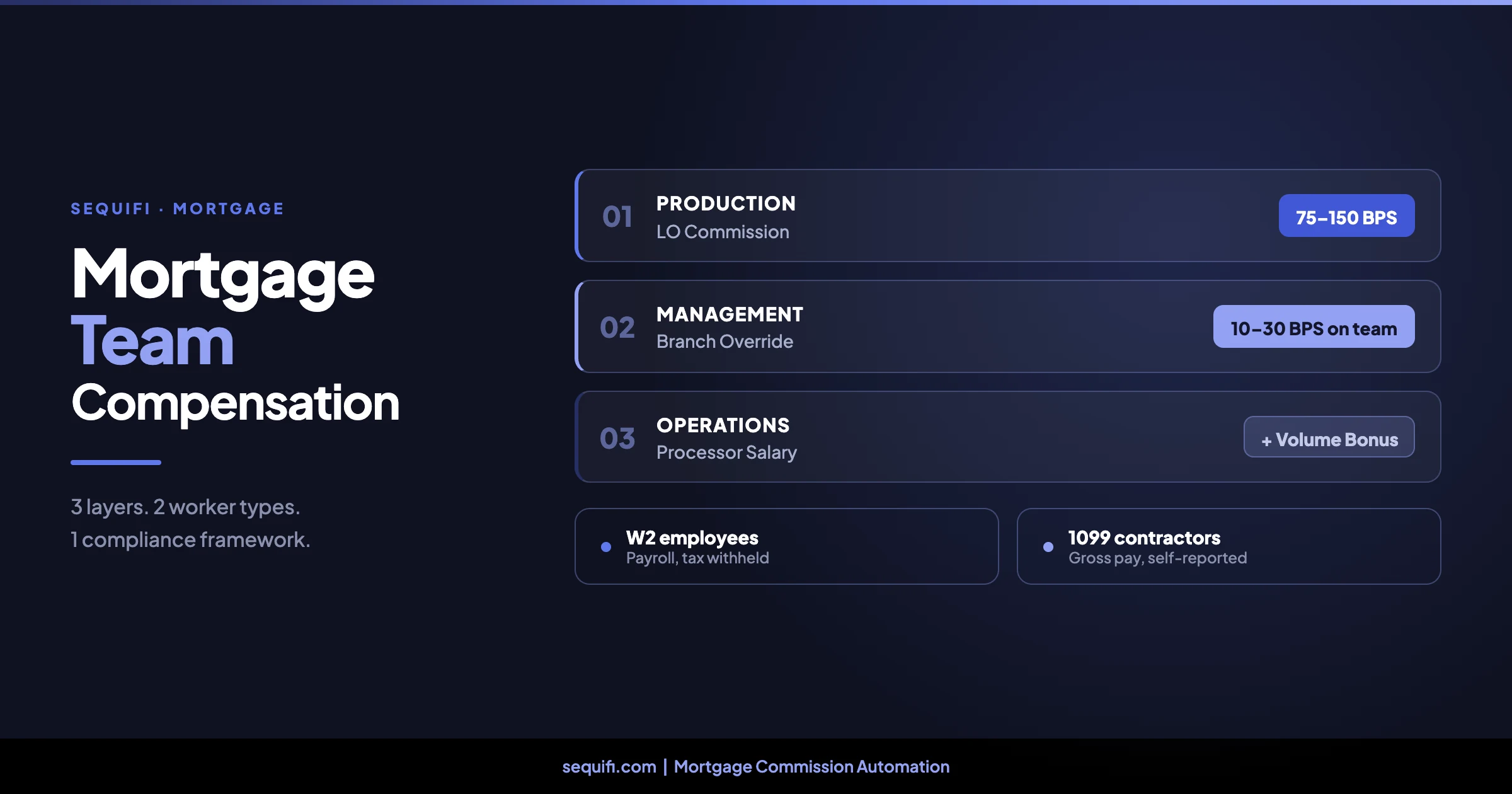
On a team, the loan officer's commission is often one layer of several: branch managers may earn an override on their team's production, and processors may earn per-file bonuses. See how mortgage branches split commissions.
Who Pays the Loan Officer?
In retail lending, the lender employs the loan officer and pays their commission. In the broker channel, the brokerage is paid on the loan, either by the lender or by the borrower, and then pays its loan officers under their own comp plan. Federal rules do not allow a loan originator to be paid by both the borrower and another party on the same loan.
What the Rules Allow and Prohibit
Loan officer pay is shaped by Regulation Z's loan originator compensation rule (12 CFR 1026.36):
- Allowed: compensation based on a fixed percentage of the loan amount (BPS), including with minimum and maximum dollar amounts, and pay that rewards loan volume.
- Prohibited: compensation based on a term of the transaction, such as the interest rate, or on a proxy for a term. An LO cannot be paid more for steering a borrower into a higher rate.
- Prohibited: dual compensation, meaning payment from both the borrower and another party on the same loan.
- Required: lenders must keep records of loan originator compensation agreements and payments (12 CFR 1026.25(c)(2)).
More detail in how the LO Comp Rule affects the way you pay loan officers and how mortgage lenders stay compliant when paying commissions.
When Loan Officers Get Paid, and When Pay Is Taken Back
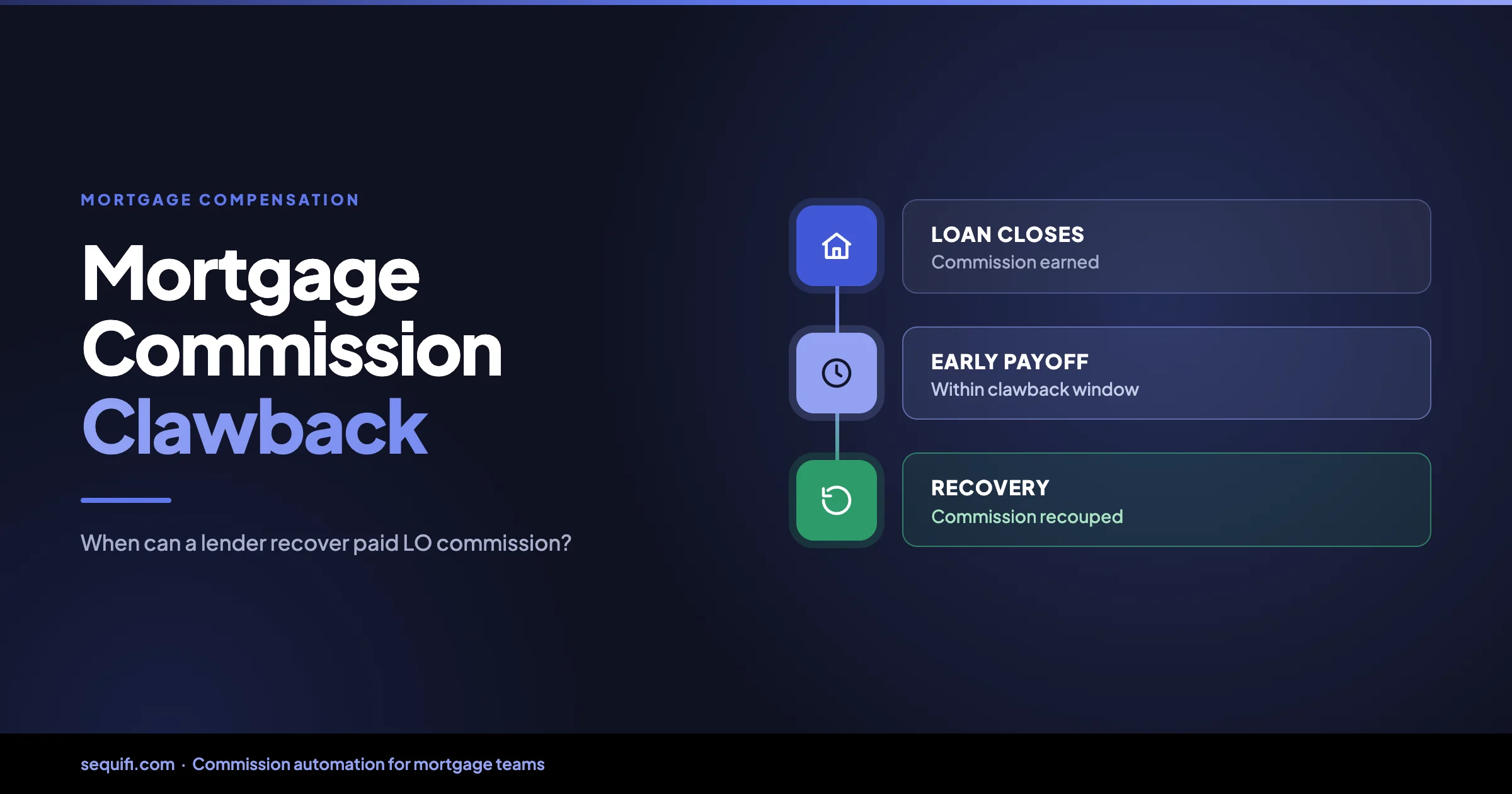
Commission is normally earned when a loan funds and paid on the next payroll or commission cycle. Some plans recover commission later if a loan pays off early or is repurchased after an early payment default; see how mortgage commission clawbacks work.
How Sequifi Handles Loan Officer Commission
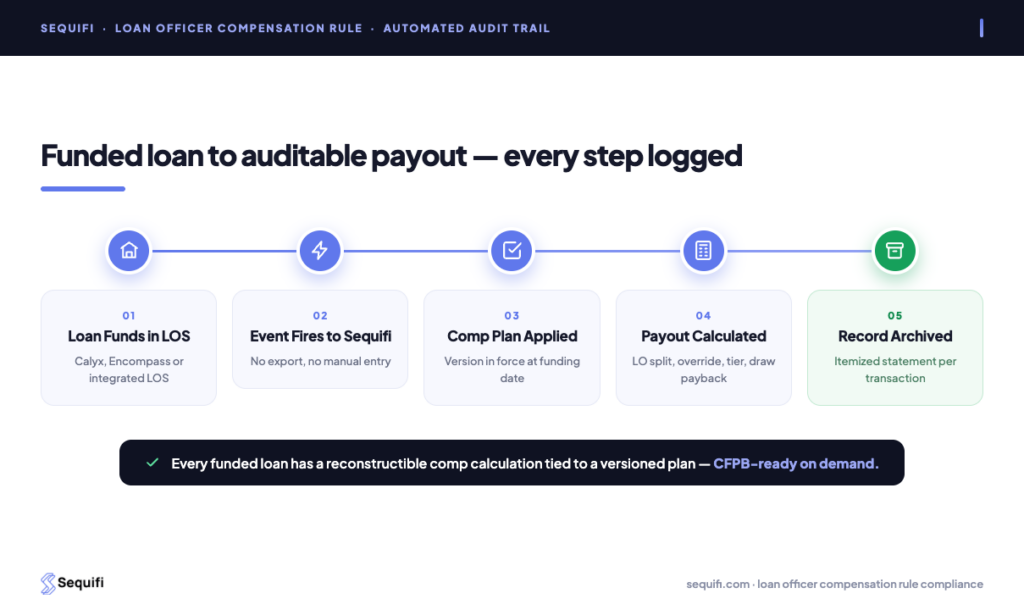
Sequifi calculates loan officer commission from the rules in your comp plan, including BPS rates, minimums and maximums, tiers, branch overrides and clawbacks, and carries it into payroll. Loan officers can see every commission and how it was calculated. See Sequifi for mortgage or book a demo.
Frequently Asked Questions
How much commission does a loan officer make on a $300,000 loan?
It depends on the rate in their comp plan. At 100 BPS (1%) it is $3,000; at 75 BPS, $2,250; at 125 BPS, $3,750.
What is a basis point in loan officer pay?
One basis point is 0.01% of the loan amount. 100 basis points equal 1%. Loan officer commission is commonly quoted in basis points: loan amount × BPS ÷ 10,000.
Do loan officers get a base salary?
Many do. According to the Bureau of Labor Statistics, loan officers on commission are usually paid a base salary plus commission, while some loan officers are paid a flat salary instead.
Can a loan officer be paid more for a higher interest rate?
No. Regulation Z prohibits basing loan originator compensation on a term of the transaction, such as the interest rate, or on a proxy for a term.
How much do loan officers make a year?
The Bureau of Labor Statistics reports a median annual wage of $76,690 for loan officers in May 2025, with the lowest 10% earning less than $39,430 and the highest 10% more than $153,180. Commissioned mortgage loan officers' income depends mainly on how many loans they fund and how large those loans are.
Related Reading
- How Do You Calculate Loan Officer Commissions in Basis Points?
- Per-Loan vs. BPS vs. Tiered: How to Structure LO Comp Plans
- How Does the LO Comp Rule Affect the Way You Pay Loan Officers?
- What Is a Mortgage Commission Clawback?
- How Mortgage Companies Manage Team Compensation
Sources
See Sequifi run your kind of pay.
Commissions, payroll and HR in one platform, built for teams where every paycheck is different.
Book a demo