What is OTE? On target earnings explained, with pay mix examples
What on target earnings means, how to calculate OTE, how pay mix changes what reps actually earn above and below quota, and what to ask about any OTE.
Quick Answer
On target earnings (OTE) is the total pay a salesperson can expect in a year if they hit 100% of their quota: base salary plus variable pay at target. A role advertised at $100,000 OTE with a 60/40 pay mix pays a $60,000 base plus $40,000 in commission or bonus when the rep meets quota. OTE is a target, not a guarantee. Reps below quota earn less, and reps above quota can earn more, especially when the plan has accelerators.
What Does OTE Mean?
OTE stands for on target earnings. It is how sales roles state total expected pay, because a large share of that pay depends on performance. The formula is simple: OTE = base salary + variable pay at 100% of quota.
Pay Mix: How OTE Is Split
The pay mix is the split between base and variable at target, written as base/variable. A 60/40 mix on $100,000 OTE is $60,000 base and $40,000 variable. Roles where the rep has more influence over the outcome, or a longer sales cycle with fewer, larger deals, tend to carry more of their pay as variable.
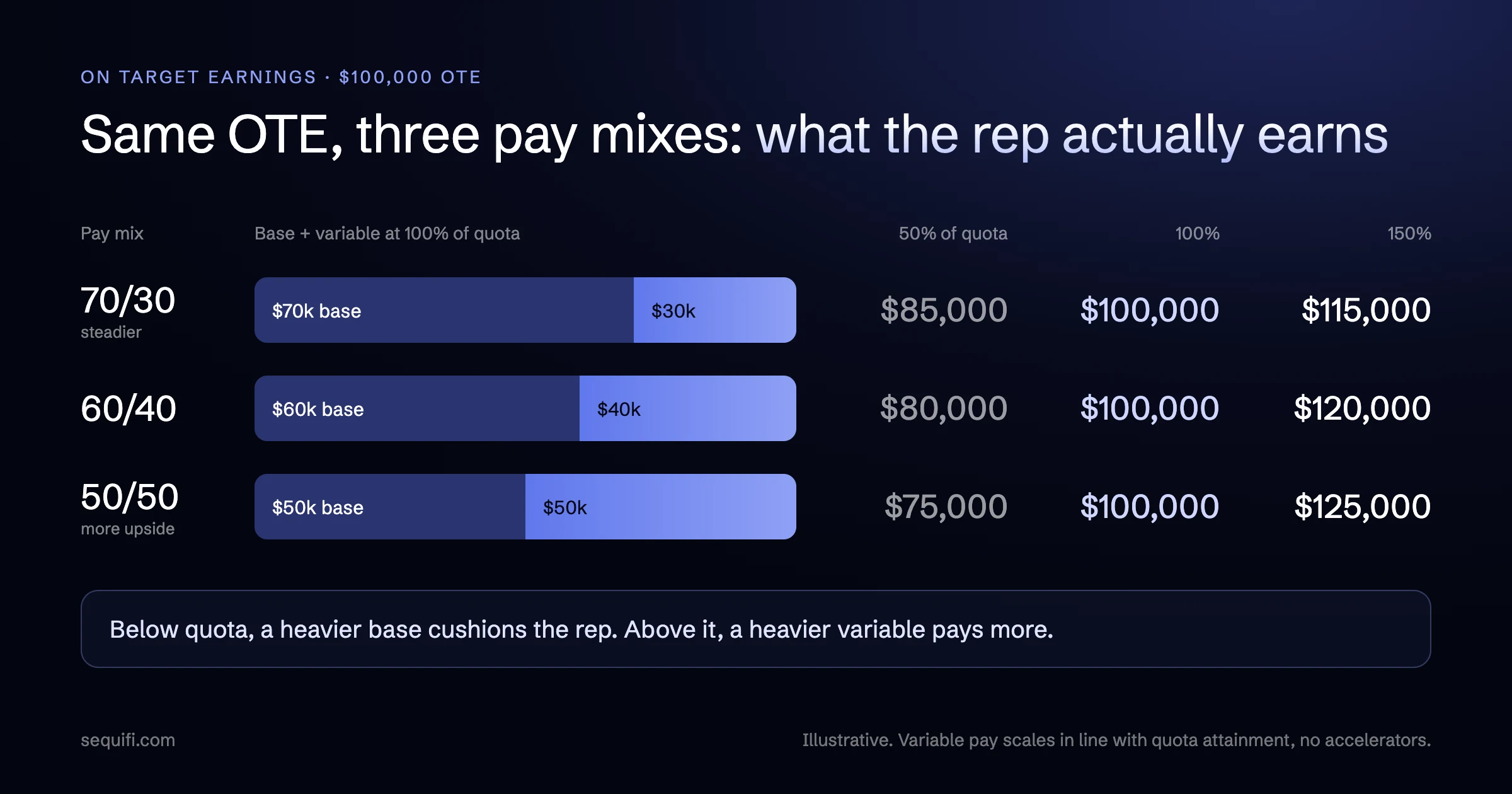
The mix matters most when results miss or beat the target. In the chart above, every rep has the same $100,000 OTE. At 50% of quota, the 70/30 rep earns $85,000 and the 50/50 rep earns $75,000. At 150% of quota the order flips: $115,000 versus $125,000.
How to Calculate OTE
- Start with the base salary, for example $60,000.
- Add the variable pay at 100% of quota, for example 4% commission on a $1,000,000 annual quota = $40,000.
- OTE: $60,000 + $40,000 = $100,000.
To see what a rep earns at other attainment levels, apply their actual sales to the plan's rates, including any tiers. Our free commission calculator handles flat and tiered plans.
Capped vs. Uncapped OTE, and Accelerators
Uncapped plans keep paying variable as sales grow; capped plans stop at a maximum. Many plans add accelerators, a higher rate on sales above quota, so a rep at 150% earns more than 1.5 times their target variable. A decelerator does the reverse below a threshold. When comparing offers, ask whether the plan is capped, where accelerators start, and what attainment most reps actually reach.
OTE in Commission-Only and Field Sales Roles
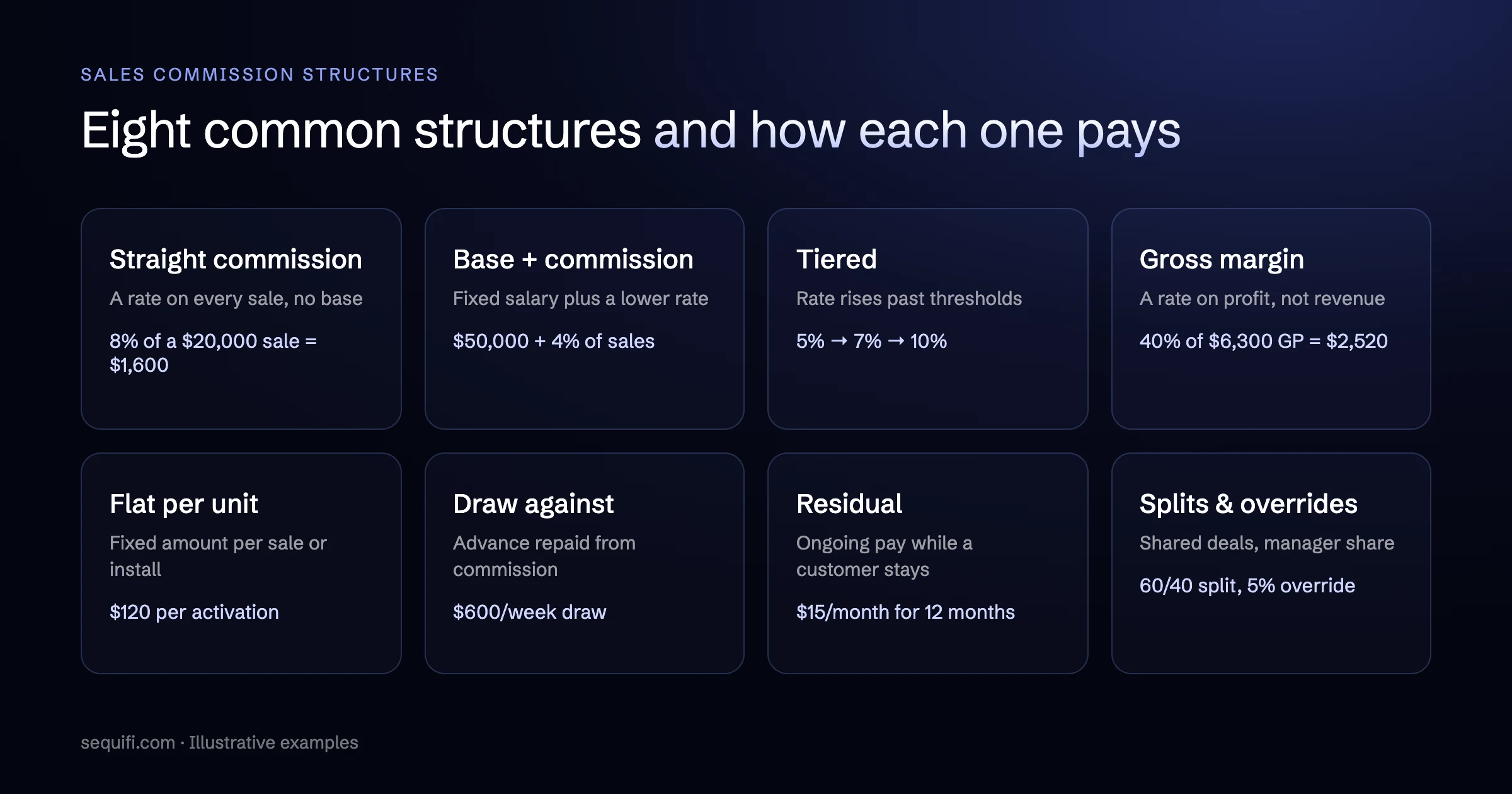
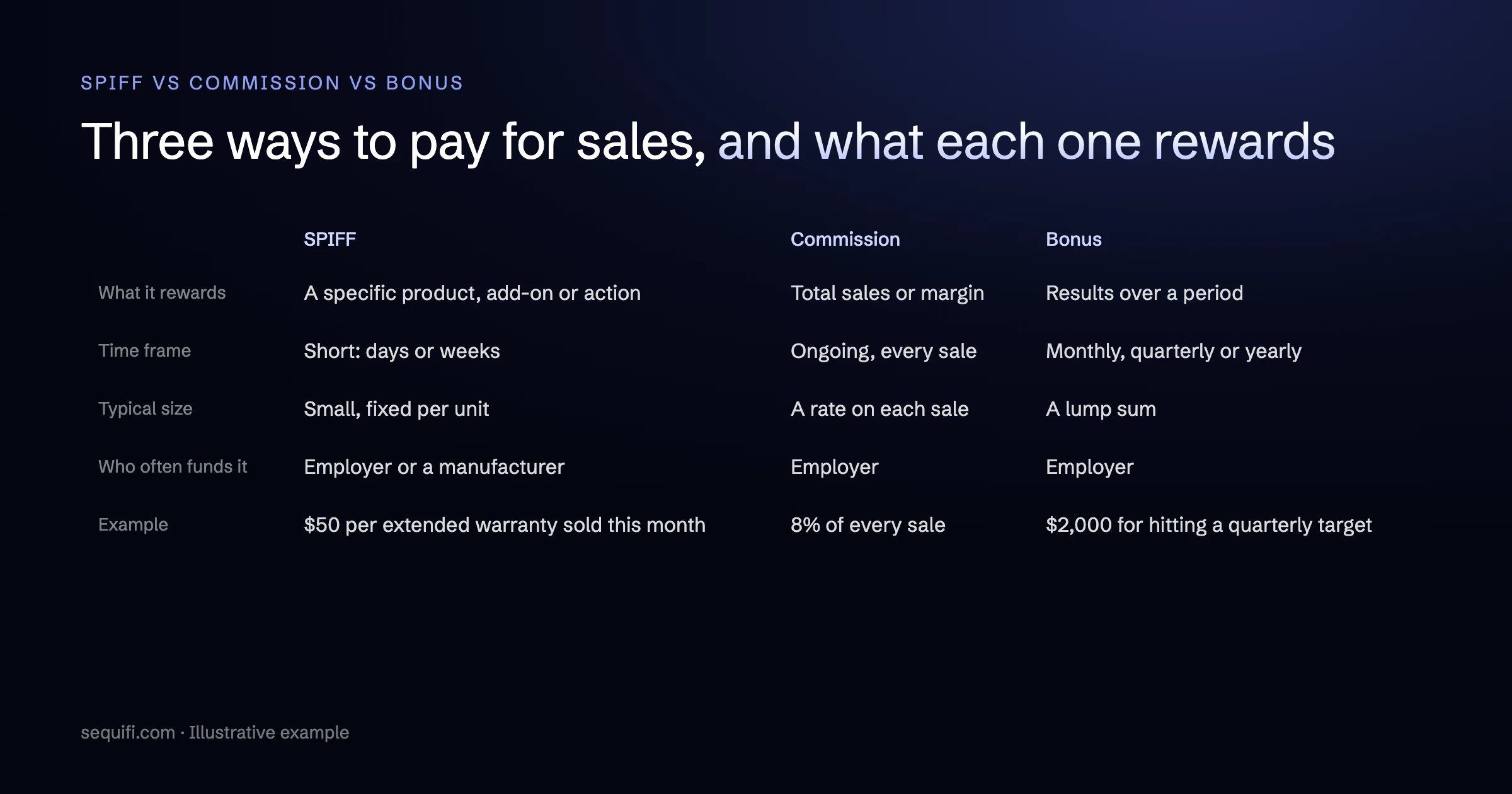
In commission-only roles, common in door-to-door solar, roofing and pest control, there is no base, so OTE is simply expected commission at a typical production level. Those roles often use a draw against commission to smooth pay while a rep ramps, and their plans can include SPIFFs, overrides and clawbacks that change what a rep takes home.
Questions to Ask About an OTE
- What percentage of reps hit quota last year?
- Is the plan capped? Where do accelerators start?
- How often is commission paid, and when is it earned?
- Are there clawbacks, and on what terms?
- Can I see how each payment is calculated?
Sequifi shows every rep how their commission was calculated against their plan, including tiers, accelerators, SPIFFs and clawbacks, and pays it through payroll. See Sequifi commission software or book a demo.
Frequently Asked Questions
What does OTE mean in a job posting?
OTE means on target earnings: the base salary plus the variable pay the role pays when the person hits 100% of their quota.
Is OTE guaranteed?
No. Only the base salary is guaranteed. The variable part depends on performance, so actual earnings can be below or above OTE.
What is a good OTE pay mix?
There is no single right mix. More base gives stability; more variable gives upside. 70/30, 60/40 and 50/50 are all common, and commission-only roles have no base at all.
Does OTE include benefits?
Usually not. OTE normally covers cash compensation: base salary plus commission or bonus at target.
What is the difference between OTE and base salary?
Base salary is the fixed part of pay. OTE adds the variable pay expected at 100% of quota.
Related Reading
See Sequifi run your kind of pay.
Commissions, payroll and HR in one platform, built for teams where every paycheck is different.
Book a demo