What does losing a sales rep really cost your company?
Recruiting, ramp time, lost pipeline and pay disputes add up fast. Here's how to calculate the real cost of losing a sales rep, and what to fix.
Quick Answer
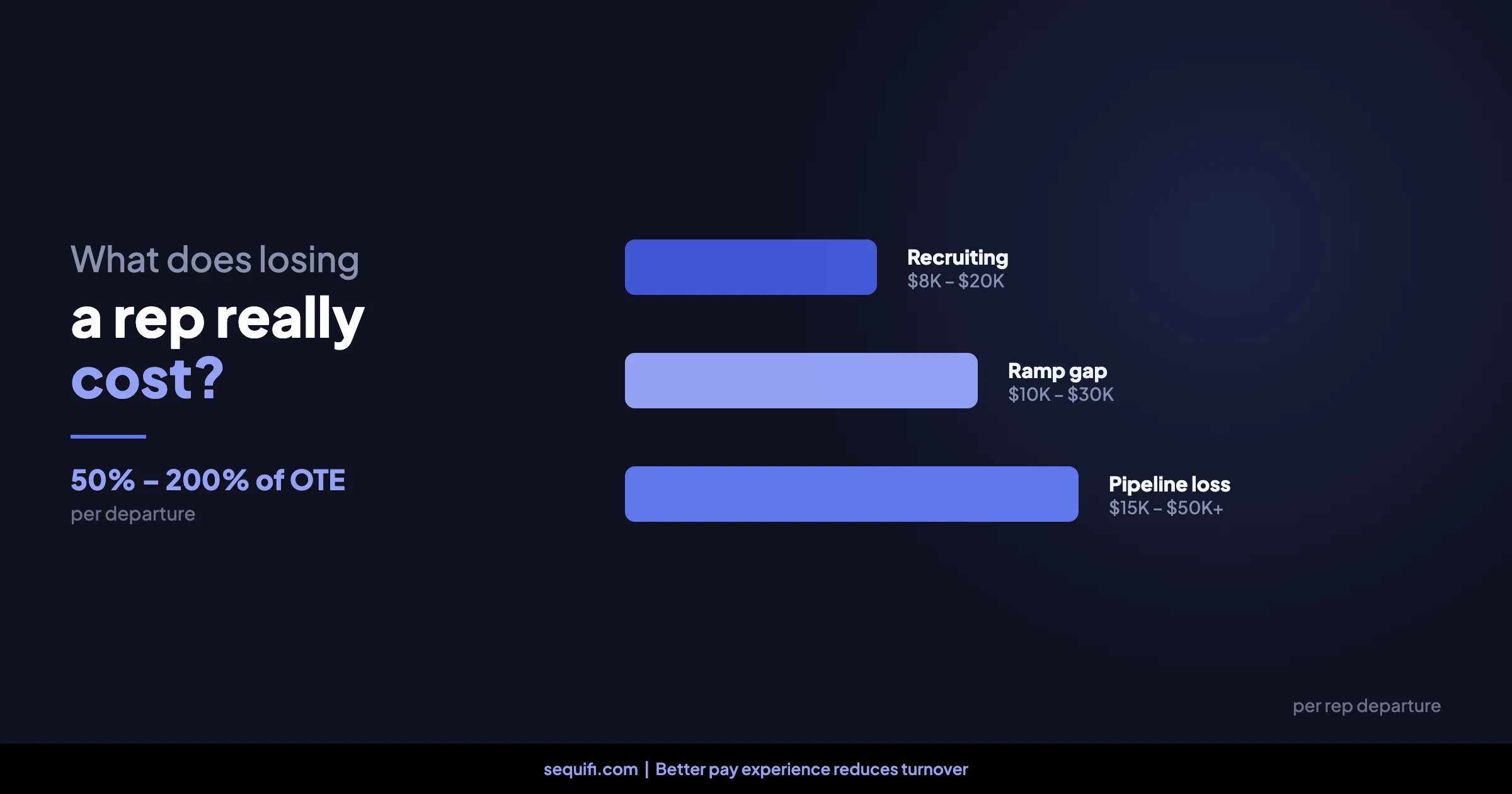
Gallup estimates that replacing an employee costs one-half to two times their annual salary. Apply that to a solar, mortgage, or fiber sales rep earning $80,000 a year and the cost of losing a sales rep is $40,000 to $160,000 per departure, once you count recruiting fees, ramp time, lost pipeline, and manager distraction. Most sales leaders dramatically underestimate this number because they count only the visible costs - job posting fees, recruiter time - and ignore the pipeline, territory, and institutional knowledge that walks out with the rep. The fix is not always compensation level. Pay experience - whether reps trust their commission statement, understand how they are being paid, and feel confident their check will be right - is one of the most controllable reasons reps stay or go.
Why the Real Cost Is Always Higher Than You Think
Most sales managers think of rep turnover as a headcount problem: someone leaves, you post the role, you fill it, you move on. The accounting is simple because most of the costs never appear on a report.
The recruiting fee appears on an invoice. The three months your regional manager spent covering the territory, coaching an underperforming backfill, and re-explaining the company's comp plan to someone new does not. The deals that stalled in the departing rep's pipeline - some of which went to a competitor when the rep joined them - never get traced back to the turnover event. The institutional knowledge about why certain customers buy, which objections to expect in which territories, and how to navigate the company's internal processes: gone, and unquantifiable.
The cost of losing a sales rep is not what you paid to replace them. It is the full economic impact of the departure across every system the rep touched - pipeline, territory, team morale, and management bandwidth.
The Five Cost Categories of Losing a Sales Rep
The true cost of losing a sales rep falls into five categories, most of which go unmeasured.
1. Recruiting and hiring costs
Job board fees, recruiter commissions (typically 15% to 25% of base salary for external hires), background check and onboarding administration, and the manager and HR time spent screening, interviewing, and selecting a replacement. For a field sales role, external recruiting fees alone often run $8,000 to $20,000.
2. Ramp time - the productivity gap
A new rep is not immediately productive. In solar, mortgage, and fiber sales - industries with long deal cycles and technical product knowledge requirements - the ramp period before a new rep reaches average productivity commonly runs 3 to 6 months. During that window, the territory is either uncovered, partially covered by a manager, or covered by an underproducing new hire. The productivity gap between what the departing rep would have produced and what the replacement actually produces during ramp is a direct revenue cost.
3. Lost pipeline
Deals in the departing rep's pipeline do not automatically transfer. Some close under a replacement or manager. Many stall. Some customers follow the rep to their next company. In solar and mortgage, where a single deal can represent $500 to $3,000 in commission and weeks of sales effort, losing even 20% of a departing rep's pipeline to stall or competitor poaching represents a significant revenue impact.
4. Training and onboarding
Product training, CRM onboarding, comp plan explanation, field shadowing, and manager coaching time for the new hire. Often underestimated because this time comes from existing employees - managers, trainers, senior reps - whose own productivity drops during the onboarding period.
5. Team morale and secondary turnover
Voluntary departures are contagious. When a rep leaves - particularly if they leave citing pay disputes, comp plan confusion, or commission errors - other reps on the team notice. If a rep with similar concerns does not see those issues addressed, their own likelihood of departure increases. The cost of losing a sales rep can therefore be a multiplier: one departure that is not addressed creates conditions for the next one.
The Pipeline Cost Nobody Calculates
In commission-heavy sales industries, the most significant component of the cost of losing a sales rep is almost always the pipeline - and almost no company calculates it correctly.
A solar sales rep with a 90-day average sales cycle and a $1,200 average commission per deal, closing 3 deals per month, carries roughly $10,800 in earned but unpaid commission at any given time. Behind that earned commission is a pipeline of partially worked deals - homeowners in proposal stage, leads scheduled for appointment, referrals recently contacted - that represents the rep's future production.
When that rep leaves:
- Earned commissions on closed deals must still be paid (and often are disputed)
- In-progress deals may close at a lower rate under a replacement who does not know the customer
- Early-stage pipeline is often abandoned entirely
- Territory coverage gaps allow competitors to fill the void
In a 10-rep solar team with average annual production of $120,000 OTE per rep, losing two reps in a quarter - a 20% turnover rate, which is modest by industry standards - can represent $200,000 to $400,000 in combined pipeline, recruiting, and ramp costs.
Why Pay Disputes Accelerate Turnover
The cost of losing a sales rep is closely tied to the quality of the pay experience - and one of the most avoidable triggers for voluntary departure in commission sales is not compensation level. It is commission disputes.
A rep who trusts their commission statement - who can look at their payout, see every deal itemized, understand how the calculation was done, and verify that the number is right - has one less reason to leave. A rep who receives a lump sum with no breakdown, suspects an error, spends three hours reconstructing the calculation from a spreadsheet they were emailed, and is told by their manager that "the system is right" - that rep is already looking for another job.
Commission dispute resolution is expensive beyond the direct cost of the dispute. Manager time spent reconstructing commission calculations, the admin burden of spreadsheet audits, and the morale impact on the rep while the dispute is unresolved all compound the cost. In the solar, mortgage, and fiber industries - where reps are sophisticated about their own earnings and often compare notes with peers - a pattern of unresolved or poorly explained commission calculations gives reps a reason to leave.
Sequifi eliminates the conditions that produce commission disputes: every payout is itemized by deal, every calculation is shown with the deal it came from, and every rep can see their running commission total in real time. When a rep can verify their own commission, disputes drop - and so does the turnover driven by pay frustration.
The Ramp Tax: How Long Until a New Rep Pays for Themselves?
The ramp tax is the cumulative cost of a new rep's underproduction during their first months - the gap between what they produce and what the departing rep would have produced in the same period.
In solar residential sales, an experienced rep closing 3 deals per month at $1,200 average commission produces $3,600 per month for the company (in rep commission cost terms, the equivalent in revenue contribution is significantly higher). A new hire during ramp may close 0.5 to 1 deal per month for the first 60 days and 1.5 to 2 deals per month for days 61 to 120. The productivity gap over a 4-month ramp is roughly 6 to 8 deals - $7,200 to $9,600 in commission contribution alone, before accounting for any draw advances paid during the ramp period.
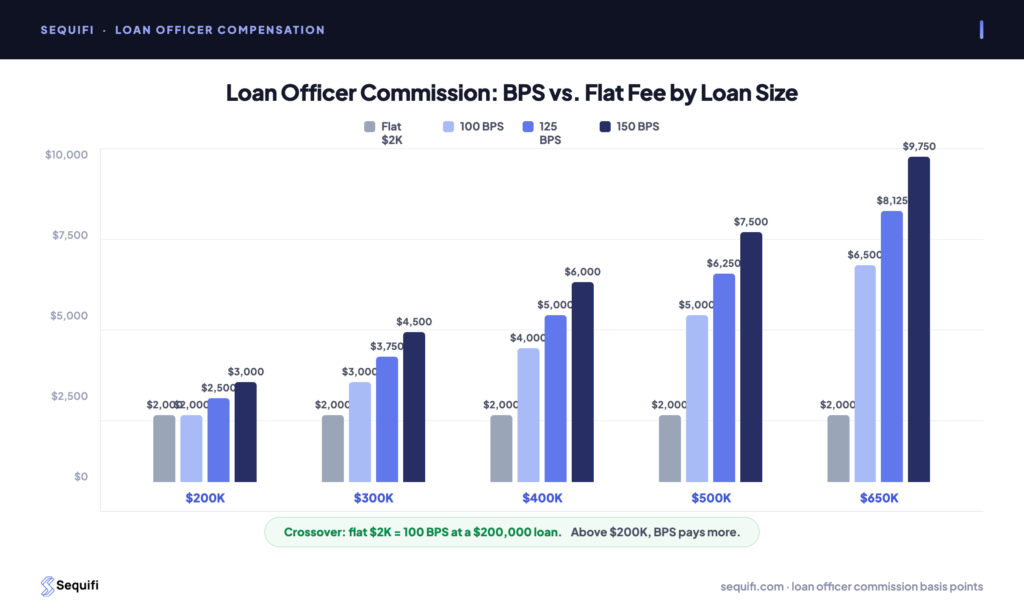
In mortgage, where deals are larger but cycles are longer, the ramp tax is even more severe: a new LO may produce nothing in commissionable loans for the first 60 to 90 days while building pipeline. If that LO was hired to replace a producer closing $3 million in loan volume per month at 100 BPS ($30,000/month), the ramp gap represents $60,000 to $90,000 in commission production loss before the new hire reaches parity.
Adding the ramp tax to recruiting costs, it is easy to see how the cost of losing a sales rep lands within Gallup's range of one-half to two times annual pay.
How Turnover Compounds at Scale
Individual rep departures are expensive. Turnover at scale - which is the reality in door-to-door solar, fiber, and mortgage wholesale - can be structurally damaging.
D2D solar companies with high annual rep turnover face a perpetual ramp tax: a significant portion of their sales force is always in the early unproductive phase of their tenure. The company is effectively funding the recruitment and training of a continuous stream of new reps, many of whom will leave before reaching full productivity.
The math is stark. Take a hypothetical 20-rep solar team with 80% annual turnover: 16 reps are replaced each year. At a conservative $30,000 cost per replacement (recruiting plus ramp tax), that is $480,000 per year in turnover cost - before accounting for the pipeline and territory disruption. Even a reduction from 80% to 60% annual turnover saves $120,000 per year in direct replacement cost alone.
What moves turnover from 80% to 60%? Pay level is only part of the answer. The part most companies can control quickly is pay experience: how clearly reps understand their compensation, how accurately and transparently their commissions are calculated, and whether they trust that their paycheck will be right.
What the Data Actually Says
Two public data sources help put the cost of losing a sales rep in context.
On replacement cost, Gallup estimates that the cost of replacing an individual employee can range from one-half to two times their annual salary, and calls that a conservative estimate. It is a general workforce figure rather than one specific to sales, but commission-heavy roles carry the extra pipeline and ramp costs described above on top of it.
On how often people leave, the Bureau of Labor Statistics Job Openings and Labor Turnover Survey (JOLTS) counted 62.8 million separations across US employers in 2025, an average monthly separation rate of 3.3 percent. Quits made up 60.6 percent of those separations, so most turnover is voluntary, and voluntary turnover is where pay experience makes a difference.
How a Better Pay Experience Reduces Turnover
The cost of losing a sales rep is not inevitable. Companies that invest in pay experience - not higher pay, but clearer, more accurate, and more transparent pay - remove one of the most common sources of friction between reps and the business: doubt about the paycheck.
A better pay experience means:
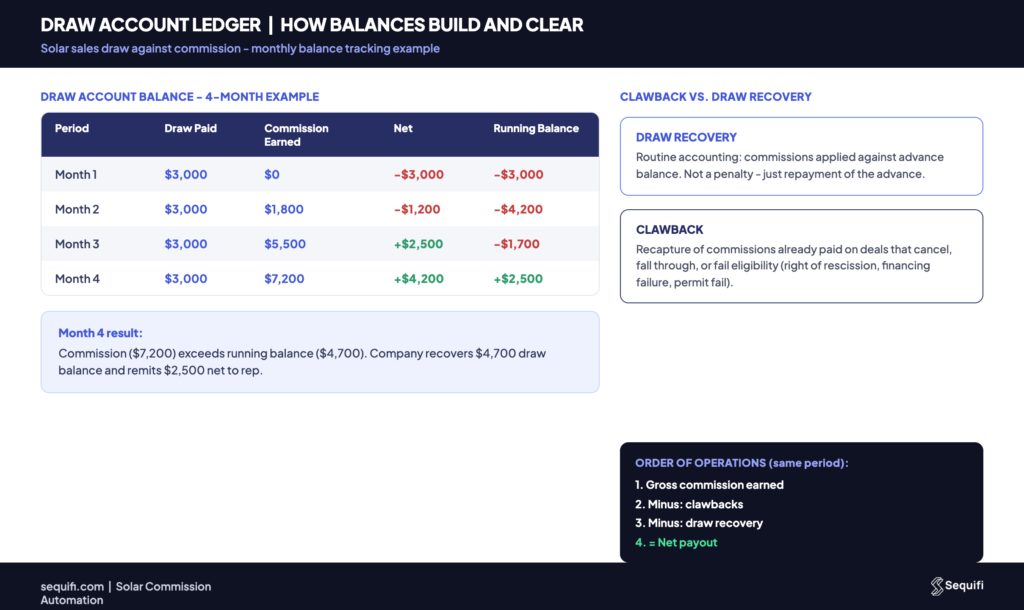
Reps receive an itemized commission statement for every deal - not a lump sum deposit with a note. They can see exactly which deals are included, what rate was applied, whether any draws were recovered, and what the net payout is and why.
Comp plan changes are documented in writing, with an effective date, before they take effect. Reps are not surprised by a different calculation on their next paycheck.
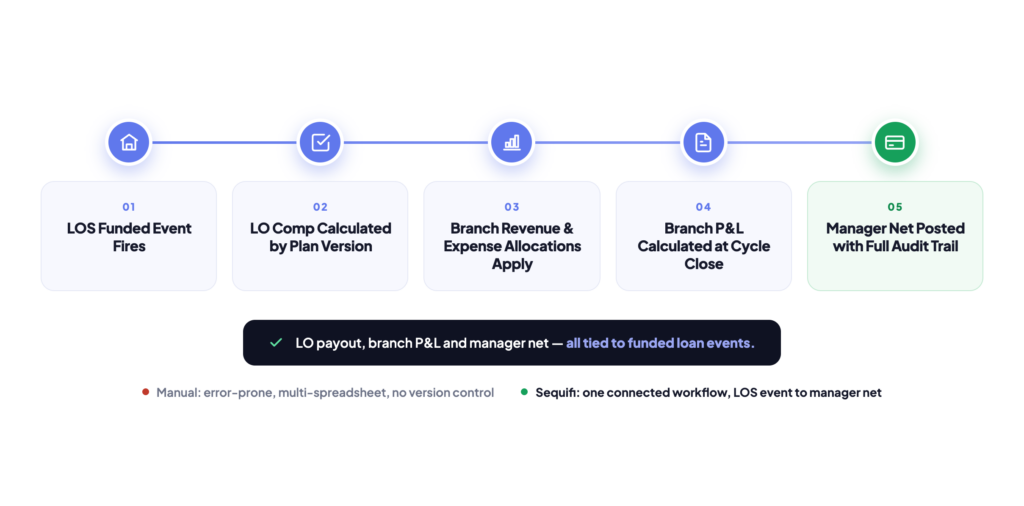
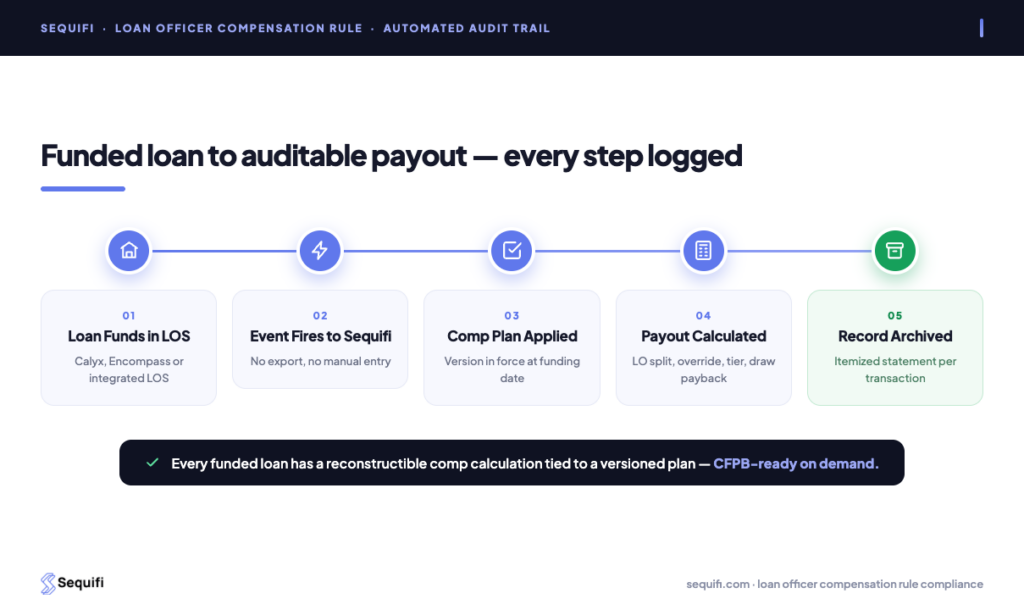
Commission disputes are resolved quickly because every calculation is traceable - the deal event and the calculation logic are in one place and can be reconstructed in minutes rather than hours.
Reps can see their running commission total in real time - how many deals have closed, what is in their pipeline, and what they can expect on their next paycheck - rather than waiting until the cycle closes to find out what they earned.
Sequifi delivers all of these by automating the commission calculation, generating itemized per-deal statements, and giving reps a live view of their earnings. The result is not just administrative efficiency - it is a materially better pay experience that reduces the friction and distrust that drives voluntary departure. Learn how Sequifi works at sequifi.com or see Sequifi's integration partners.
Getting Started
For sales leaders who want to reduce the cost of losing a sales rep:
- Calculate your actual turnover cost. Add recruiting fees, ramp tax (productivity gap during onboarding), and pipeline loss for your last three departures. The number is almost always larger than leadership expects.
- Survey departing reps on commission clarity. Exit interviews can surface pay frustration that never reached a manager. Even a simple question - "Did you always understand how your commission was calculated?" - reveals patterns.
- Audit your commission statement quality. Can a rep look at their last paycheck and independently verify the calculation? If not, you have a transparency gap that is producing avoidable disputes and voluntary attrition.
- Document every comp plan change in writing before it takes effect. Mid-cycle surprises are one of the most common triggers for rep distrust and departure.
- Give reps visibility into their running earnings. A rep who can see what they have earned in real time has less reason to doubt the process - and less anxiety between pay cycles.
- Connect your deal event system to your commission engine. Manual commission processes are the primary source of errors, delays, and the disputes that drive turnover.
See how Sequifi reduces commission disputes and improves pay experience at sequifi.com.
Frequently Asked Questions
What is the average cost of losing a sales rep?
Gallup estimates that replacing an employee costs one-half to two times their annual salary. For a sales rep earning $80,000 a year, that is $40,000 to $160,000 per departure. Where a departure lands in that range depends on pipeline loss, recruiting conditions, and how long the replacement takes to ramp.
Why do sales reps really leave?
There is rarely a single reason, but pay experience is one of the most controllable. Reps who do not trust their commission calculation, cannot verify their own paycheck, or are surprised by comp plan changes mid-cycle have a concrete reason to look elsewhere. Manager quality and career path clarity matter too.
How does commission transparency reduce turnover?
When reps receive itemized commission statements they can independently verify, they spend less mental energy second-guessing their pay. This removes a persistent source of friction and distrust. Companies that give reps real-time visibility into their running commission total also see less anxiety between pay cycles - which means fewer manager hours spent on commission questions and fewer departures driven by pay frustration.
What is the ramp tax in sales hiring?
The ramp tax is the productivity gap between what a departing rep would have produced during the replacement period and what the new hire actually produces during ramp. In solar, a new rep may take 60 to 120 days to reach full productivity, during which the territory is underproducing. That gap - in deals, revenue, and commission contribution - is a direct cost of the original departure that rarely appears in turnover cost estimates.
Does higher pay reduce sales rep turnover?
Not on its own. Higher pay does not fix a commission process reps cannot trust: a rep who cannot verify their paycheck still has a reason to doubt it, whatever the rate. Clear, verifiable commission statements address that doubt directly, without raising the compensation budget.
Conclusion
The cost of losing a sales rep is not a recruiting line item. It is a compounding economic event that touches pipeline, territory, team morale, manager productivity, and company growth capacity. Most sales organizations underestimate it because most of the costs are invisible - they never appear on a report, never get attributed to the departure that caused them, and never trigger the organizational response they warrant.
The most controllable lever is pay experience, not just pay level. Transparent, itemized, verifiable commission statements and real-time earnings visibility remove a common source of distrust between reps and the business, without raising compensation budgets.
See how you can automate your commission process and reduce rep turnover at sequifi.com.
Industry Resources
- Gallup - This Fixable Problem Costs U.S. Businesses $1 Trillion (employee replacement cost)
- Bureau of Labor Statistics - Job Openings and Labor Turnover Survey (JOLTS)
- SHRM - Society for Human Resource Management - Turnover cost calculation frameworks
See Sequifi run your kind of pay.
Commissions, payroll and HR in one platform, built for teams where every paycheck is different.
Book a demo