How do pest control companies pay door-to-door reps?
Pest control companies pay door-to-door reps per account: upfront pay after the first service, a backend held to season end, chargebacks and overrides. A worked example.
Direct answer
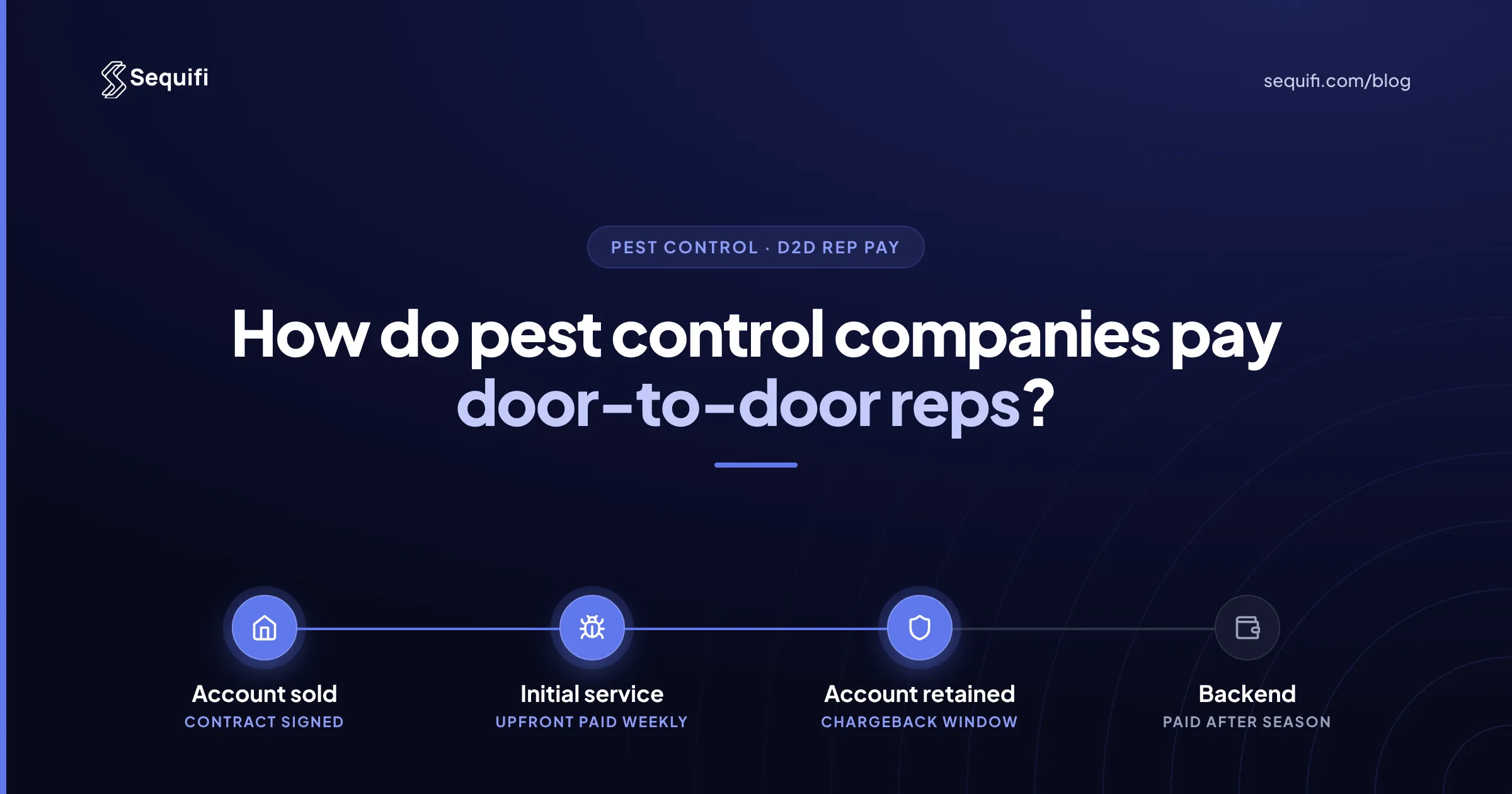
Most pest control companies pay door-to-door reps a commission on every account they sell, set as a percentage of the contract's first-year value or a flat amount per account. Part is paid upfront, usually weekly once the initial service is done. The rest is held as a backend, paid after the season if the account stays active. Cancellations are charged back, managers earn overrides, and most summer reps are paid as 1099 contractors.
Breakdown
- Per-account commission: a percentage of contract value or a flat rate per account, often tiered by volume.
- Upfront pay: a share of each account's commission, paid in the weekly cycle after the initial service is completed, not when the contract is signed.
- Backend: the held portion, paid after the season once accounts prove they will stick, typically conditioned on the rep finishing the season.
- Chargebacks: reversals when a customer cancels, never pays, or refuses the first service within a set window.
- Overrides: payments to team leads and managers on their teams' sales.
- Deductions and advances: rent for company housing, equipment, and draws or advances recovered from later pay.
Deep dive
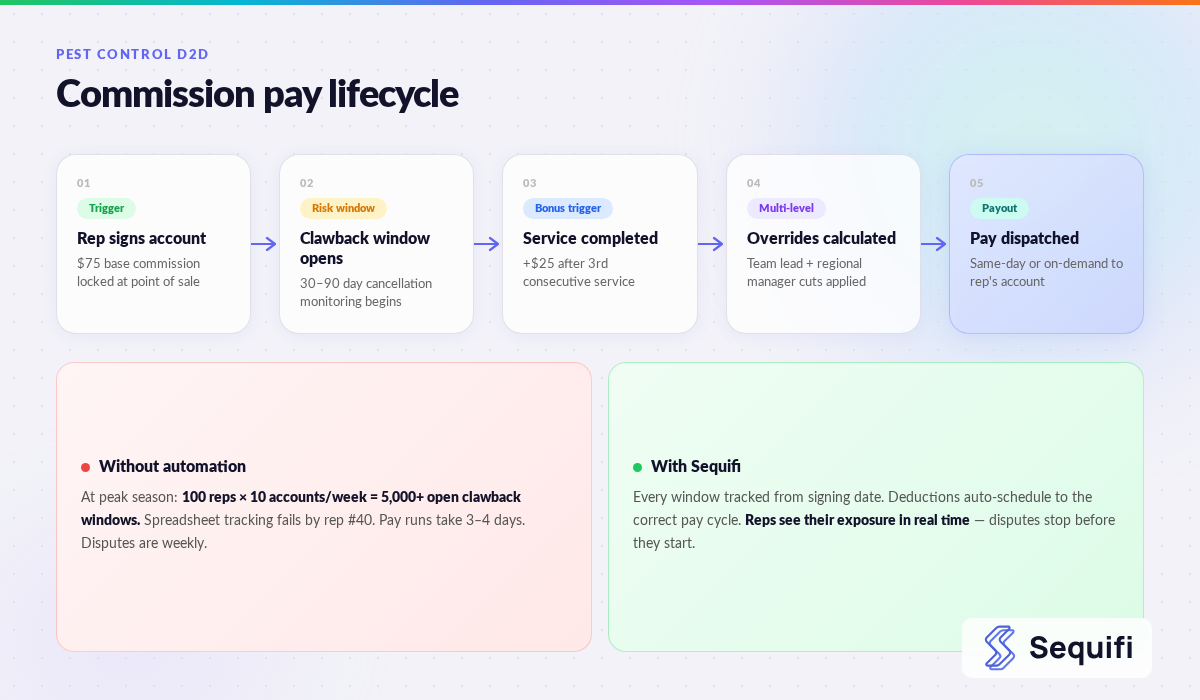
Door-to-door pest control runs on a seasonal sales model. Companies recruit teams of reps, often students, for a summer push of roughly 12 to 16 weeks. Reps sell recurring service plans (quarterly or bi-monthly treatments billed over a year) to homeowners in assigned territories. The pay plan has one job: reward volume without paying for accounts that cancel before they ever generate revenue.
That tension explains the upfront-plus-backend split. Pay everything at signature and you fund cancellations. Pay everything at season end and reps cannot cover rent, and your best closers take offers from companies that pay sooner. Most plans land in the middle: enough upfront to keep reps motivated week to week, enough held back to protect the company from bad accounts.
The plan usually starts with contract value. A quarterly plan with an initial service fee and recurring charges has a calculable first-year value. Commission is a percentage of that number, or a flat dollar amount per account that changes with plan type. Many companies tier the rate by season volume, so a rep who passes a set account count earns a higher rate on every account, sometimes retroactively. Retroactive tiers break spreadsheets, because one late sale can reprice hundreds of earlier accounts (see how to manage complex commission structures).
The trigger matters as much as the rate. Paying on the completed initial service, not the signature, filters out the customers who change their minds before a technician arrives. That makes the service team's records part of the payroll process. If service completions are logged late, reps get paid late.
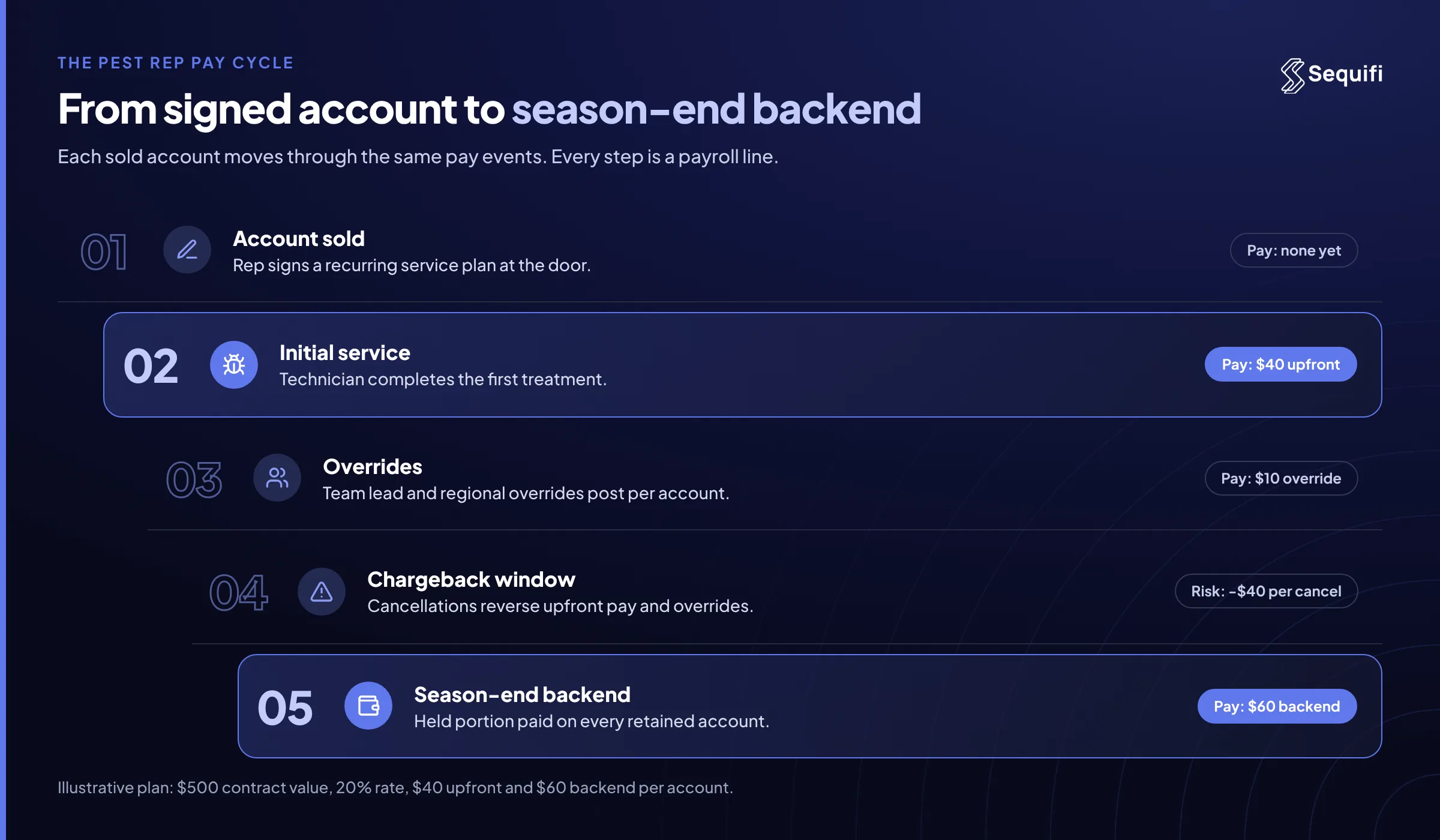
Worked example (illustrative). A rep sells 300 accounts over a 15-week summer. Average first-year contract value is $500 and the rep's rate is 20%, so each account is worth $100 in commission. The plan pays $40 per account upfront once the initial service is done, and holds $60 per account as backend.
- Upfront across the season: 300 x $40 = $12,000, paid weekly as services complete.
- Over the season, 36 accounts (12%) cancel inside the backend window. Those accounts earn no backend, and their $40 upfront is charged back: 36 x $40 = $1,440.
- Backend on retained accounts: 264 x $60 = $15,840, paid after the season.
- Company housing deduction: four months at $500 = $2,000.
Net season pay: $12,000 − $1,440 + $15,840 − $2,000 = $24,400. Multiply that across a 60-rep office, add a $10 team lead override and a regional override, and the company tracks thousands of payment lines in one summer.
Classification adds a second layer. Many summer reps are independent contractors who receive a Form 1099-NEC. Others, plus most managers and office staff, are W-2 employees. Employees whose main duty is selling away from the office can fall under the Department of Labor's outside sales exemption, but state rules vary, so get your plan reviewed by employment counsel. Either way, the same commission data has to feed two kinds of payroll.
For the software side of this, see the software pest control companies use to pay reps. Industry groups like the National Pest Management Association are a good starting point for broader context on the residential pest market your reps are selling into.
What breaks at scale
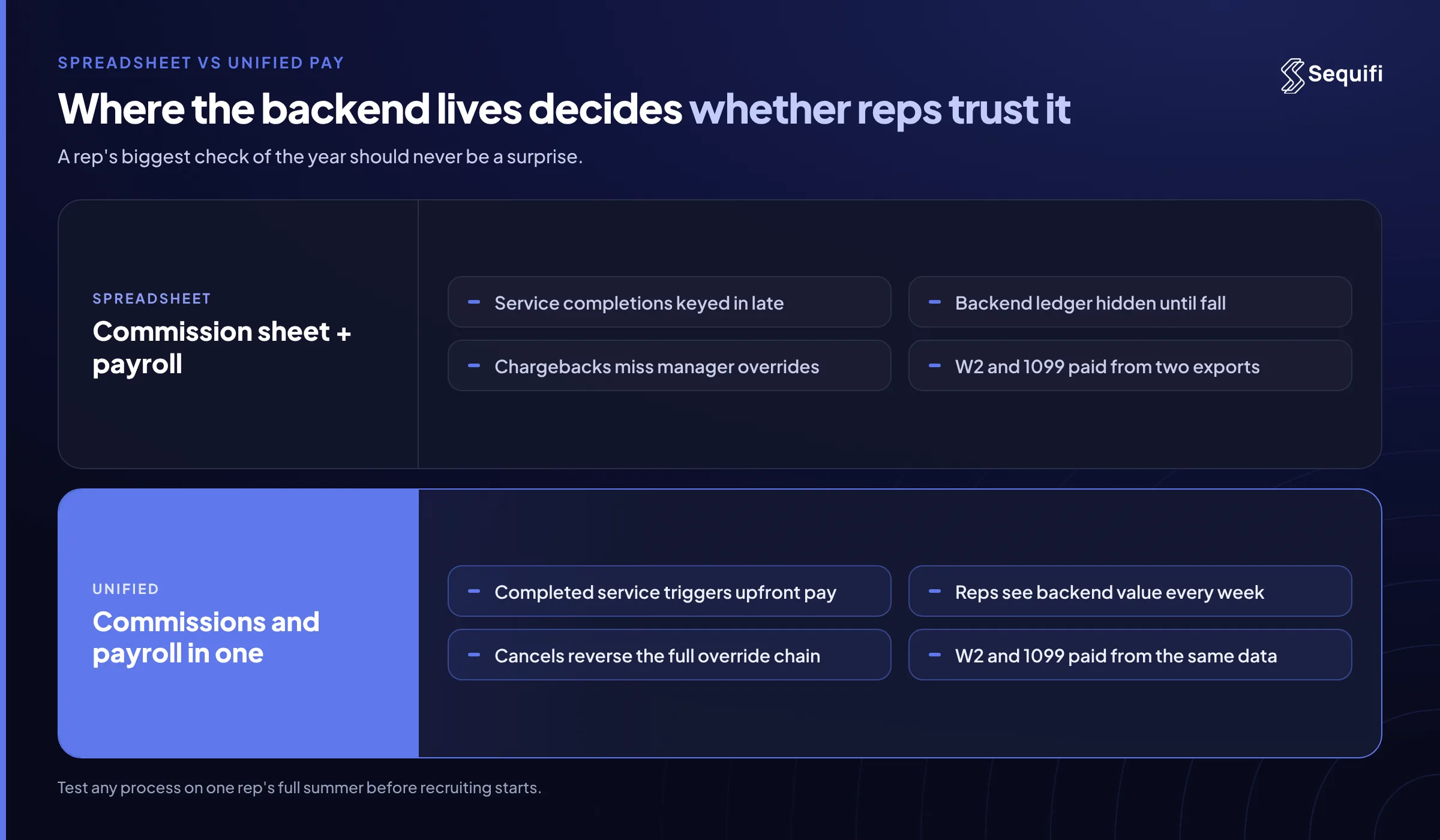
At 50 reps, one office manager can run pay from a spreadsheet. They know every rep, every housing deduction, and every cancellation. The weak spot is the backend ledger: it lives in one workbook, and reps have no way to check it until the season ends.
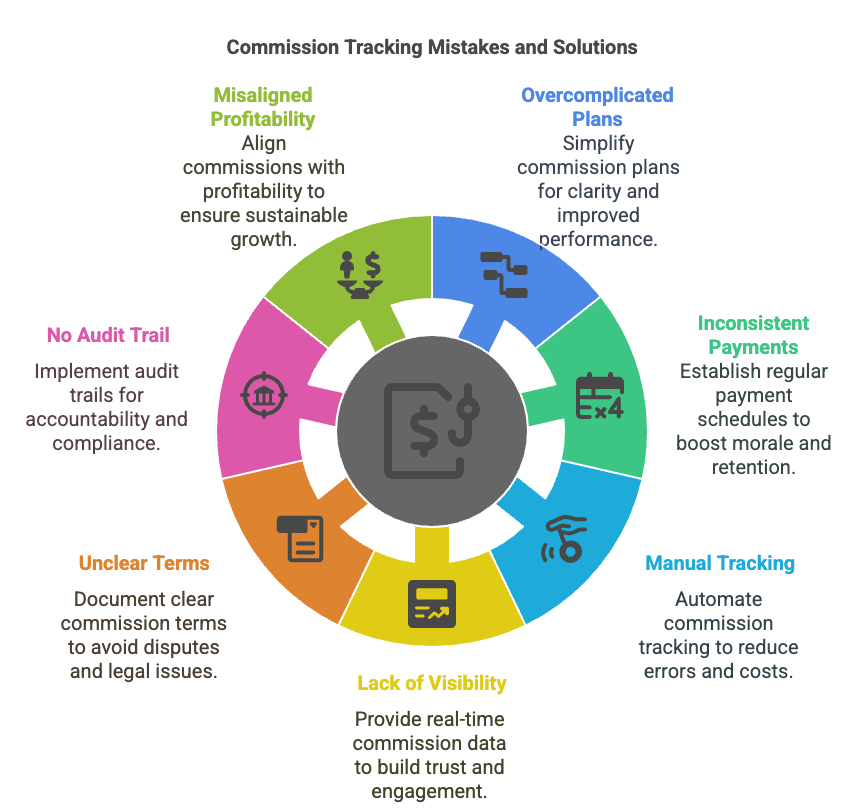
At 200 reps, across several offices, the service schedule and the commission sheet drift apart. Completed initial services get logged days late, so upfront pay slips. Cancellations hit the closer but not the team lead's override. Retroactive tier bumps get applied to some reps and missed for others. Disputes pile up in the final weeks of summer, when reps are deciding whether to come back next year.
At 500 reps, pay becomes a recruiting problem. You are onboarding hundreds of reps in a few weeks each spring, running multiple plan versions, and paying a mix of W-2 and 1099 workers. A slow or unexplained backend is the fastest way to lose top closers, and pay is a core part of the recruiting edge in D2D sales. Ops spends the fall reconciling instead of planning the next season.
How Sequifi solves this
Sequifi is built for any high-velocity sales org with multi-trigger comp plans, including pest control, solar, fiber, and home services. For door-to-door pest teams, three capabilities carry most of the load:
- Multi-trigger commission rules: Upfront pay on completed initial service, backend at season end, chargebacks on cancellations, and override reversals all run from the same account record, including retroactive tier changes.
- Unified W-2 and 1099 payroll: Commissions, deductions, and payouts for contractors and employees run in one system, so there is no export between the commission sheet and payroll.
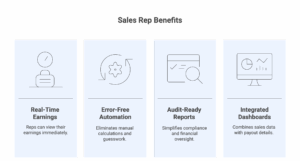
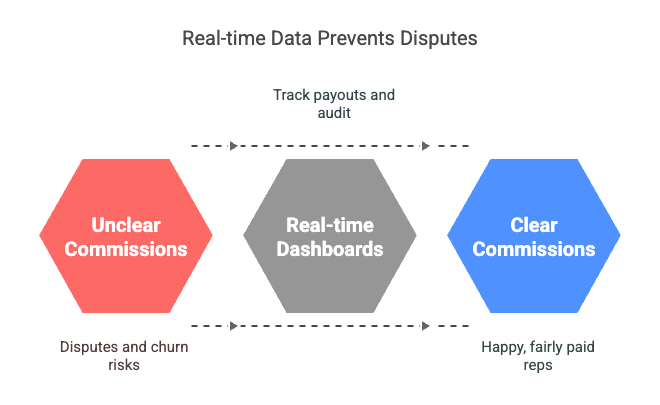
- Rep-facing pay transparency: Reps see each account's status, what they have been paid, and what their backend is worth today.
It is also built for rapid onboarding, when an office adds hundreds of reps before the season.
Frequently asked questions
Do pest control door-to-door reps get paid hourly?
Usually not. Most door-to-door pest control reps are paid on commission only, earning money per account sold rather than per hour worked. Some companies add a small weekly draw or advance early in the season, recovered from later commissions. If reps are classified as W-2 employees, check federal and state wage rules with counsel. Managers sometimes earn a base salary plus overrides on their team's accounts.
What is a backend in pest control sales?
A backend is the portion of a rep's commission held until after the season. It is paid once the sold accounts have stayed active for a set period, and it often requires the rep to finish the full season. The backend protects the company from paying for accounts that cancel early. For reps, it is frequently the largest single check of the year.
When do pest control reps get paid?
Upfront commissions are usually paid weekly or biweekly, once the initial service on each account is completed. Backend pay typically arrives after the season ends, often in the fall. Companies that pay faster have an edge in recruiting, which is why more of them are shortening the gap. Our guide on how companies pay reps faster covers the options.
How do chargebacks work for pest control reps?
When a customer cancels, refuses the first service, or never pays within a set window, the commission already paid on that account is reversed. The reversal is taken from the rep's next upfront payment or from the backend. Well-run plans also reverse the matching overrides for team leads and managers, so the whole chain stays accurate rather than just the closer's statement.
Are pest control reps W-2 or 1099?
Both models exist. Many summer reps are independent contractors paid on a 1099, while managers and year-round staff are more often W-2 employees. The right classification depends on how much control the company has over the work, and state rules differ. Whichever you use, the commission data has to flow cleanly into payroll, which is hard when contractors and employees sit in separate systems.
Conclusion
Pest control companies pay door-to-door reps through a per-account commission split into upfront pay and a held backend, with chargebacks, overrides, and deductions layered on top. The plan is not complicated. Running it accurately for hundreds of reps across a short, intense season is. Before next season's recruiting starts, take one rep's full summer, every account, cancellation, and override, and check whether your current process can show them exactly what they earned. If it cannot, see how Sequifi unifies commissions and payroll for pest control teams.
See Sequifi run your kind of pay.
Commissions, payroll and HR in one platform, built for teams where every paycheck is different.
Book a demo