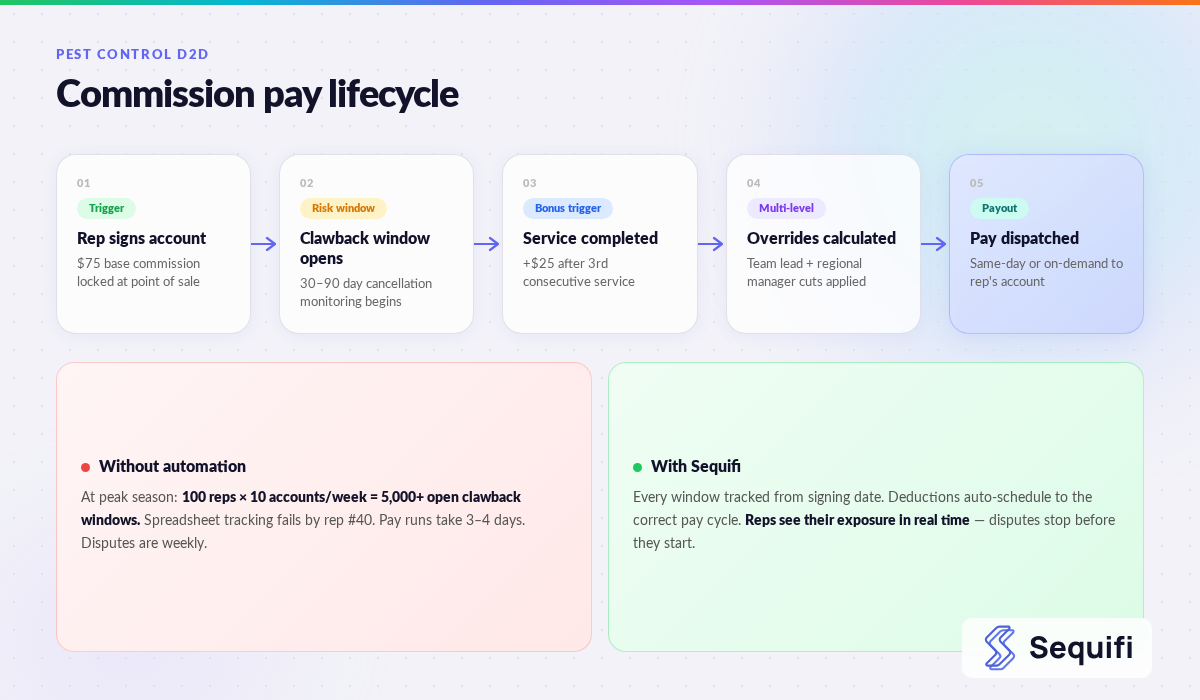
What is the best payroll system for pest control sales teams?
The best payroll system for pest control sales teams pays upfront commissions, backends, chargebacks and overrides for W-2 and 1099 reps from one record.
Direct answer
The best payroll system for a pest control sales team is one that pays commissions directly from account data, not one that waits for a spreadsheet upload. It should handle upfront pay on completed initial services, season-end backends, chargebacks, and manager overrides, and pay W-2 and 1099 reps from the same record. Standard payroll handles hours and taxes well. Pest sales teams need a system built around commission events.
Breakdown
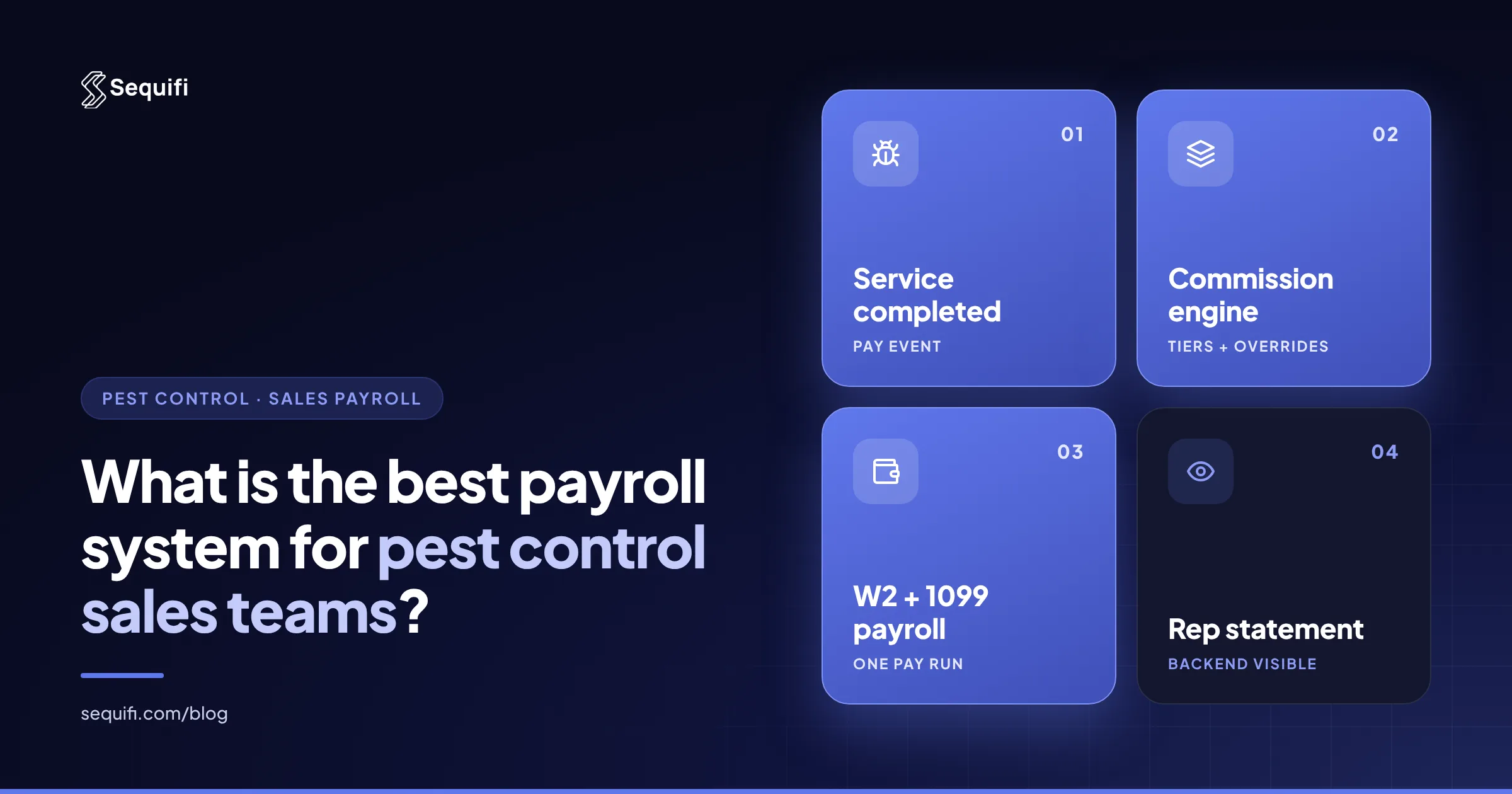
- Commission-native pay runs: payouts triggered by account events, such as a completed initial service, instead of totals keyed in by hand.
- Backend and holdback tracking: a running ledger of what each rep has earned but not yet been paid.
- Chargebacks and override reversals: cancellations that adjust the rep, team lead, and regional manager in one step.
- Mixed W-2 and 1099 payroll: contractors and employees paid from the same data with the right tax treatment.
- Seasonal onboarding: hundreds of new reps set up in weeks, with plans, deductions, and payment details in place before their first week.
- Rep-facing statements: each rep can see accounts, payouts, deductions, and backend value without asking the office.
Deep dive
Pest control companies usually run two very different payrolls. Technicians and office staff are paid hourly or salaried, on a steady schedule. Door-to-door sales reps are paid per account, often as independent contractors, with pay that swings week to week and a large backend at the end of the season. Most payroll systems are designed for the first group. The second group is where the work, and the mistakes, pile up.
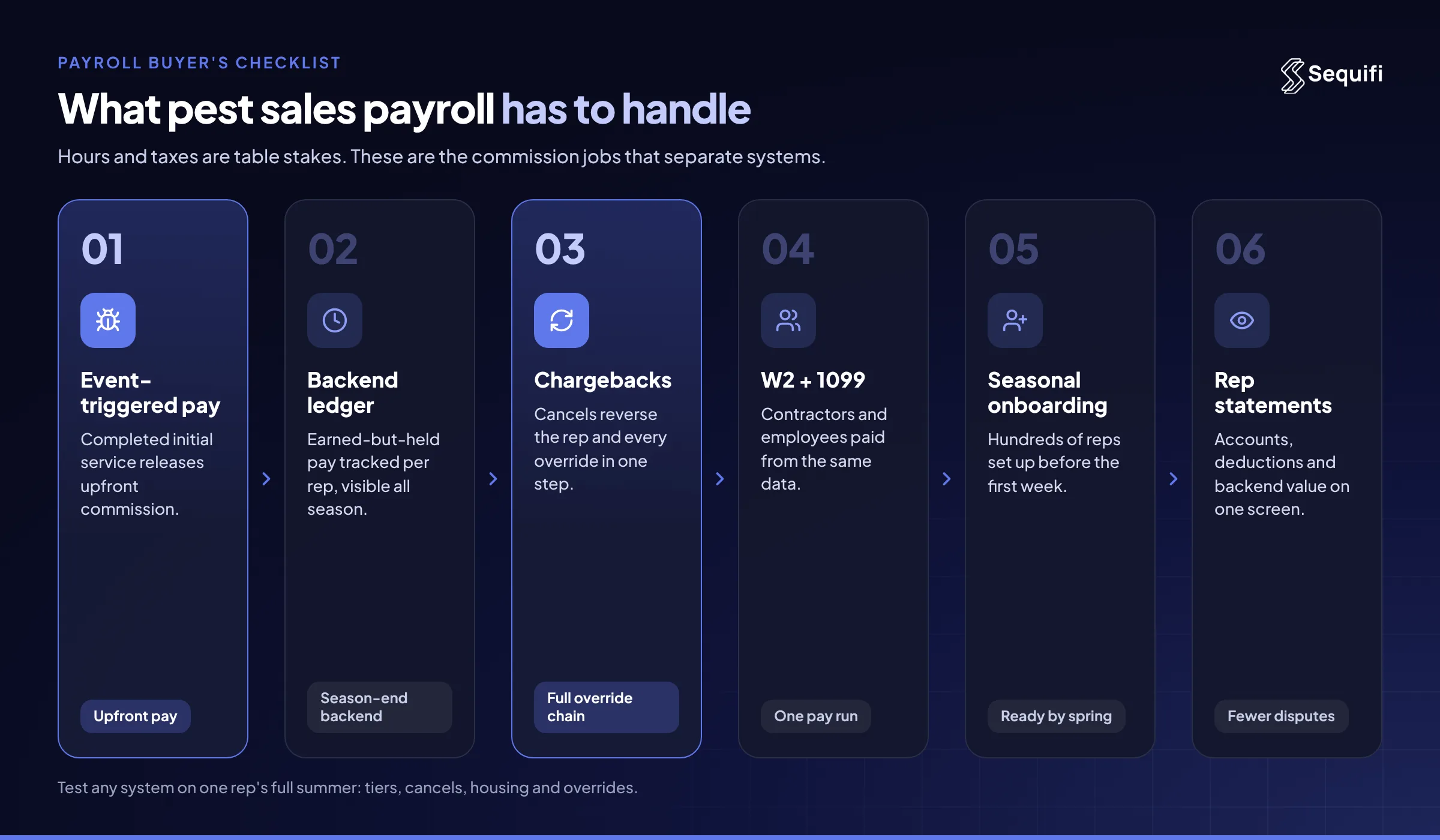
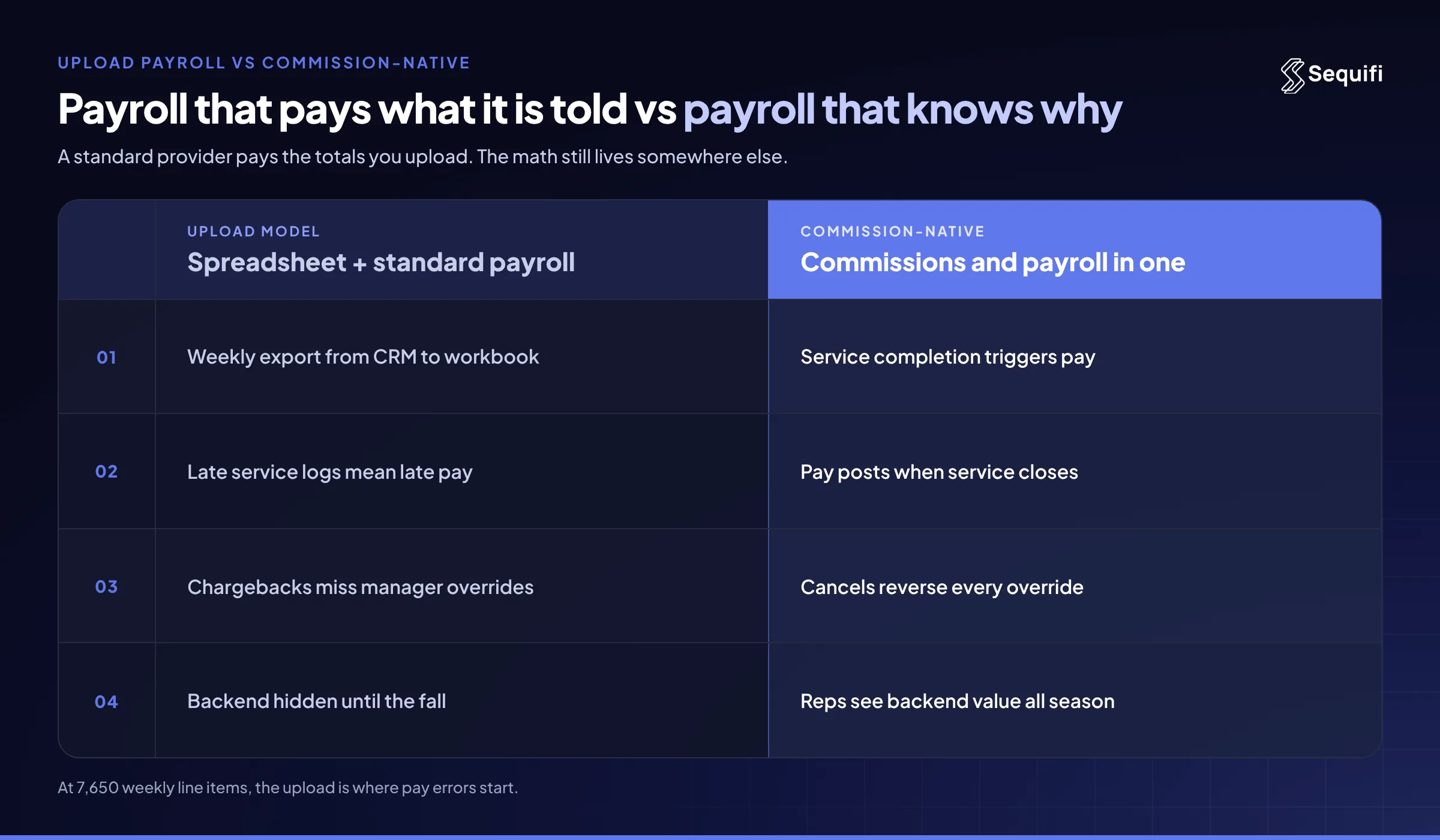
Here is the common setup. Accounts live in the field service or CRM platform. Ops exports them weekly, matches completed initial services, applies commission rates and tiers in a spreadsheet, subtracts housing and equipment deductions, and uploads totals into the payroll provider. The provider handles direct deposit and tax forms. It has no idea why a number is what it is.
That gap shows up in three places:
- Timing. Upfront pay depends on when the initial service is marked complete. If the service team logs completions late, the export misses them, and reps get paid a week late on accounts they know were serviced.
- Adjustments. A cancellation should reverse the rep's upfront pay and every override tied to the account. In a spreadsheet, the closer gets charged back and the manager override often stays put.
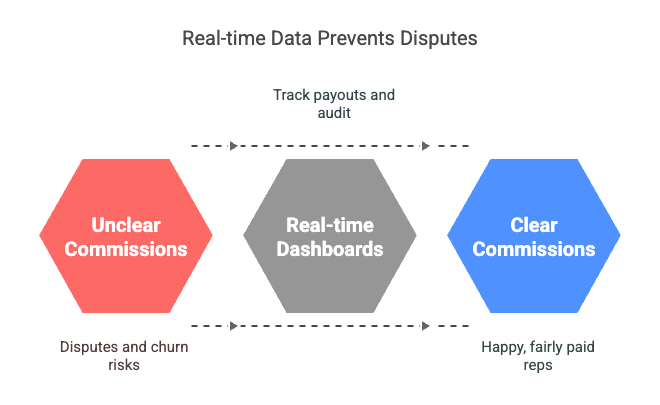
- Visibility. The backend is usually the largest check a summer rep receives. If it lives in a workbook only ops can open, reps spend the season guessing, and the guessing turns into disputes in August.
So when you evaluate payroll for pest sales, judge it on the commission side first. Ask each vendor to run one real rep's summer: every account, a retroactive tier bump, five cancellations, a housing deduction, and a team lead override. Then ask where each number came from. If the answer is "your upload," the system is a payment rail, not a payroll system for sales.
Classification matters too. Many companies pay summer reps as contractors who receive a Form 1099-NEC, while managers are W-2 employees. The IRS lays out the factors in its guidance on independent contractor vs. employee status. W-2 sales employees may fall under the Department of Labor's outside sales exemption, but state rules vary, so review your setup with employment counsel. Whatever you decide, the system has to support both worker types without a second export.
Worked example (illustrative). A pest company runs a 150-rep summer program across three offices. Each rep averages 20 new accounts a week, so 3,000 accounts per week. About 2,400 reach a completed initial service that week and trigger upfront pay. Each of those also pays a team lead override and a regional override, so 7,200 payout lines. Add 150 weekly housing deductions and roughly 100 cancellations, each reversing three lines, and payroll week touches about 7,650 line items.
At 30 seconds of checking and keying per line, that is more than 60 hours of manual work every week, before anyone answers a rep's question. A commission-native system turns most of it into a review of exceptions.
For more on the pay plan itself, see how pest control companies pay door-to-door reps. For the wider tooling picture, see the software pest control companies use to pay reps.
What breaks at scale
At 50 reps, a spreadsheet plus a standard payroll provider is workable. One person owns the commission file, knows the exceptions, and catches most errors before the upload. The risk is that the logic lives in that person's head.
At 200 reps, the upload becomes the bottleneck. Service completions arrive late, tier bumps get applied inconsistently, and chargebacks miss overrides. The payroll provider pays exactly what it is told, so every upstream error reaches a rep's bank account. Reps start keeping their own account lists to check statements, and ops spends Mondays answering pay questions.
At 500 reps, across several offices and states, you are onboarding hundreds of reps each spring, running multiple plan versions, and splitting pay between W-2 and 1099 workers. Payroll week stretches into days. Backends paid late or without explanation become the reason good reps sign elsewhere next season, which is why pay speed is part of the recruiting edge in D2D sales.
How Sequifi solves this
Sequifi is built for any high-velocity sales org with multi-trigger comp plans, including pest control, solar, fiber, and home services. For pest sales teams, it closes the gap between commissions and payroll:
- Unified commission engine and payroll: Upfront pay, backends, chargebacks, and overrides are calculated and paid in one system, with no export or upload in between.
- Unified W-2 and 1099 payroll: Contractors and employees are paid from the same account data with the right tax handling.
- Rapid onboarding and rep transparency: New reps can be set up by the hundreds before the season, and every rep sees accounts, payouts, and backend value as they change.
Same-day pay on qualifying events is available when you want to pay faster.
Frequently asked questions
Can a standard payroll provider handle pest control commissions?
It can pay them, but it usually cannot calculate them. Standard providers process the totals you upload and handle taxes and direct deposit well. The commission math (tiers, upfront and backend splits, chargebacks, overrides) still happens in a spreadsheet or separate tool. That works for small teams. As rep count grows, the upload becomes the main source of pay errors and late payments.
What features matter most in payroll for pest control sales reps?
Prioritize event-triggered commission payouts, a backend ledger reps can see, chargebacks that reverse every override, and support for W-2 and 1099 workers in one system. Next, look at onboarding speed for seasonal hiring, deductions for housing and equipment, and statements that explain every number. Tax filing and direct deposit are table stakes. The commission handling is what separates the options.
How do pest control companies handle housing deductions in payroll?
Many summer sales programs provide apartments and recover the cost through payroll deductions, often a fixed weekly or monthly amount. The deduction should appear on the rep's statement as its own line, separate from commissions and chargebacks. Rules differ for W-2 employees and 1099 contractors, and some states limit wage deductions, so confirm the approach with your payroll and legal advisors.
How fast should pest control reps be paid?
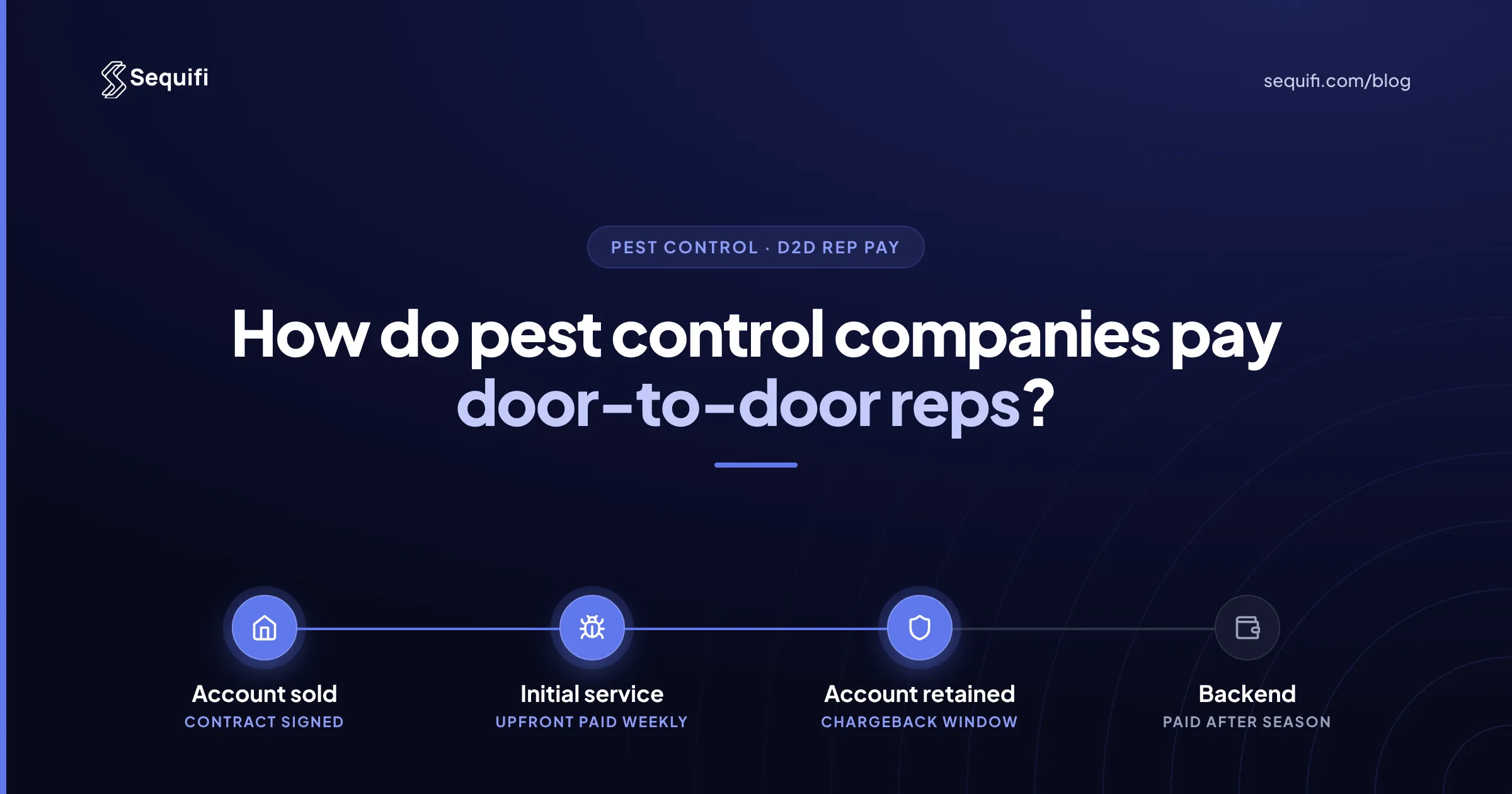
Most companies pay upfront commissions weekly once the initial service is complete, with the backend paid after the season. Faster pay is a real recruiting advantage, which is why some companies now pay on qualifying events within the same day. See how companies pay reps faster for the options and the controls that make them safe.
When should a pest control company switch payroll systems?
Switch before the season, not during it. Common triggers are crossing 100 to 200 reps, adding a second office or state, recurring disputes about backends, or payroll week taking more than a day of ops time. Plan migration for the off-season so plans, rates, and rep records are tested on real accounts before spring recruiting starts.
Conclusion
The best payroll system for a pest control sales team is the one that understands commissions, not just paychecks. Hourly payroll for technicians is a solved problem. Sales payroll, with upfront pay, backends, chargebacks, overrides, and a mixed W-2 and 1099 workforce, is where teams lose time and reps lose trust. Before next season, run one rep's full summer through your current process and count the manual steps. If the number is high, see how Sequifi unifies commissions and payroll for pest control teams.
See Sequifi run your kind of pay.
Commissions, payroll and HR in one platform, built for teams where every paycheck is different.
Book a demo