How do real estate teams split commissions with agents?
Real estate teams split commission in layers: the brokerage takes a share, then team and agent split by lead source, plus caps and fees. See how Sequifi fits.
Direct Answer
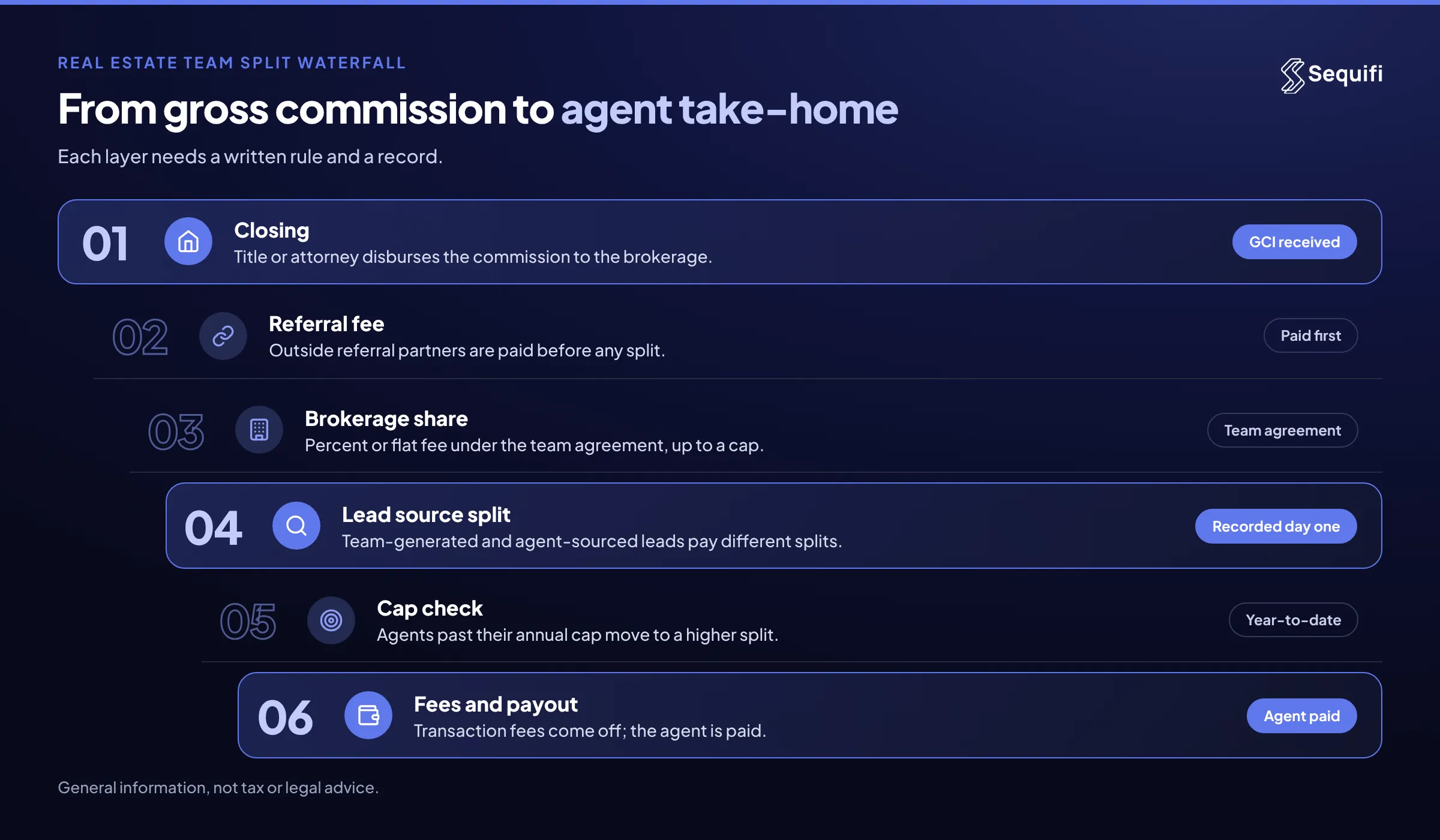
Real estate teams split commission in layers. The brokerage takes its share of the gross commission first, then the team leader and the agent split what remains, usually based on who generated the lead. Team-provided leads often pay the agent around half, while agent-sourced deals pay more. Caps, transaction fees, and referral fees adjust the final number, and pay is typically released at closing.
Breakdown
- Brokerage split: the brokerage takes a percentage or flat fee from each deal's gross commission income (GCI), often until the team hits an annual cap.
- Team split by lead source: team-generated leads pay the agent a lower split than leads the agent sources personally.
- Caps: once an agent pays a set amount to the team in a year, their split rises.
- Fees: transaction, technology, and compliance fees come off the agent's share.
- Referral fees: outside referral partners are paid before anyone else splits.
- Timing: commission is usually paid at closing, once the title company or attorney disburses funds.
Deep Dive
A team is a business inside a brokerage. That means every deal runs through at least two split agreements: the brokerage's agreement with the team, and the team's agreement with each agent.
The brokerage layer. The brokerage holds the license and receives the commission check. It keeps its share under the team's agreement, which might be a percentage of GCI, a flat fee per deal, or a split that drops to zero once the team pays an annual cap. Whatever is left goes to the team.
The lead-source layer. This is where most team splits are decided. If the team bought the lead through paid advertising or its sphere, the agent typically receives a lower split, often around 50%, because the team carried the cost of finding the client. If the agent brought the client, the split might be 70% or higher. The labels must be clear: an online lead the agent converted, a past client of the team, and a referral from the agent's friend are three different cases. Define each before the first dispute.
Caps and fees. Many teams cap how much an agent pays the team each year. After the cap, the agent's split rises for the rest of the year. Transaction fees and technology fees then come off the agent's share. These rules compound, so an agent's real take-home on a deal can be hard to predict without a statement. Our guide to how to calculate commissions for sales reps covers the basics of layered plans.
Buyer-side changes. Since the 2024 settlement involving the National Association of Realtors, buyer-agent compensation is negotiated more explicitly, often in a written buyer agreement before touring. For teams, that means the commission on a buyer deal can vary more from deal to deal, so splits should be calculated on actual GCI, not an assumed rate.
Classification. Most team agents are independent contractors paid on commission, while inside sales agents, transaction coordinators, and admins may be W2 employees. The IRS guidance on independent contractors and employees explains how worker status is determined, and licensed real estate agents have specific rules. The Bureau of Labor Statistics profile of real estate brokers and sales agents describes how the two licenses differ. This is general information, not tax or legal advice.
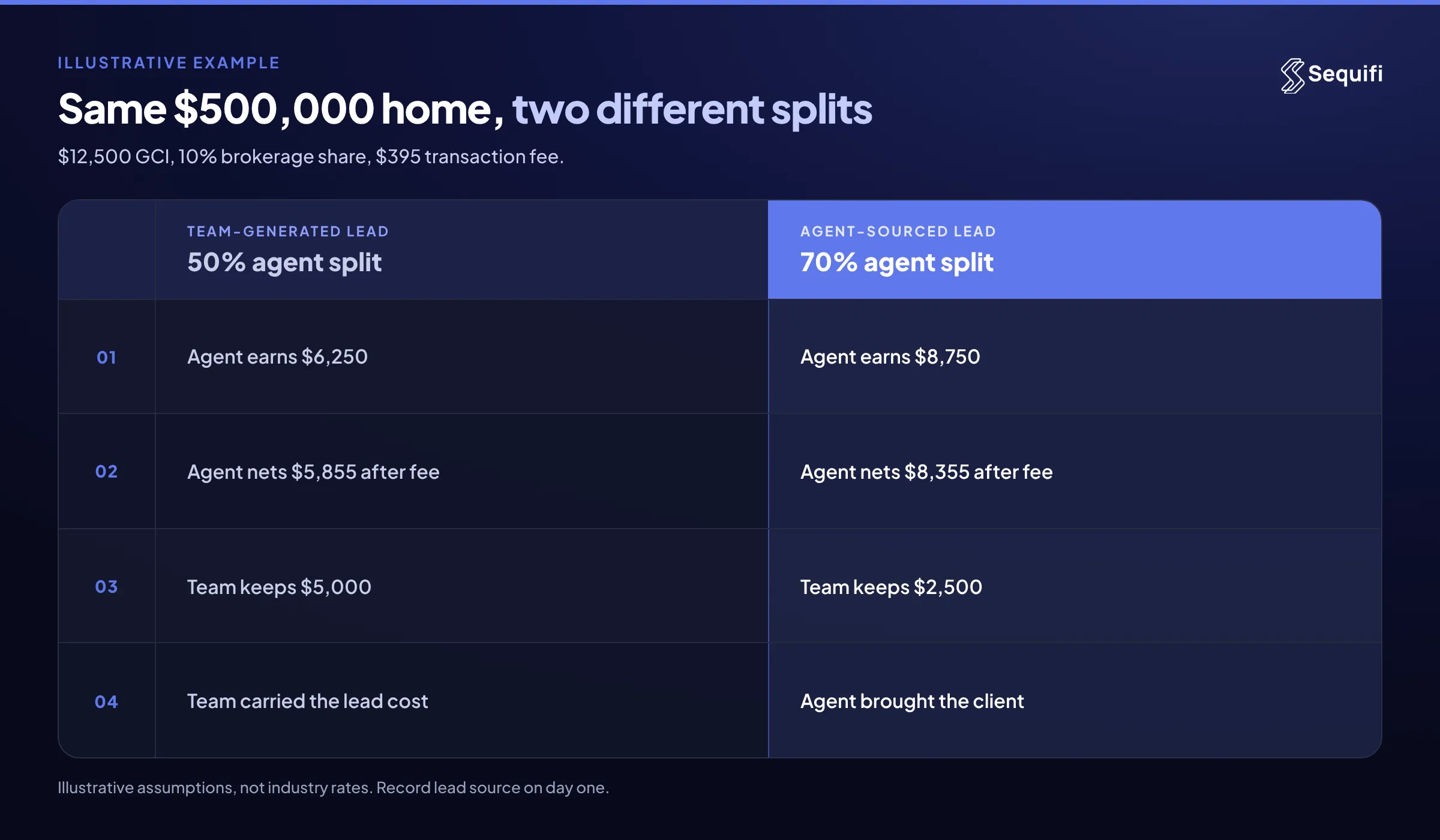
Worked example (illustrative). These numbers are assumptions, not industry rates. A home sells for $500,000, and the team's side earns 2.5%, or $12,500 GCI. The brokerage takes 10%, or $1,250. The agent pays a $395 transaction fee.
- Team-generated lead (50% agent split on GCI): the agent earns $6,250, minus the $395 fee, for $5,855. The team keeps $5,000 after the brokerage share.
- Agent-sourced lead (70% agent split on GCI): the agent earns $8,750, minus the fee, for $8,355. The team keeps $2,500.
Same house, same price, a $2,500 difference in agent pay. That is why lead source has to be recorded in the CRM the day the lead arrives, not argued about at closing.
What Breaks at Scale
At 50 agents, the team leader or an operations manager runs splits in a spreadsheet. They remember who sourced which lead and which agents have hit their caps. Mistakes get fixed over coffee.
At 200 agents across several markets, lead source labels drift between offices, caps reset on different dates, and referral fees are paid late. Agents start keeping their own records to check the team's math. Closing-day disbursements wait on a manual split calculation, and a single wrong split on a large deal turns into a dispute that consumes a week.
At 500 agents, the team often runs multiple brokerage agreements, ISAs on salary plus bonus, and showing agents paid per appointment. Each group is paid differently, on different schedules. Without one system that ties closing events to splits, caps, and payroll, finance spends every month reconciling, and top producers leave for teams that pay faster and more clearly. Recruiting suffers too, because agents compare split statements before they switch teams.
How Sequifi Solves This
Sequifi is built for any high-velocity sales org with multi-trigger comp plans, including real estate teams, mortgage, solar, and home services.
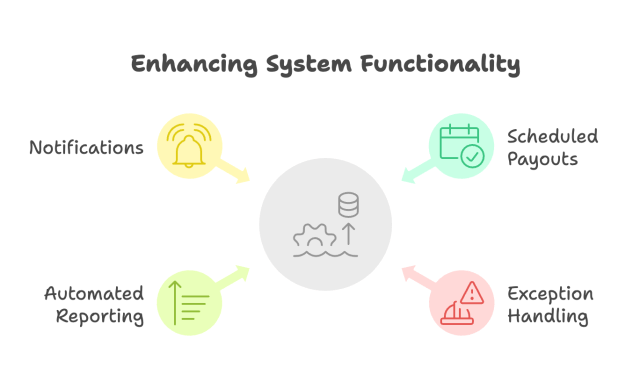
- Multi-trigger commissions. Splits can follow lead source, caps, fees, and referral payouts by rule, with pay released on a qualifying event such as closing.
- Commissions and W2 and 1099 payroll in one system. Independent agents, salaried ISAs, and admins are paid in one run, with no spreadsheet export.
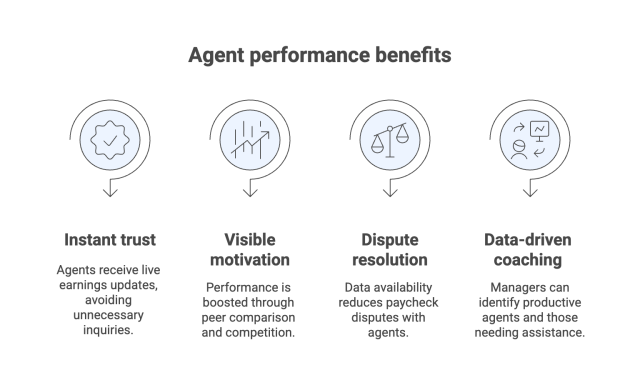
- Rep-facing transparency. Agents see each deal's split, fees, and cap progress before payday, which removes most closing-day disputes.
The result: splits are calculated the same way for every agent in every office, and closing-day pay no longer waits on a spreadsheet.
Frequently Asked Questions
What is a typical real estate team commission split?
It varies widely by market and team model. Many teams pay agents around 50% of GCI on team-generated leads and a higher split, often 60% to 80%, on leads the agent sources. The brokerage takes its share first, under the team's own agreement. The right split depends on how much lead flow, marketing, and support the team provides, and it belongs in a signed agreement.
Who decides whether a lead is team-generated or agent-sourced?
The team's written policy should decide, and the CRM should record it when the lead arrives. Common rules: paid online leads and past team clients are team-generated, while the agent's personal sphere and direct referrals are agent-sourced. Gray areas, such as an agent's friend who first found the team online, need a named rule. See our guide to eliminating commission disputes.
How do commission caps work on real estate teams?
A cap limits how much an agent pays the team or brokerage in a year. Once the agent has paid that amount, their split rises, sometimes to 100% minus fees, until the cap resets on the agent's anniversary or January 1. Caps reward top producers but make every deal's math depend on year-to-date totals, so agents need to see their cap progress.
When do real estate agents on a team get paid?
Usually at closing, when the title company or closing attorney disburses the commission to the brokerage, which pays the team and agents. Some brokerages pay agents the same day; others pay on a weekly or semimonthly cycle. Faster, predictable payment is a recruiting advantage; see how companies pay reps faster.
How are ISAs and showing agents paid on a team?
Inside sales agents who qualify leads are often paid a base or hourly wage plus a bonus per set appointment or closed deal. Showing agents are commonly paid a flat fee per showing or a small share of the deal. Because ISAs may be W2 employees while agents are 1099 contractors, both groups should be paid under clear, written rules from one system.
Conclusion
Real estate teams split commission in layers: the brokerage takes its share, then the team and agent split the rest by lead source, with caps, fees, and referral payouts on top. The splits that hold up are written down, tied to a lead source recorded on day one, and visible to agents before closing. As a next step, pull your last twenty closings and check that each one has a recorded lead source, cap status, and fee list. If any are missing, fix the policy first. Teams that also want leaderboards and payout tracking can start there. To see how commissions and payroll run together, visit Sequifi.
See Sequifi run your kind of pay.
Commissions, payroll and HR in one platform, built for teams where every paycheck is different.
Book a demo