How do insurance agencies pay commissions to sales reps?
Insurance agencies pay producers a split of carrier commission, with separate new and renewal rates, advances, and chargebacks. See how Sequifi automates it.
Direct Answer
Insurance agencies pay sales reps, usually called producers, a share of the commission the carrier pays the agency. Most plans pay a higher split on new business and a lower split on renewals. Some lines, especially life, pay producers an advance at issue and charge it back if the policy lapses early. The hard part is not the split. It is tracking every carrier statement, renewal, and chargeback down to each producer's paycheck.
Breakdown
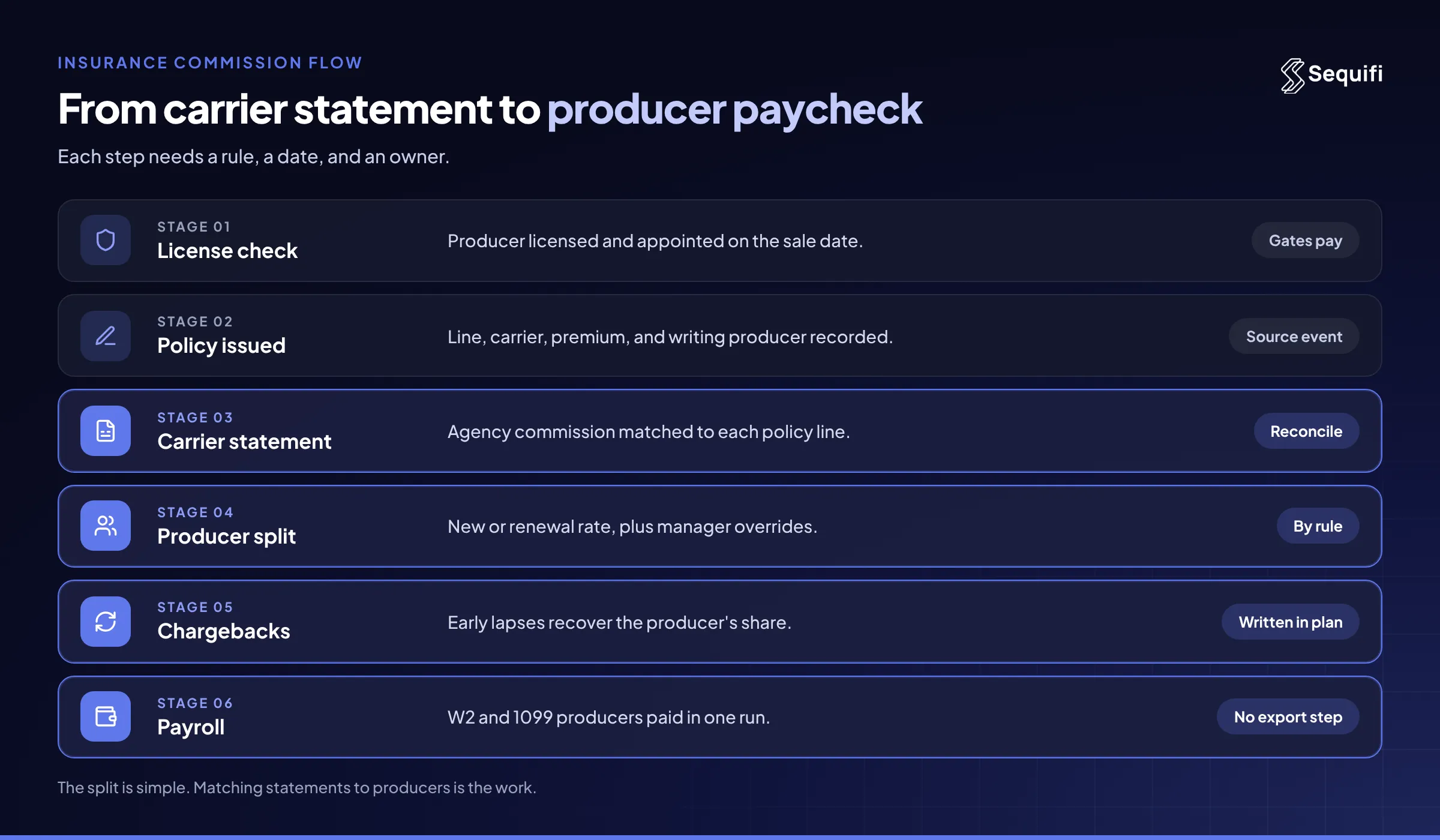
- Carrier commission: the carrier pays the agency a percentage of premium, set by the carrier contract and the line of business.
- Producer split: the agency passes a share of that commission to the producer who wrote or services the policy.
- New vs renewal rates: first-year business usually pays the producer more than renewals of the same policy.
- Advances and draws: some agencies pay before the carrier does, then recover it from future commissions.
- Chargebacks: when a policy cancels or lapses early, the carrier takes back unearned commission, and the agency recovers the producer's share.
- Overrides and bonuses: managers and agency principals often earn overrides on their team, plus production or retention bonuses.
Deep Dive
Insurance commission starts with the carrier, not the agency. The agency sells a policy, the carrier collects premium, and the carrier pays the agency a commission under its appointment contract. The agency then pays its producers under its own comp plan. That two-step flow is why insurance pay is harder to run than a simple percentage of revenue.
The Bureau of Labor Statistics notes that commission is the most common form of pay for insurance sales agents, especially experienced ones, while employed agents may earn salary plus commission or salary plus bonus. Captive agencies, independent agencies, and call-center sales floors all mix these differently. A captive agency may pay a base salary and a modest commission. An independent agency may pay a producer commission only, with a larger share of renewals they own.
New business and renewals pay differently. A producer who writes a commercial property and casualty account typically earns a larger split in year one and a smaller split each year it renews. Many agencies tie renewal pay to who services the account, so a producer who leaves may lose renewals to an account manager. Write that rule down. It is one of the most common sources of disputes.
Life and health add advances and chargebacks. Life carriers often pay a large first-year commission and much smaller renewals. Agencies that want to attract producers may advance part of that first-year commission at issue rather than wait for premiums to come in. If the policy lapses inside the chargeback period, the carrier takes back the unearned portion, and the agency has to recover the producer's share. Our guide to draw against commission covers how advances and recoveries work in general, and our guide to commission clawbacks covers how to handle recoveries fairly, using mortgage as the example.
Licensing gates pay. Producers must hold a license in each state where they sell, and life and health licenses are separate from property and casualty. The NAIC's producer licensing overview explains how state regulators handle this. Many agencies will not pay commission on a policy written by someone who was not licensed and appointed at the time of sale, so the pay system needs license and appointment dates per producer. Treat this as general information, not legal advice, and confirm the rules for your states and carriers with counsel.
Worked example (illustrative). Assume a commercial policy with $20,000 in annual premium. Assume the carrier pays the agency 12% on new business, or $2,400. Assume the agency's plan pays producers 40% of agency commission on new business, so the producer earns $960. At renewal, assume the carrier rate stays at 12% and the producer split drops to 25%, so the producer earns $600.
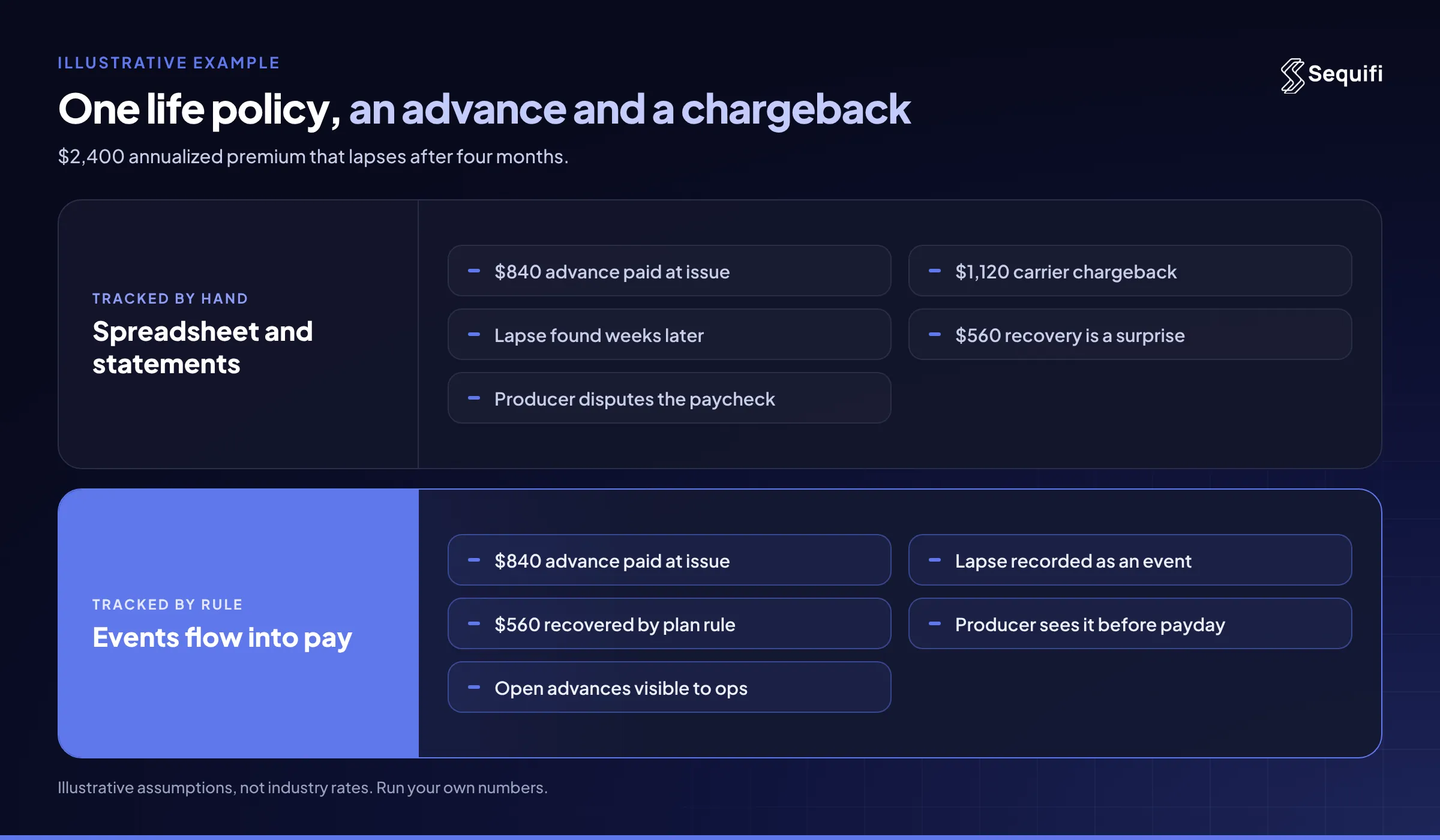
Now a life policy. Assume $2,400 in annualized premium and a first-year agency commission of $1,680. Assume the agency advances the producer half of that, $840, at issue. The policy lapses after four months. The carrier charges back the unearned eight months, $1,120. The agency recovers eight-twelfths of the producer's advance, $560, from the producer's next commissions.
Multiply that by hundreds of policies, a dozen carriers, and statements that arrive on different schedules, and the work is no longer the math. It is matching each carrier line to the right policy, producer, rate, and pay period. These numbers are assumptions, not industry rates. Run your own.
What Breaks at Scale
At 50 producers, an agency can reconcile carrier statements in a spreadsheet. One person knows every split, every renewal owner, and every advance that is still open. Errors get fixed with a phone call.
At 200 producers, carrier statements pile up. Each carrier formats them differently, and some arrive weeks after the policy is written. Chargebacks land after the producer was already paid. Renewal ownership changes when producers leave or accounts are reassigned, and nobody updates the sheet. Producers start keeping their own records to check their pay.
At 500 producers across several states and lines, the gaps compound. Override chains for managers and agency principals change with every promotion. Open advances pile up with no clear recovery plan. License and appointment dates live in a different system from pay. Payroll for W2 account managers and 1099 producers drifts apart. Top producers, who have the most renewals at stake, are the first to question every statement and the first to leave. Our guide to managing complex commission structures covers the rule design side.
How Sequifi Solves This
Sequifi is built for any high-velocity sales org with multi-trigger comp plans, including insurance agencies, mortgage teams, solar, and home services. For insurance, three capabilities matter most:
- Multi-trigger commission rules. New business, renewals, overrides, advances, and clawbacks are calculated by rule from the events you record, not by hand in a spreadsheet.
- Unified W2 and 1099 payroll. Salaried account managers and commission-only producers are paid from the same system in the same run, with no export between commissions and payroll.
- Rep-facing pay transparency. Producers see each policy, its pay status, and any chargeback against them, from the same numbers payroll uses.
Frequently Asked Questions
What is a typical commission split for insurance producers?
There is no single standard. Splits vary by line of business, carrier, whether the producer generates their own leads, and whether the agency pays a base salary. Most agencies pay a larger share on new business than on renewals, and commission-only producers usually earn a larger share than salaried ones. Write each split into the plan, by line and by new versus renewal, rather than relying on habit.
Do insurance producers get paid on renewals?
Usually, yes, though often at a lower rate than new business. The key question is who owns the renewal. Some agencies pay the original producer for as long as the policy renews. Others shift renewal pay to the account manager who services it, especially after a producer leaves. Put the ownership rule in the comp plan so producers know what they keep.
How do chargebacks work in insurance commissions?
When a policy cancels or lapses inside the carrier's chargeback period, the carrier takes back commission it has not earned. The agency then recovers the producer's share, usually by deducting it from future commissions. Fair chargeback handling means the rule is written in the plan, applied the same way to every policy, and visible to the producer before it hits their paycheck.
Are insurance producers W2 employees or 1099 contractors?
Both models are common. Captive and call-center agencies often employ producers on W2, while independent agencies may pay commission-only producers as contractors. Classification depends on how much control the agency has over the work, under IRS guidance on employees versus independent contractors and state law. This is general information, not legal advice. Review each role with counsel.
How often should insurance agencies pay producers?
Most agencies pay monthly, after carrier statements arrive and are reconciled. That delay is a recruiting weakness. Agencies that track policy events as they happen can pay faster, either on a weekly cycle or on qualifying events such as an issued policy. Faster pay only helps if it is accurate, so fix the reconciliation first. See how companies pay reps faster.
Conclusion
Insurance agencies pay producers a share of carrier commission, with different rates for new business and renewals, and with advances and chargebacks in lines like life and health. The plan itself is rarely the problem. The work is matching carrier statements to policies and producers, tracking renewal ownership, and recovering advances without surprises. As a next step, pick one carrier statement and trace every line to a producer's paycheck, noting each manual step. Fix the steps that depend on one person first. To see how commission rules, payroll, and producer pay visibility run together, visit Sequifi.
See Sequifi run your kind of pay.
Commissions, payroll and HR in one platform, built for teams where every paycheck is different.
Book a demo