How do you scale a sales team without payroll breaking?
Scale a sales team without breaking payroll: set each rep up once, pay from verified events, and run W-2 and 1099 reps together. A worked example from 60 to 180 reps.
Direct answer
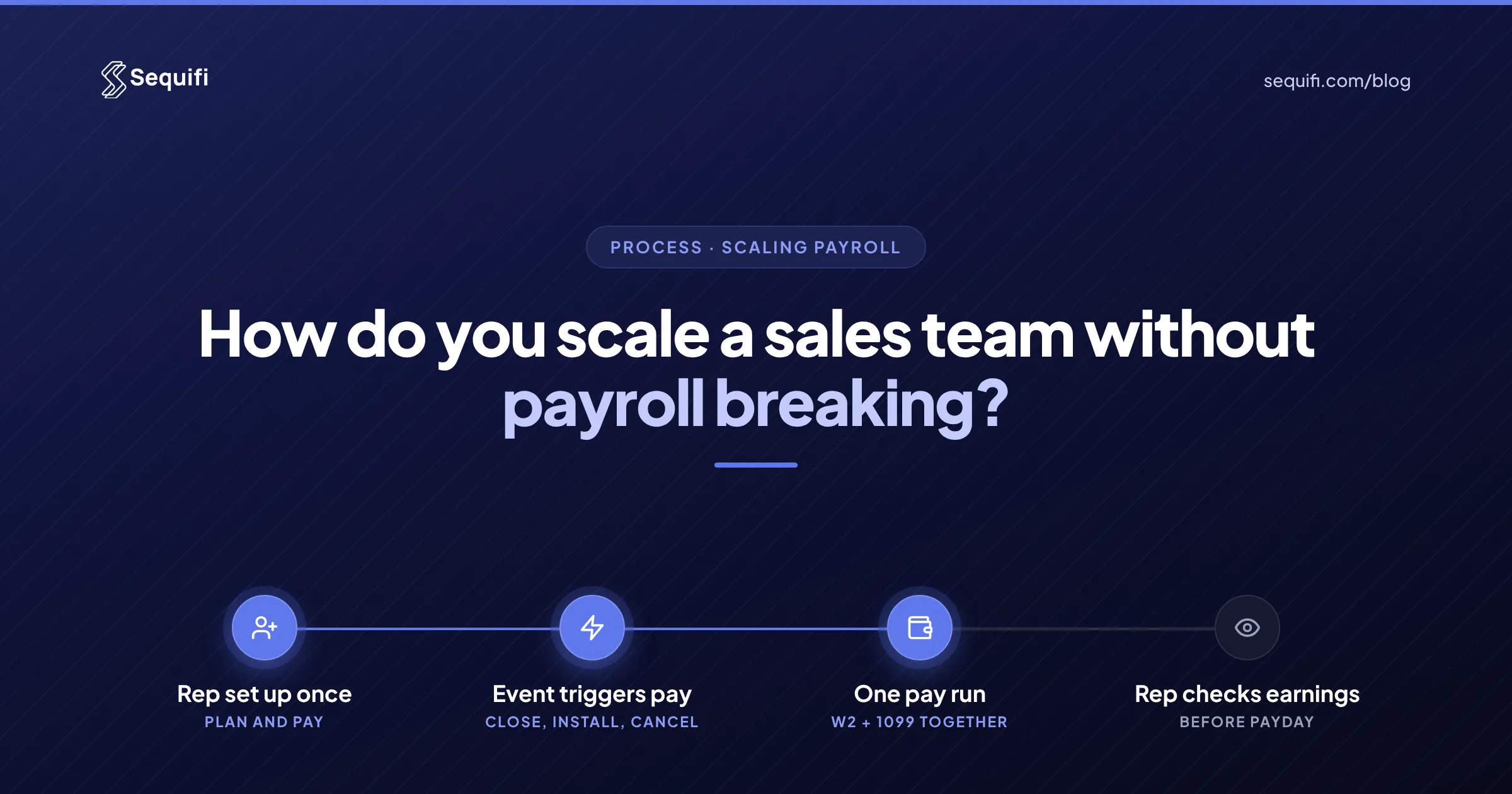
You scale a sales team without breaking payroll by removing the manual steps that grow with headcount. Set each new rep up once for plan and pay. Pay from verified events, not spreadsheets. Run W-2 and 1099 reps in the same cycle, and let reps see their earnings before payday. Payroll rarely breaks because of volume alone. It breaks because every new rep adds re-keying, exports, and reconciliation that one ops team cannot absorb.
Breakdown
- One setup per rep: plan, hierarchy, worker type, and pay details entered once, before the first deal.
- Event-driven pay: closes, installs, activations, and cancellations trigger pay and clawbacks automatically.
- Versioned comp plans: plan changes carry an effective date, so old deals pay on old rules.
- One pay run for W-2 and 1099: both worker types paid from the same approved numbers.
- Rep-facing earnings: reps check their own numbers before payday, not after.
- A fixed close calendar: cutoffs, approvals, and off-cycle rules written down and enforced.
Deep dive
Most payroll problems in a growing sales org trace back to one design choice made at 20 reps: commissions live in a spreadsheet or a separate tool, and someone moves the totals into payroll by hand. That works when one person knows every plan by heart. It stops working when hiring doubles and that person is still one person.
Here is what changes as you scale, and what to fix first.
Onboarding becomes a payroll event. A new rep is not ready to be paid until their worker type, tax forms, comp plan, manager, and override chain are set. If those live in three systems, a rep can sell for two weeks before anyone notices their plan was never loaded. Their first check is wrong, and first checks set the tone for retention. If you hire in waves, the playbook for onboarding 100 sales reps quickly matters as much as the recruiting plan.
Comp plans multiply. Growth usually means new regions, new products, and new roles: setters, closers, team leads, regional managers. Each adds a plan variant, and each variant adds overrides and splits. Without version control, a mid-quarter plan change quietly rewrites pay on deals that closed under the old plan. That is how disputes start. The fixes for managing complex commission structures apply here: one source of plan rules, effective dates, and a full audit trail.
Pay triggers drift apart from the CRM. In solar, the second payment depends on install. In fiber, it depends on activation. In pest control, it can depend on the first service. In mortgage, it depends on funding. When those events sit outside the commission tool, someone has to match them by hand each cycle. Matching by hand scales with deal count, not with the size of your ops team.
Worker mix gets harder. Many fast-growing teams pay both W-2 employees and 1099 contractors. The IRS treats them differently for withholding and reporting, and classification follows IRS rules on independent contractors versus employees. Running two payroll processes off one commission spreadsheet doubles the places an error can hide.
Multi-state pay rules add up. Expanding into new states brings new pay-frequency and final-pay rules. The Department of Labor keeps a state-by-state table of payday requirements. Each new state is one more calendar your process has to respect.
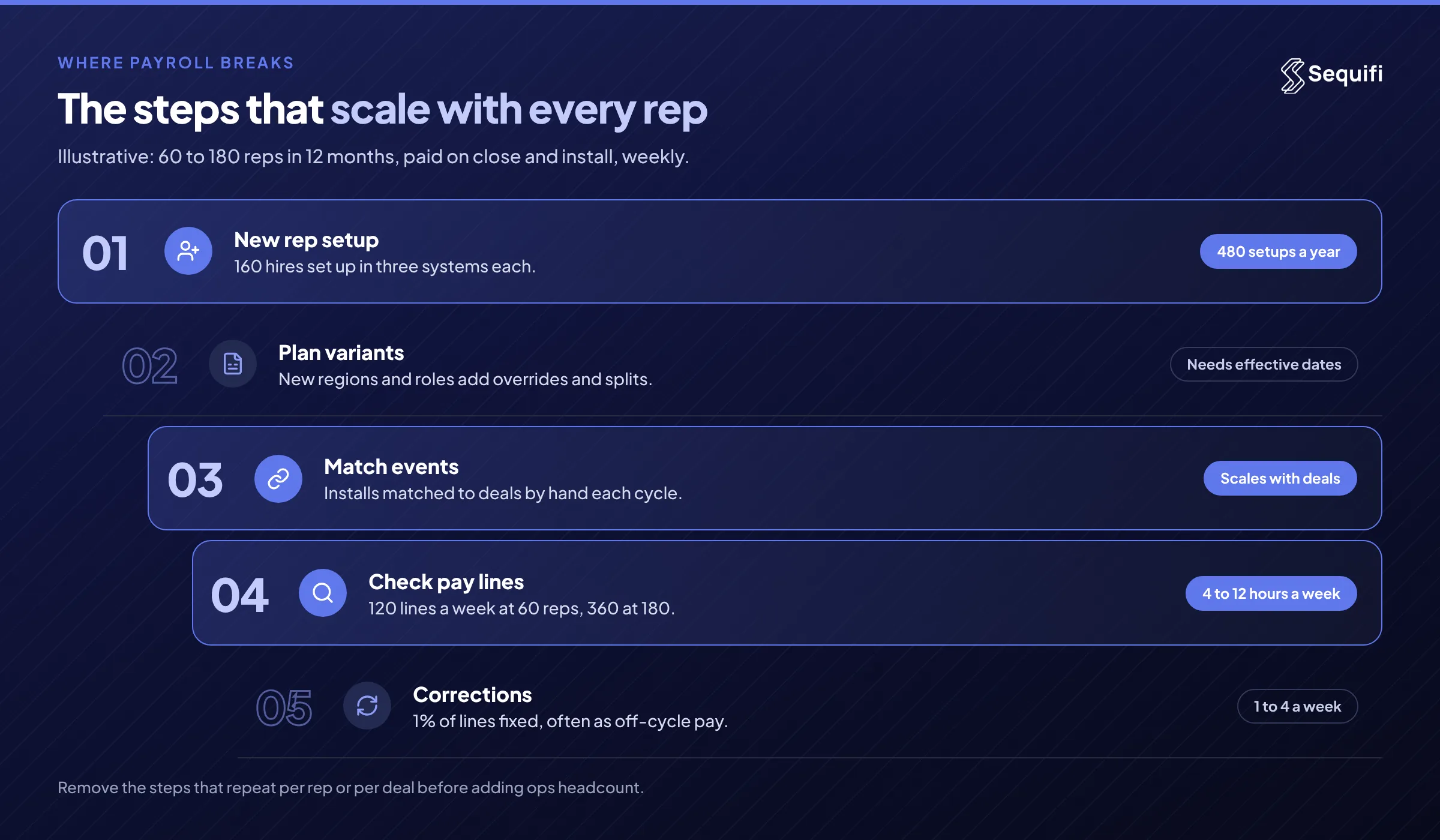
Worked example (illustrative). A sales org grows from 60 to 180 reps in 12 months. It hires about 160 people to net 120, because some reps leave. Reps earn on close and again on install, and pay runs weekly.
At 60 reps, with about two pay lines per rep per week, ops checks roughly 120 lines each Friday. At two minutes per line, that is 4 hours. At 180 reps it is 360 lines, or 12 hours, every week, before anyone answers a rep question. If 1% of lines need a correction, corrections go from about 1 a week to about 4, and many become off-cycle payments.
Onboarding scales the same way. Setting up 160 hires in three systems is 480 setups. At 20 minutes each, that is 160 hours a year of data entry. Setting each rep up once cuts that to about 53 hours, and removes the most common cause of a wrong first check.
The lesson: do not add headcount to ops at the same rate you add reps. Remove the steps that scale with reps.
What breaks at scale
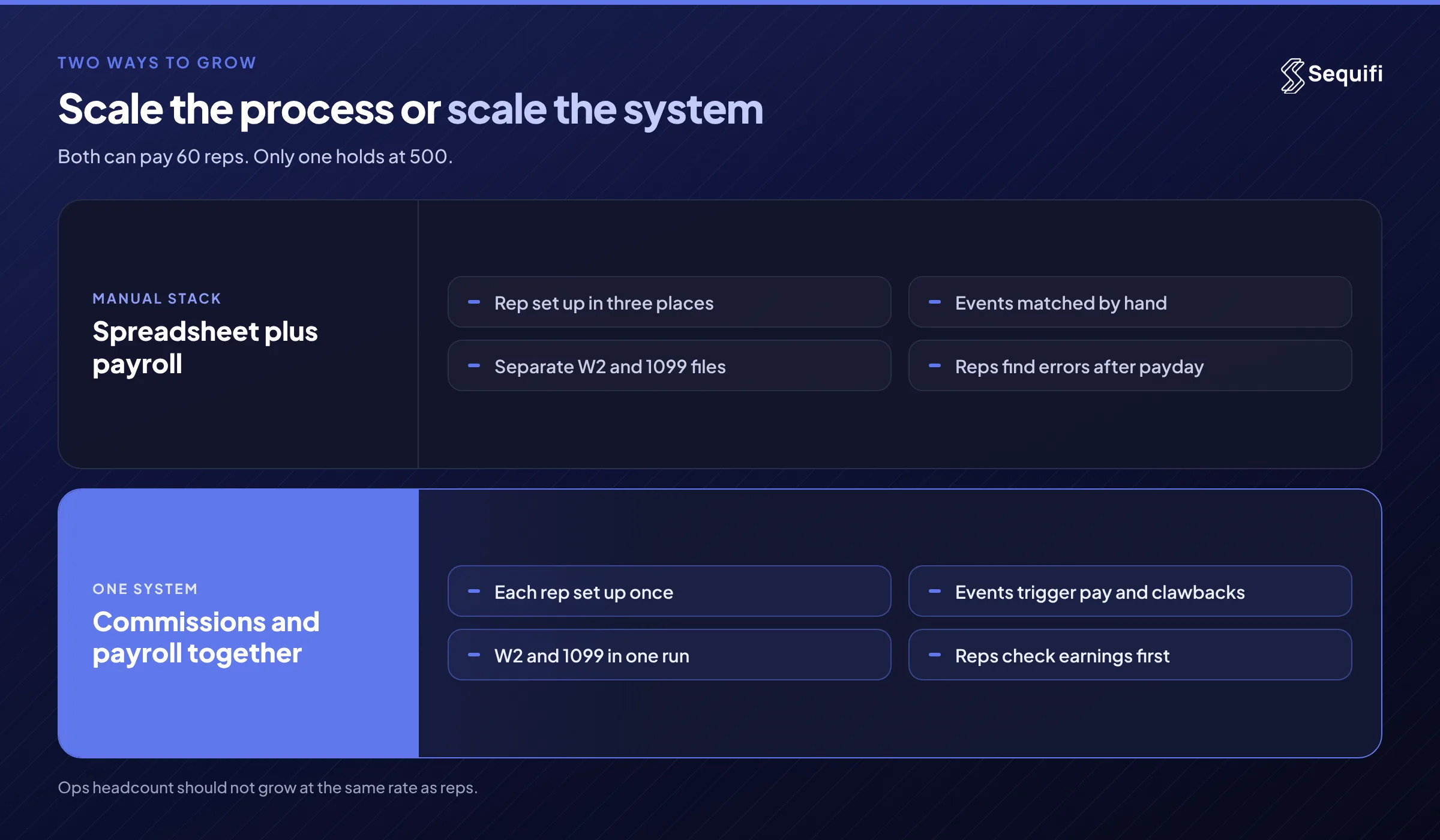
At 50 reps, a spreadsheet and a payroll provider hold together. One ops lead knows every plan, catches most errors by eye, and fixes the rest with a quick off-cycle check. The cost is hidden in that person's week.
At 200 reps, the hidden cost shows up. Plan variants multiply by region and role. Clawbacks cross pay periods and get missed. New reps sell before their plans are loaded. Close takes two or three days instead of one, and rep questions pile up in Slack. This is where the root causes of payroll errors in commission-based teams stop being occasional and start being weekly.
At 500 reps, across several states and worker types, the manual model fails outright. Every plan change has to be mirrored in multiple systems. Corrections outnumber what the team can review. Top reps leave for companies that pay accurately and faster, and recruiting slows because word travels.
How Sequifi solves this
Sequifi is built for any high-velocity sales org with multi-trigger comp plans, including solar, fiber, pest control, mortgage, insurance, and home services. Three capabilities do the most to keep payroll intact as you grow:
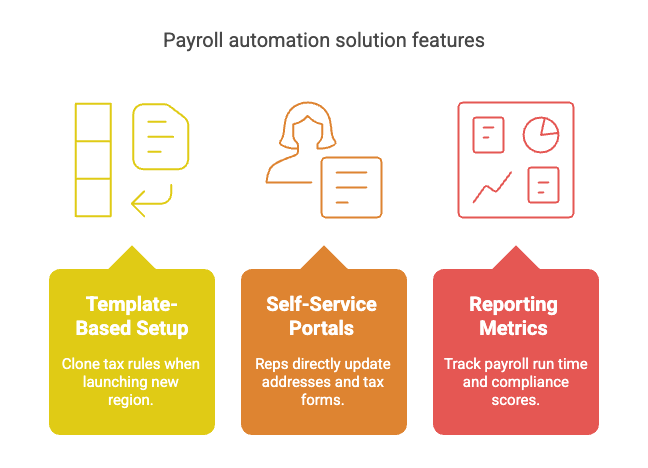
- Commission engine and payroll in one system. Approved commissions become payroll lines without an export, and W-2 and 1099 reps are paid in the same run.
- Multi-trigger pay and rapid onboarding. Closes, installs, activations, clawbacks, and overrides are handled as rules, and each new rep is set up once, even when you add hundreds a month.
- Rep-facing pay transparency. Reps see every trigger, adjustment, and payout in a dashboard that matches their paycheck, so questions drop as headcount rises.
Frequently asked questions
At what team size does commission payroll usually start to break?
There is no fixed number. It usually shows up when plan variants, clawbacks across periods, and monthly hiring outgrow what one person can check by hand, and close starts taking days instead of hours. The trigger is complexity as much as headcount. A 60-rep team with three pay triggers and mixed W-2 and 1099 reps can hit the wall before a 200-rep team on a flat plan.
Should we hire more payroll staff as the sales team grows?
Hire for judgment, not for data entry. If your ops team grows at the same rate as your sales team, the process is doing the scaling instead of the system. Before adding headcount, count the steps that repeat per rep or per deal: setups, exports, matching events, and corrections. Automating those usually does more than another analyst, and it keeps close times flat as you grow.
How do we change comp plans mid-year without causing payroll errors?
Give every plan change an effective date and apply it only to deals that close on or after that date. Keep the old version active for deals still waiting on installs, activations, or clawback windows. Tell reps what changed in writing before it takes effect. Then run one cycle in parallel and compare totals. Most mid-year errors come from rules that silently apply to deals they should not touch.
How do we pay W-2 and 1099 reps together without mistakes?
Use one source of approved commission numbers for both groups, then apply the right tax treatment by worker type in the same pay run. Errors grow when W-2 and 1099 reps are paid from separate exports, because adjustments land in one file and not the other. Confirm each rep's classification at onboarding, and store it with their plan so it cannot drift between systems.
Does faster pay make payroll harder to scale?
Only if pay depends on batch exports. When commissions and payroll share one system, paying on a qualifying event is a rule, not an extra run. Teams that try faster pay on a spreadsheet stack usually see errors rise, because each extra cycle repeats every manual step. See how companies pay reps faster for the approaches that hold up at volume.
Conclusion
Scaling a sales team does not have to mean scaling payroll pain. The teams that grow cleanly remove the steps that multiply with every hire: duplicate setups, manual exports, and event matching by hand. Start this week with a simple audit. List every step between a closed deal and a rep's paycheck, and mark each one that repeats per rep or per deal. Those are the steps that will break first. To see how one system handles commissions and payroll together, book a demo with Sequifi.
See Sequifi run your kind of pay.
Commissions, payroll and HR in one platform, built for teams where every paycheck is different.
Book a demo