How do sales overrides work for managers in multi-level teams?
A sales override pays managers a set amount or percentage on team deals. See how override chains, clawbacks, and promotions work, and where Sequifi fits.
Direct Answer
A sales override is pay a manager earns on deals closed by the reps below them. It is usually a flat amount per deal or a percentage of revenue, paid on top of the rep's commission. In multi-level teams, overrides stack up a chain: a team lead earns on direct reps, a regional manager earns on every team in the region. Each level needs clear rules, effective dates, and clawbacks so managers are paid on the right deals.
Breakdown
- Override basis: a flat amount per deal, a percentage of contract value, or a percentage of the rep's commission.
- Hierarchy: who reports to whom, by level, with start and end dates for every reporting line.
- Scope: direct team only, or every rep below the manager, sometimes with different rates by depth.
- Pay trigger: overrides usually pay on the same event as the rep, such as a close, install, activation, or funded loan.
- Clawbacks: when a deal cancels, the rep's pay and every override on that deal reverse together.
- Compression rules: what happens to an override when a level in the chain is empty.
Deep Dive
Overrides exist for a simple reason. You want managers to build teams that sell, not to compete with their own reps for deals. Paying a manager on their team's production rewards recruiting, coaching, and retention. It shows up across high-velocity sales: solar and fiber offices, pest control and home services teams, insurance agencies with agency managers, and mortgage branches where branch managers earn on loan officer volume. Our guide to how mortgage branches split commissions between loan officers and branch managers covers one version in detail.
The basis decides what managers chase. A flat amount per deal is easy to explain and rewards volume. A percentage of contract value rewards bigger deals. A percentage of the rep's commission keeps the manager aligned with the rep's plan, but it means every rep plan change also changes the manager's pay. Pick one per level and write it down.
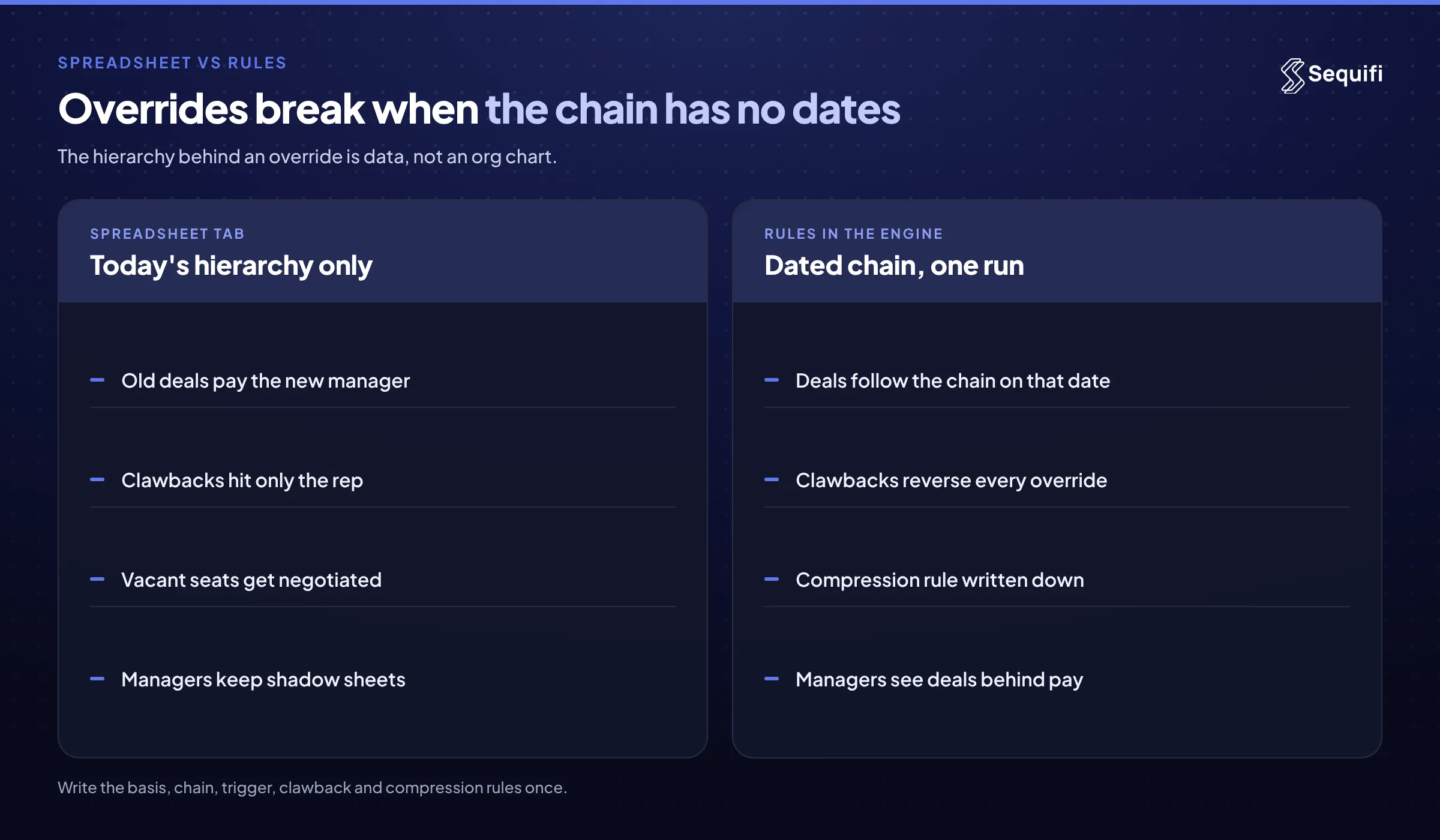
The hierarchy is data, not an org chart. An override is only as accurate as the reporting line behind it. Every rep needs a manager on a given date, and every manager needs a manager above them. When a rep moves teams on the 15th, deals before the 15th belong to the old chain and deals after belong to the new one. Teams that store the hierarchy without effective dates end up paying the current manager for deals the old manager built.
Overrides must follow the same events as rep pay. If a rep is paid on install, the override should pay on install too. If the rep's commission is clawed back, every override on that deal should reverse with it. See how companies handle commission clawbacks for how to write that rule, using mortgage as the example.
Legitimate overrides are tied to real sales. Override pay should come from deals closed with real customers, not from recruiting people into the team. The FTC's business guidance on multi-level marketing draws this line clearly. Classification matters too: a 1099 manager earning overrides is still subject to IRS rules on employees versus independent contractors. This is general information, not legal advice; review your plan with counsel.
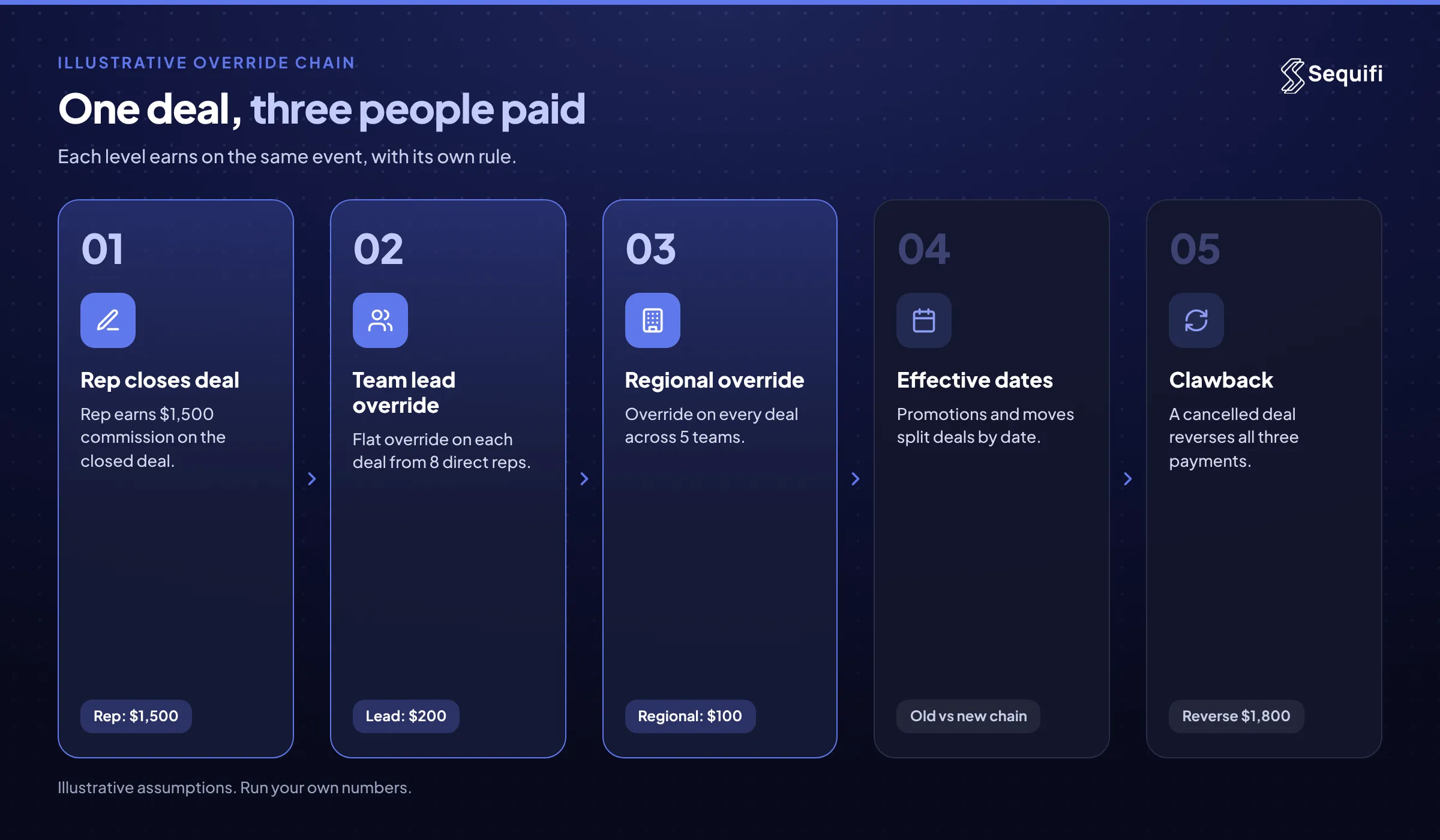
Worked example (illustrative). Take a three-level chain:
- Rep: earns $1,500 per closed deal.
- Team lead: earns a $200 override on each deal closed by their 8 direct reps.
- Regional manager: earns a $100 override on every deal in a region of 5 teams.
If each rep closes 4 deals a month, a team closes 32 deals. The team lead earns $6,400 in overrides. The region closes 160 deals, so the regional manager earns $16,000. Each deal carries $1,800 in total pay: $1,500 to the rep and $300 in overrides.
Now one deal cancels after everyone was paid. The correct clawback is $1,800 across three people, not $1,500 from the rep alone. Then a rep is promoted to team lead mid-month. Deals they closed before the promotion pay them as a rep and pay their old lead an override. Deals their new team closes after the promotion pay them the override. Then a team lead quits and the seat sits empty for six weeks. Does the $200 roll up to the regional manager, or does the company keep it? That is a compression rule, and it needs to be in the plan before it happens. These numbers are assumptions; run your own.
Override design is part of plan design. For the broader view, see how to set up a commission structure for a sales team and how to manage complex commission structures.
What Breaks at Scale
At 50 reps, overrides live in a spreadsheet tab. One ops lead knows who reports to whom and fixes mistakes by hand. It works because there are only a few managers and the chain rarely changes.
At 200 reps, the chain changes every week. Reps move teams, get promoted, and leave. The spreadsheet holds today's hierarchy, not last month's, so overrides on older deals go to the wrong manager. Clawbacks hit the rep but not the managers above them. Managers start keeping their own shadow sheets to check their pay, and disputes grow every pay run.
At 500 reps across several offices and states, the problem compounds. Some managers are W2 and some are 1099. Different regions run different override rates. Vacant seats raise compression questions nobody wrote down. Every promotion requires someone to rebuild the chain by hand, and every mistake is paid to people who manage others, so trust breaks at the top of the team first.
How Sequifi Solves This
Sequifi is built for any high-velocity sales org with multi-trigger comp plans, including solar, fiber, pest control, insurance, mortgage, and home services teams.
- Overrides inside the commission engine. Sequifi handles multi-trigger structures, including overrides, clawbacks, and ramps, so a cancellation reverses the rep's pay and every override on the deal by rule.
- Unified W2 and 1099 payroll. Commissions and overrides are paid in the same run, whether a manager is W2 or 1099, with no export between systems.
- Pay transparency for managers. Performance dashboards show each manager the deals behind their override, from the same numbers payroll uses.
Frequently Asked Questions
What is a typical sales override for a manager?
There is no single standard. Overrides are usually a flat dollar amount per deal or a small percentage of contract value or of the rep's commission, set so the manager earns more from a healthy team than from selling alone. The right amount depends on your margins, team size, and how much coaching you expect. Model it against a full team at average production before you commit.
Do overrides reduce the rep's commission?
They should not. In most plans, the override is paid by the company on top of the rep's commission, not taken from it. If a plan funds overrides by cutting rep pay, reps will notice, and trust drops fast. Make the source of override pay clear in the written plan and show reps their full commission on every deal.
What happens to overrides when a deal is clawed back?
Every override on that deal should reverse along with the rep's commission. If a rep's $1,500 is clawed back but the managers keep their overrides, the company pays for a deal it never kept. Write the rule into the plan, apply it automatically, and show managers the reversal next to the original deal so they understand the change.
How do promotions affect override pay?
Promotions need effective dates. Deals closed before the promotion pay under the old role and old reporting line. Deals closed after pay under the new ones. Without effective dates, the newly promoted manager may earn overrides on deals built under someone else, or lose pay on their own sales. Record the date in your hierarchy, not just the new title.
What is override compression?
Compression is the rule for an empty level in the chain. If a team lead seat is vacant, the override for that level can roll up to the next manager, be paid to someone covering the team, or not be paid at all. Any choice can work. What fails is having no rule, so each vacancy turns into a negotiation.
Conclusion
Sales overrides pay managers for building teams that sell. They work when the basis, hierarchy, pay trigger, clawback rule, and compression rule are written down and applied the same way every pay run. They break when the chain lives in a spreadsheet without effective dates. As a next step, take one cancelled deal from last quarter and trace every dollar paid on it, rep and managers alike. If any override was not reversed, fix the rule before your next promotion cycle. To see how commissions, overrides, and payroll run together, visit Sequifi.
See Sequifi run your kind of pay.
Commissions, payroll and HR in one platform, built for teams where every paycheck is different.
Book a demo