How do you run a year-end commission audit and reconciliation?
A year-end commission audit recalculates each rep's pay from deal data and ties it to payroll before W2s and 1099s go out. See the steps and how Sequifi fits.
Direct Answer
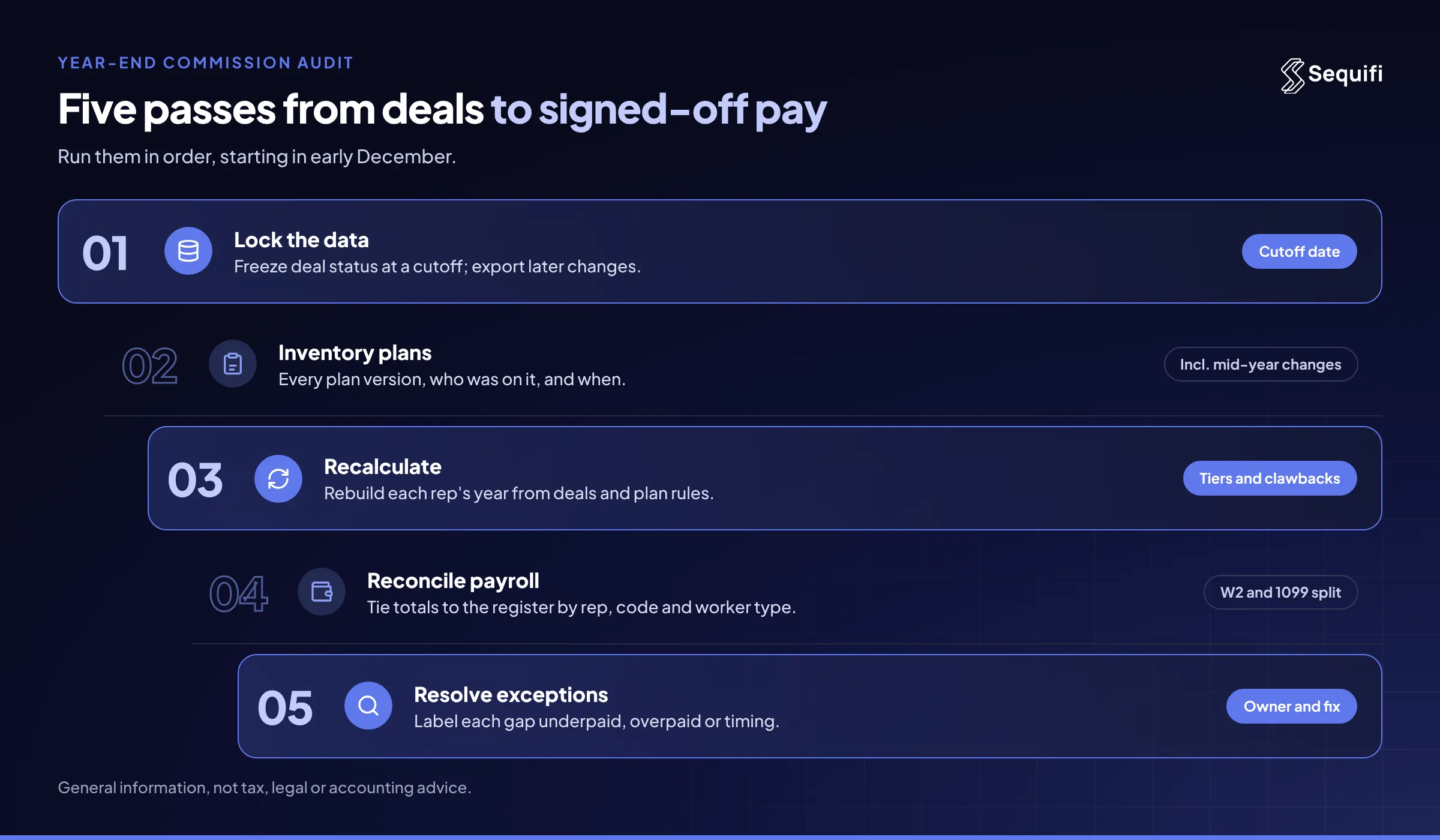
A year-end commission audit recalculates what every rep earned for the year from source deal data, then compares it to what payroll actually paid. Run it in five passes: lock the data, inventory the plans, recalculate, reconcile to payroll, and resolve exceptions. Finish before W2s and 1099-NECs go out on January 31. The result is one signed-off number per rep that matches deals, plans, payroll and tax forms.
Breakdown
- Data cutoff: a fixed date after which deal status changes count toward next year.
- Plan inventory: every comp plan version in effect, with effective dates and mid-year changes.
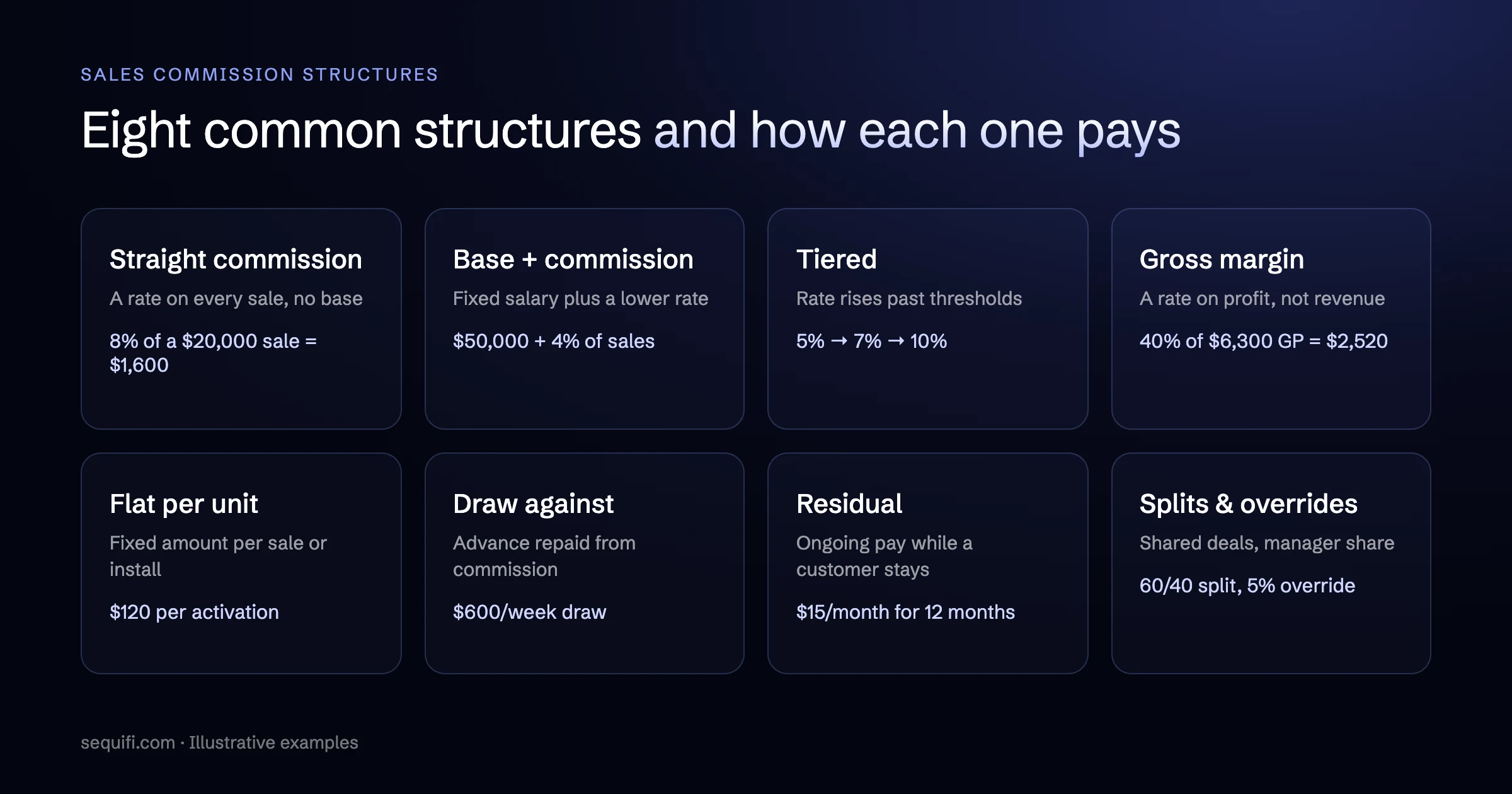
- Recalculation: each rep's year rebuilt from deals and plan rules, including tiers, clawbacks and overrides.
- Payroll reconciliation: commission totals tied to the payroll register by rep, earnings code and worker type.
- Exception log: every difference labeled as underpaid, overpaid or timing, with an owner and a fix.
- Tax and accrual tie-out: W2 and 1099 totals match payroll, and finance has accrued earned but unpaid commission.
Deep Dive
Most commission-heavy teams keep four versions of the truth: the CRM, the commission calculation, the payroll register and the general ledger. During the year, small gaps between them get patched with one-off adjustments. At year end, tax forms freeze the payroll version. A mistake you catch in December is a line on the next payroll. A mistake you catch in March can mean a corrected W2 and a harder conversation with the rep.
Pass 1: Lock the data. Pick a cutoff date and freeze deal status as of that date. Export every deal that changed status after the cutoff, such as a cancellation, a delayed install or a late activation, so you can see what moves into next year.
Pass 2: Inventory the plans. List every plan version that applied during the year, who was on it and when. Include ramped quotas for new hires, manager overrides, regional rate cards and any mid-year plan change. Most audit surprises trace back to a rep paid on the wrong plan version for a few weeks.
Pass 3: Recalculate. Rebuild each rep's year from deal data and plan rules, not from last year's statements. This is where quarterly tier true-ups that never ran show up, along with clawbacks taken twice or not at all. Check that cancellations adjusted attainment the way the plan says. Our posts on how commission accelerators and tiers work and handling commission clawbacks cover the rules to check against.
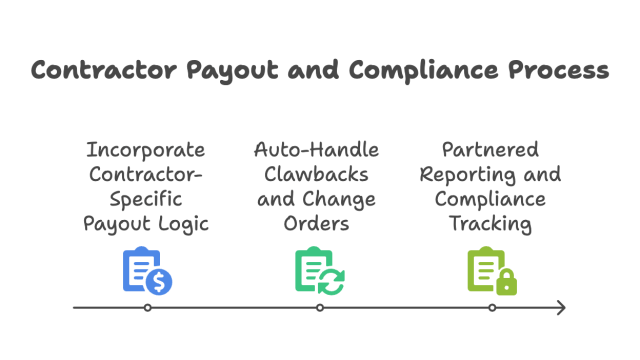
Pass 4: Reconcile to payroll. Compare recalculated commission to the payroll register for each rep, by earnings code. Split W2 employees from 1099 contractors, because they land on different forms. W2 commission is supplemental wages; IRS Publication 15 (Circular E) explains the withholding rules. Contractor commission goes on Form 1099-NEC, and both forms are due to workers by January 31. If you run mixed teams, see how companies manage W2 and 1099 reps together.
Pass 5: Resolve exceptions. Label every difference. Underpayments go on the next payroll with a clear note on the rep's statement. Overpayments need care: follow your signed plan and your state's wage deduction rules before recovering anything from a W2 employee, and get counsel if you are unsure. Timing differences are not errors, but they need a record so nobody "fixes" them twice.
Timing and accruals. Commission earned on December deals but paid in January is reported as wages in the year it is paid, so it lands on next year's W2. Finance still needs to accrue it as this year's expense. Companies that follow FASB standards may also capitalize some commission costs under ASC 340-40, which means the audit feeds the close, not just payroll. This is general information, not tax, legal or accounting advice.
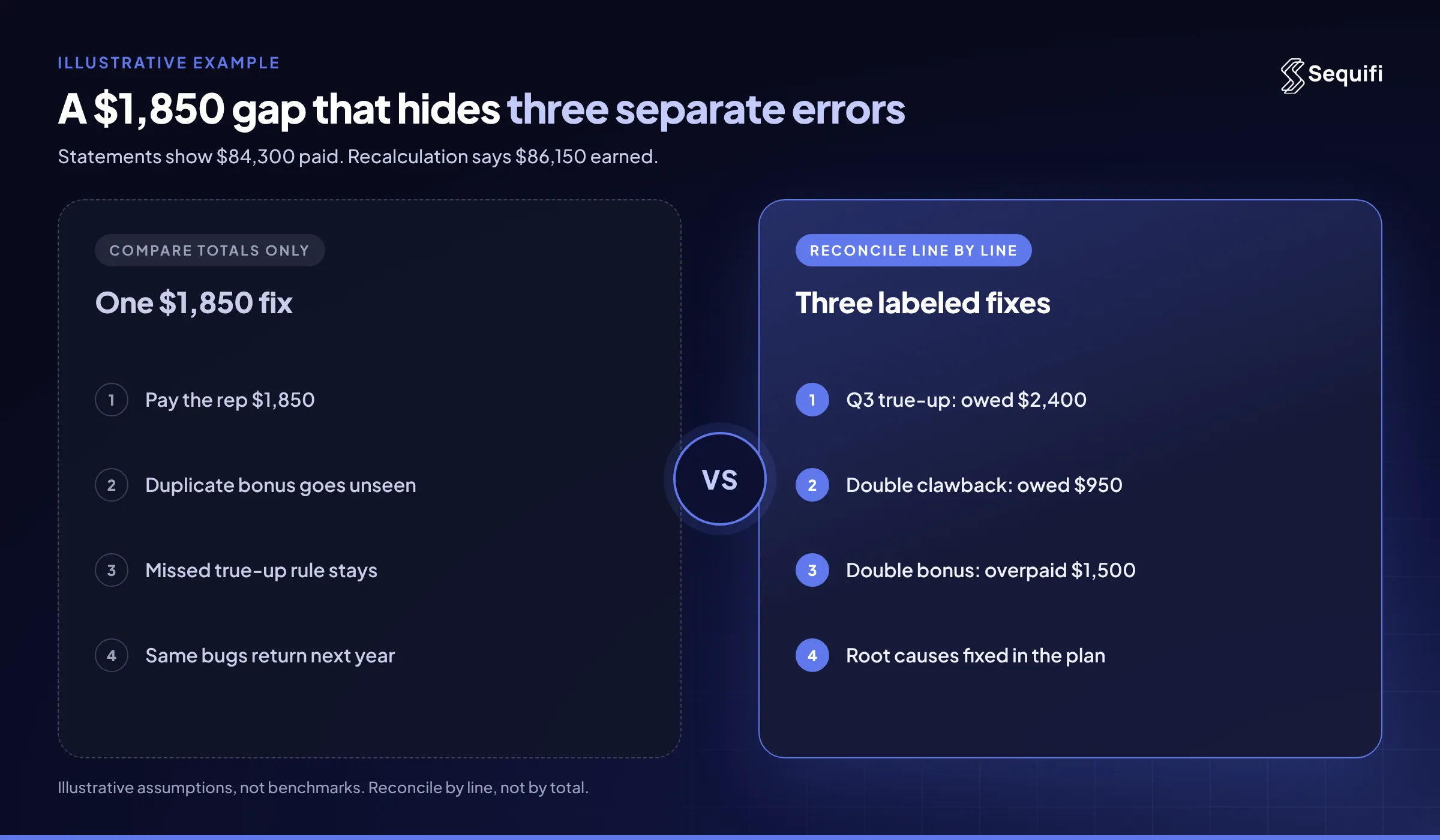
Worked example (illustrative). These numbers are assumptions, not benchmarks. A rep's statements show $84,300 paid for the year. The recalculation says the rep earned $86,150. The $1,850 gap breaks down three ways:
- Q3 tier true-up never ran: rep owed $2,400
- One clawback taken twice: rep owed $950
- One bonus paid twice: rep overpaid $1,500
- Net: rep underpaid $1,850
The net number looks small, but it hides three separate errors. If you only compared totals, you would miss the duplicate bonus, and next year's plan would carry the same bug. Separately, the rep earned $6,200 on December deals that pay on January 9. That amount belongs in this year's expense accrual and on next year's W2.
Disputes usually spike right after year-end statements go out. A clean audit is the cheapest way to eliminate commission disputes before they start.
What Breaks at Scale
At 50 reps, one ops lead can rebuild the year in a spreadsheet over a few long days. Errors exist, but each one is easy to trace to a deal.
At 200 reps, the plan inventory alone takes days. New hires joined on ramped quotas, managers earned overrides on team attainment, and a few reps switched between W2 and 1099 status mid-year. The recalculation no longer fits in one workbook, so it gets split across people, and each person makes different assumptions about cancellations and cutoffs.
At 500 reps, the audit collides with the tax deadline. Payroll needs final numbers to issue W2s and 1099-NECs, but commission is still reconciling thousands of status changes. Teams either delay the forms or file and correct later. Each adjustment made by hand during the year becomes an exception with no source record. This is how payroll errors in commission-based teams compound: the audit inherits every shortcut taken in the previous twelve months.
How Sequifi Solves This
Sequifi is built for any high-velocity sales org with multi-trigger comp plans, including solar, fiber, pest control, mortgage, insurance and inside-sales teams.
- Commissions and payroll in one system. The commission record and the payroll record are the same record, so Pass 4 becomes a check, not a rebuild.
- Multi-trigger commission engine. Tier true-ups, clawbacks and overrides run as rules, so a canceled deal adjusts pay automatically and leaves a trail.
- Unified W2 and 1099 payroll with rep-facing transparency. Both worker types are paid from one system, and reps review their statements all year, so disputes surface in the month they happen, not in January.
Frequently Asked Questions
When should you start a year-end commission audit?
Start in early December. Lock the plan inventory and run a first recalculation on data through November, then rerun only December after your cutoff. That leaves time to put underpayments on the final payroll of the year or the first one in January, before W2s and 1099-NECs are due on January 31. Teams that start in January usually end up issuing corrected forms.
How long should you keep commission records?
Keep the deal data, plan documents, statements and reconciliation workpapers together. The Department of Labor requires most payroll records to be kept for at least three years, and the IRS asks employers to keep employment tax records for at least four years. Many finance teams keep commission audit files longer. Check with your accountant or counsel for the rules that apply to you.
What should you do if the audit finds an overpayment?
First confirm it with the source deal data and the signed plan. Then follow the plan's recovery terms and your state's wage deduction rules, which vary and can limit what you deduct from a W2 employee's pay. Tell the rep in writing, show the calculation, and agree on a schedule. This is general information, not legal advice.
Do commissions earned in December go on this year's W2?
Generally no. Wages are reported in the year they are paid, so commission earned on December deals and paid in January appears on next year's W2 or 1099. Finance should still accrue that commission as an expense in the year it was earned. The audit should list these amounts separately so they are not treated as errors.
Who should own the year-end commission audit?
Sales operations usually owns the recalculation, payroll owns the register and tax forms, and finance owns accruals and sign-off. Name one person as the overall owner with a deadline. Without a single owner, each team assumes another one checked the gap between commission and payroll, and that gap is where most errors live.
Conclusion
A year-end commission audit is five passes: lock the data, inventory the plans, recalculate, reconcile to payroll, and resolve exceptions. The work is easiest when commission and payroll already share one record and reps have reviewed their statements all year. As a next step, pick five reps this week, including one with a mid-year plan change and one with a clawback, and run them through all five passes by hand. Where the numbers do not tie, you have found your audit plan. To see commissions and payroll reconciled in one system, visit Sequifi.
See Sequifi run your kind of pay.
Commissions, payroll and HR in one platform, built for teams where every paycheck is different.
Book a demo