What systems do top D2D companies rely on?
Top D2D companies run six connected systems: recruiting, a field app, deal tracking, commissions, W2 and 1099 payroll, and pay visibility. See how Sequifi fits.
Direct Answer
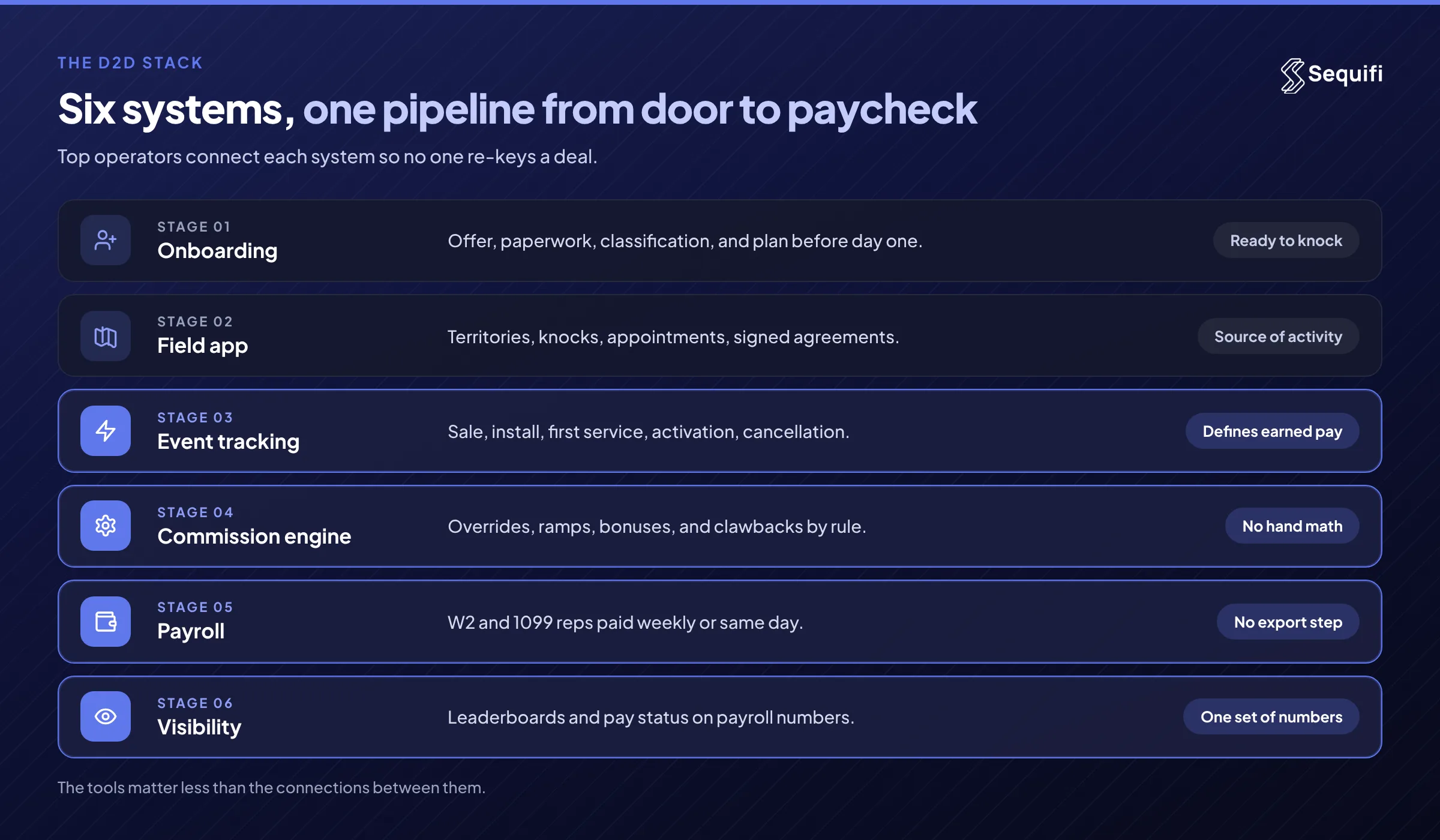
Top door-to-door companies rely on six connected systems: a recruiting and onboarding pipeline, a field sales app, a deal tracker that records every pay event, a commission engine, payroll for W2 and 1099 reps, and rep-facing pay and performance dashboards. The tools matter less than the connections. The best D2D operators run them as one pipeline, so a signed door becomes an accurate, explained paycheck without anyone re-keying it.
Breakdown
- Recruiting and onboarding: offer, paperwork, classification, and plan assignment before a rep's first door.
- Field sales app: territories, knocks, appointments, and signed agreements captured on a phone.
- Deal and event tracking: every pay trigger (sale, install, first service, activation, cancellation) with a date and a source.
- Commission engine: multi-trigger plans, overrides, ramps, and clawbacks calculated by rule.
- Payroll: W2 and 1099 reps paid on time, often weekly or same day.
- Pay and performance visibility: leaderboards and deal-level pay status built on the numbers payroll uses.
Deep Dive
Door-to-door sales runs on volume, speed, and trust. Teams hire in waves, often right before a summer season, and reps decide whether to stay based on how fast and how clearly they get paid. That puts unusual pressure on the systems behind the doors.
Recruiting and onboarding come first. Top D2D companies treat onboarding as a system, not a stack of PDFs. A recruit accepts an offer, signs paperwork, gets classified, and is assigned a comp plan and override chain before they knock a door. Classification matters. Whether a rep is W2 or 1099 follows IRS guidance on employees versus independent contractors, and some employed reps who sell away from the office may fall under the Department of Labor's outside sales exemption. Review both with counsel for each role; this is general information, not legal advice. Our guide to door-to-door sales recruiting covers the hiring side.
The field app is the source of sales activity. Reps need maps, territory assignments, lead status, and a way to capture a signed agreement on a phone. Managers use the same data to see knocks, appointments, and closes by rep and by office. Fiber teams lean heavily on territory and address data; see what software fiber D2D teams use.
Deal tracking defines when pay is earned. This is where D2D differs from most sales. A signed agreement is rarely the last pay event. Solar pays on close and on install. Fiber pays on sale and on activation. Pest control often pays when the first service is completed. Every D2D company also handles cancellations. Under the FTC's Cooling-Off Rule, customers can cancel many in-home sales within three business days for a full refund. Top operators record each event with a date and a source system, so pay follows what actually happened.
The commission engine applies the rules. Multi-trigger plans, manager overrides, recruiting bonuses, ramps for new reps, and clawbacks for cancellations all need to be calculated by rule, not by hand. How pest control companies pay door-to-door reps is a good example: per-account pay, end-of-season bonuses, and cancellation holdbacks in one plan.
Payroll closes the loop. D2D teams often mix W2 managers with 1099 reps, pay weekly, and compete for talent on pay speed. When commissions and payroll live in separate systems, someone exports, edits, and imports a file every pay run. That handoff is where most pay errors start. We compare options in the best payroll software for D2D sales teams.
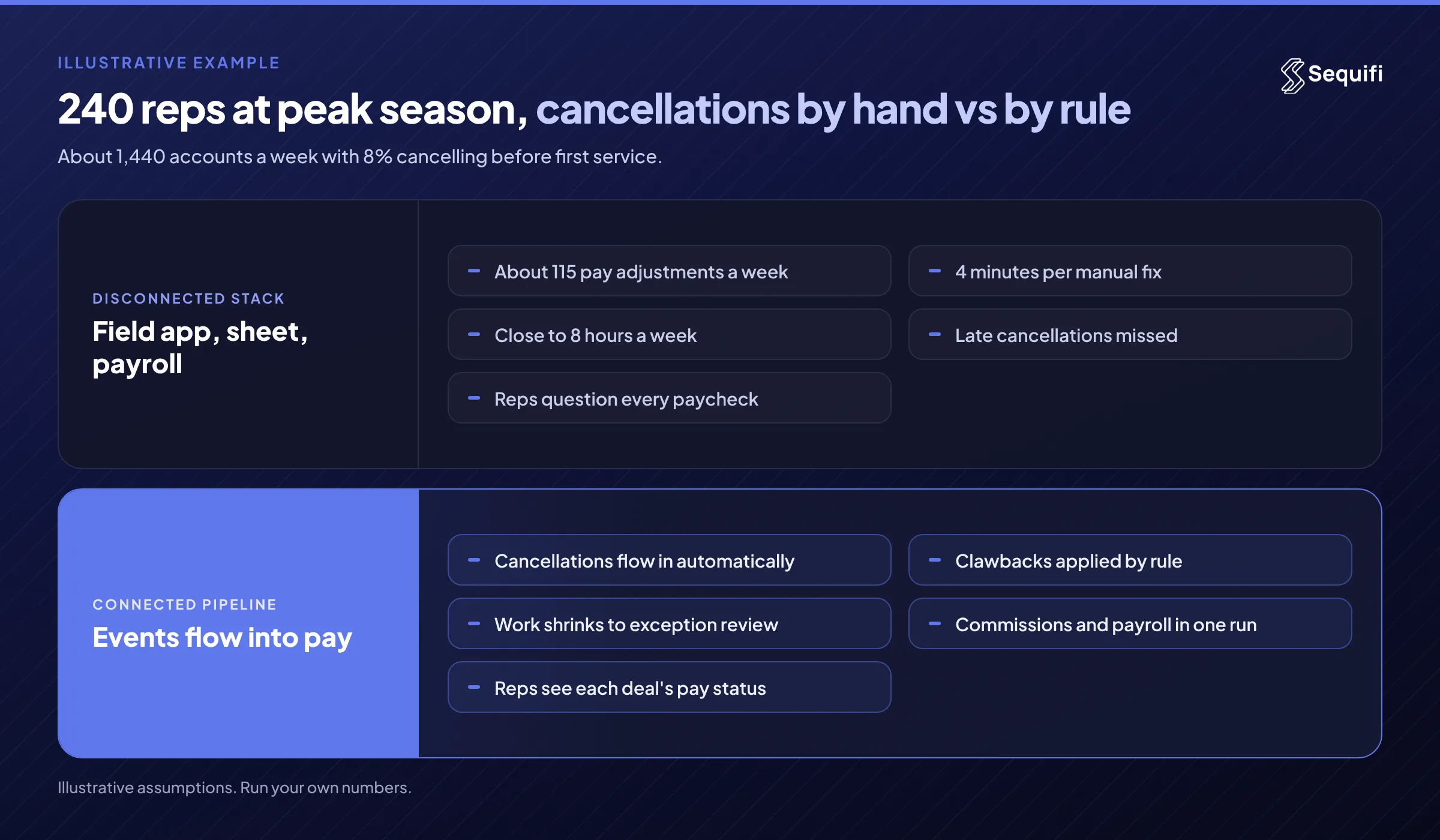
Worked example (illustrative). A pest control company starts its season with 60 reps and grows to 240 by June. Assume each rep averages 6 new accounts a week, so the company signs about 1,440 accounts a week at peak. Assume 8% cancel, either inside the three-day window or before first service. That is about 115 pay adjustments a week. If each manual adjustment takes 4 minutes to find, fix, and explain, that is close to 8 hours a week of cancellation work alone, before new-rep setup, override changes, or pay questions. When cancellations flow from the deal tracker into the commission engine automatically, that work shrinks to an exception review. These numbers are assumptions; run your own.
What Breaks at Scale
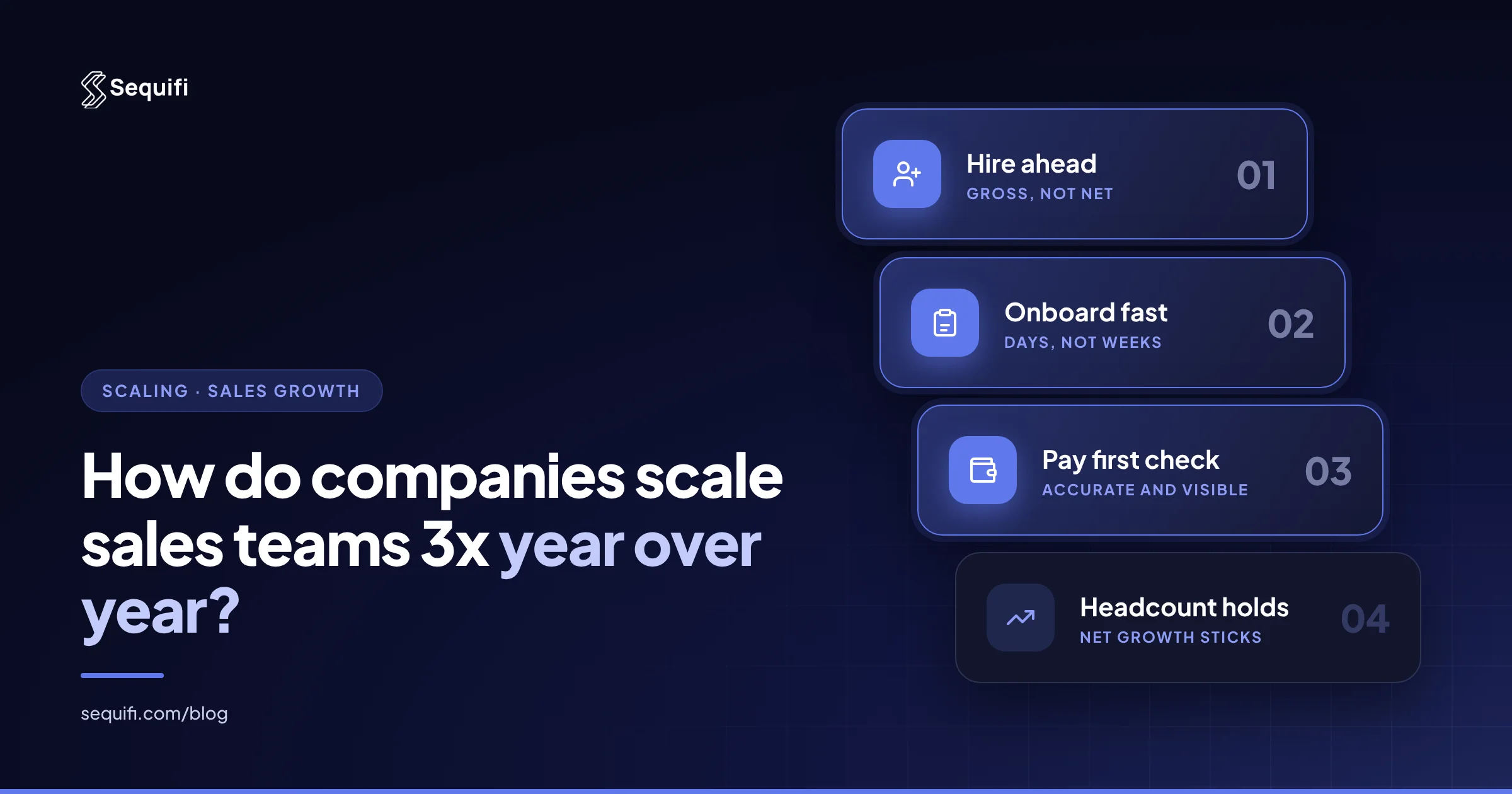
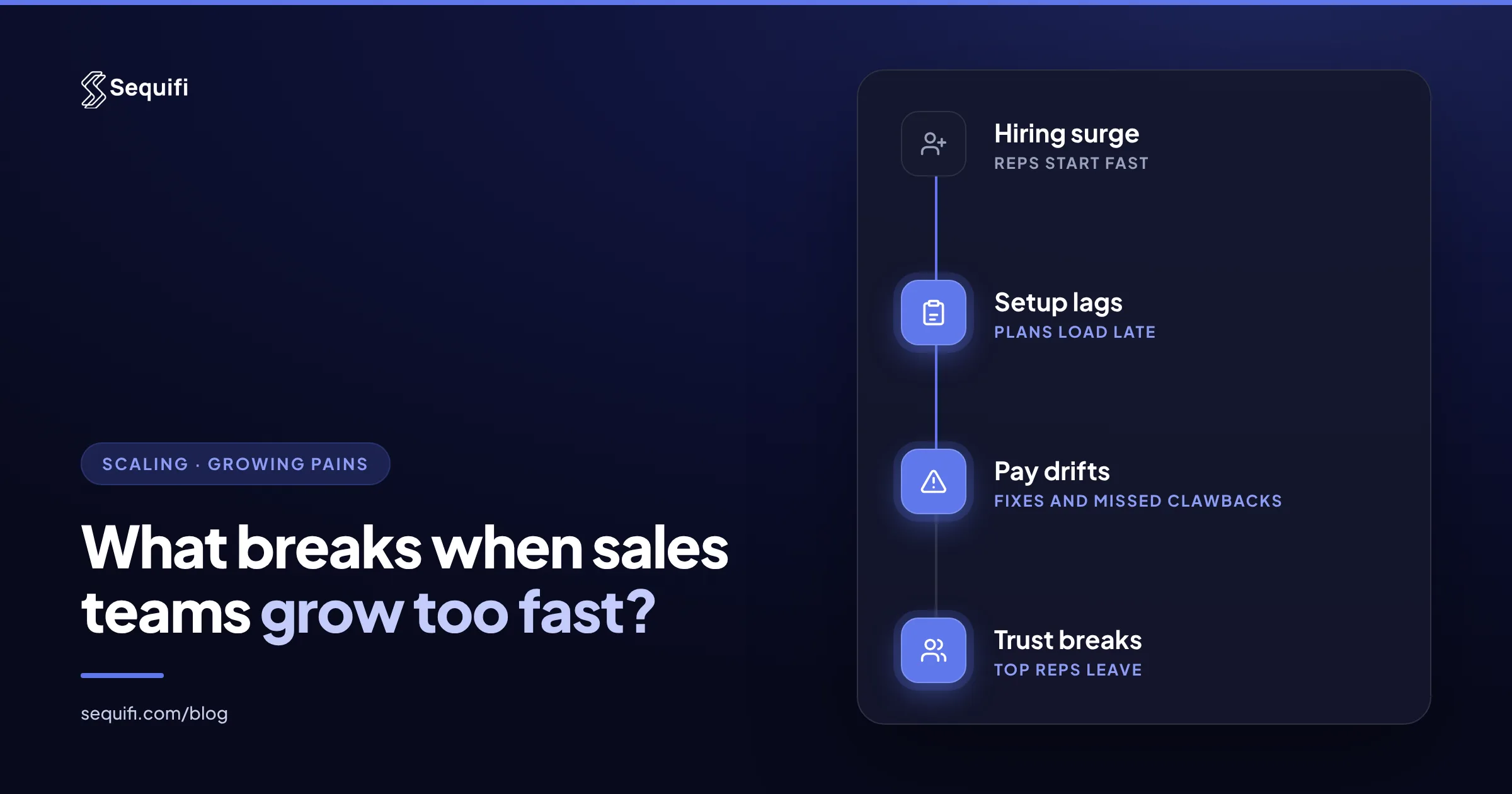
At 50 reps, one ops lead holds the systems together. They know every plan, load every rep, and fix a short paycheck with a text. It works because volume is low and memory is enough.
At 200 reps, usually mid-season, the gaps show up every week. Reps start knocking before their profiles and plans are complete. Cancellations arrive after the pay run and get missed. The commission sheet and payroll disagree, and payday slips while someone reconciles. Managers spend their evenings answering pay questions instead of coaching.
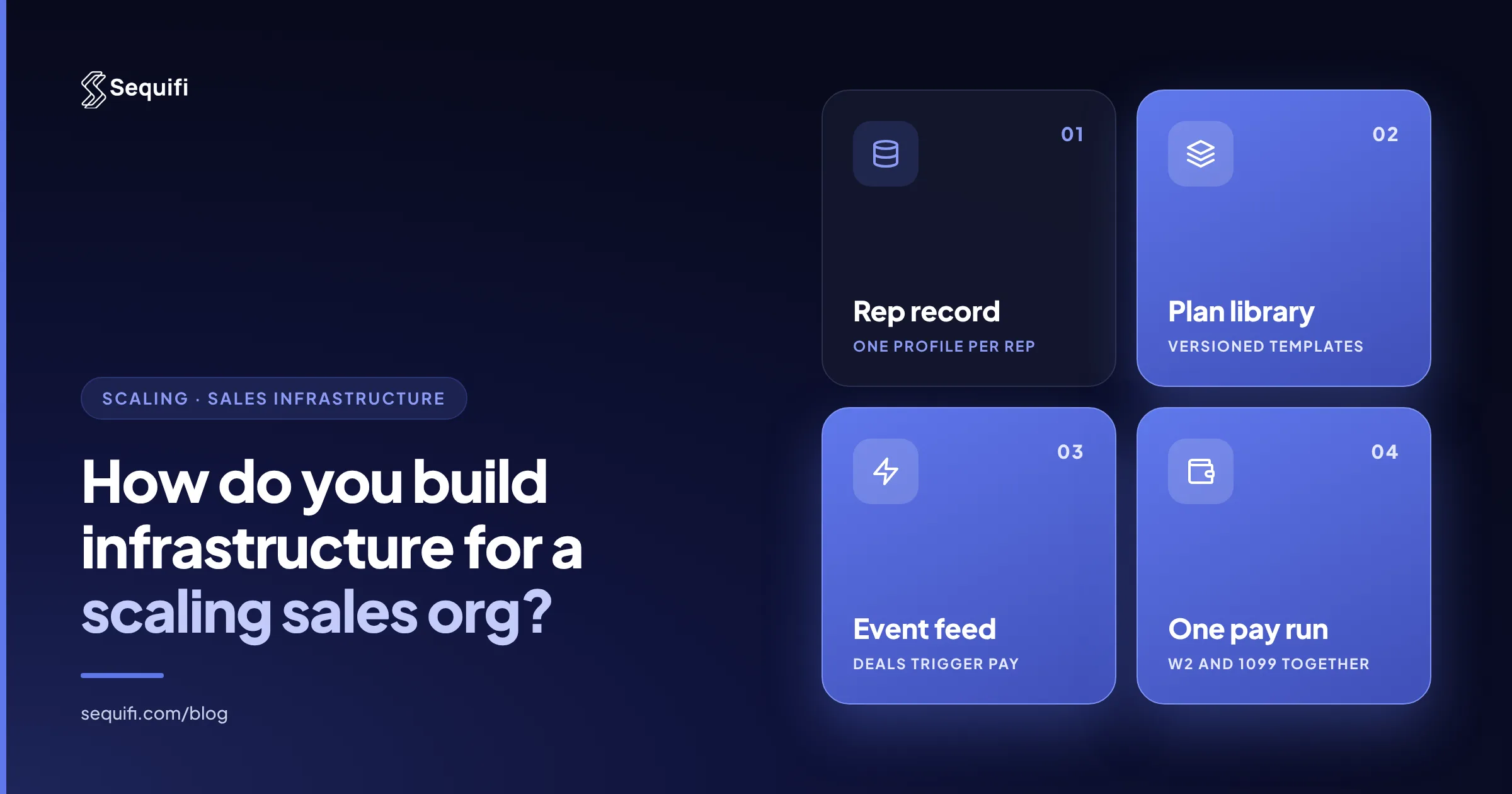
At 500 reps across several states and offices, small gaps compound. Override chains change with every promotion. Each state brings its own wage, tax, and classification questions. W2 and 1099 runs drift apart. Leaderboards no longer match paychecks, so top reps stop trusting both, and they are the first to leave for a competitor that pays faster. We cover the build order in how to build infrastructure for a scaling sales org.
How Sequifi Solves This
Sequifi is built for any high-velocity sales org with multi-trigger comp plans, including D2D teams in solar, fiber, pest control, and home services, as well as mortgage and insurance. It covers the pay half of the D2D stack in one system:
- One commission engine with unified W2 and 1099 payroll. Sales, installs, activations, overrides, ramps, and clawbacks are calculated and paid in one run, with no export between commissions and payroll.
- Same-day and on-demand pay. Reps can be paid when a qualifying event happens, instead of waiting for the next cycle.
- Rapid onboarding and pay transparency. Sequifi is built to onboard hundreds of reps a month, and reps see each deal and its pay status from the same numbers payroll uses.
Frequently Asked Questions
What is the most important system for a D2D company?
The one that connects deal events to pay. Recruiting fills the team and the field app captures sales, but reps judge the company by their paychecks. If installs, activations, and cancellations do not flow into commissions and payroll automatically, every other system produces numbers nobody trusts. Start by tracing one signed agreement to a paycheck and fixing every manual step along the way.
Do D2D companies need a separate CRM and commission system?
Most keep a field sales app or CRM for doors, leads, and territories, because that is where reps work all day. Commissions and payroll are a different job: they need plan rules, override chains, tax handling, and an audit trail. The common failure is not having two systems. It is moving data between them by hand. Connect them so deal events flow in without re-keying.
How do D2D companies handle cancellations in pay?
Top operators write the rule once and let the system apply it. A common approach is to hold pay until the cancellation window closes or the first service is completed, then claw back pay automatically if an account cancels within a set period after that. The key is that the rule is in the comp plan, visible to reps, and applied the same way to every account.
How fast should D2D reps be paid?
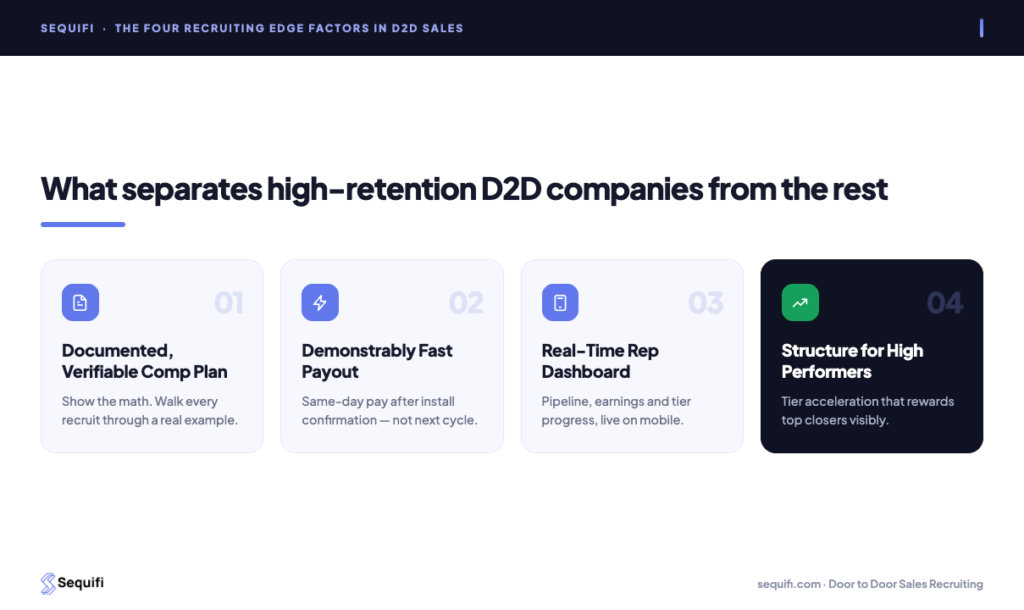
Weekly is a common baseline in D2D, and many operators now offer same-day or on-demand pay on qualifying events as a recruiting edge. Faster pay only helps if it is accurate. Paying quickly on the wrong numbers creates more clawbacks and more disputes. Get the event data and the commission rules right first, then shorten the pay cycle.
When should a D2D company replace spreadsheets?
When one person can no longer hold every plan, override, and exception in their head, or when you add a second pay trigger such as install, activation, or first service. Many teams hit that point between 50 and 100 reps, often right before a season. Replacing spreadsheets before a hiring wave costs weeks. Replacing them mid-season, while paying hundreds of reps every week, costs months and trust.
Conclusion
Top D2D companies do not win on any single tool. They win by connecting six systems into one pipeline: recruiting and onboarding, a field sales app, deal and event tracking, a commission engine, W2 and 1099 payroll, and visibility reps trust. When those systems share one set of numbers, growth adds revenue instead of pay errors and attrition. As a next step, map one signed agreement from the door to the paycheck, note every manual handoff, and fix the ones that depend on one person before your next season. To see how commissions, payroll, and pay transparency run together, visit Sequifi.
See Sequifi run your kind of pay.
Commissions, payroll and HR in one platform, built for teams where every paycheck is different.
Book a demo