What breaks when sales teams grow too fast?
When sales teams grow too fast, pay breaks first: late plan setup, missed clawbacks, slipping paydays. See the failure order and how Sequifi prevents it.
Direct Answer
When sales teams grow too fast, pay breaks first. Comp plans get loaded late, so new reps get wrong first checks. Commission and payroll numbers drift apart, clawbacks get missed, and payday slips while ops reconciles. Then trust breaks: reps stop believing their statements, managers spend their week on pay questions, and good reps leave. Hiring outruns the systems that onboard, track, and pay people, and attrition quietly erases the growth.
Breakdown
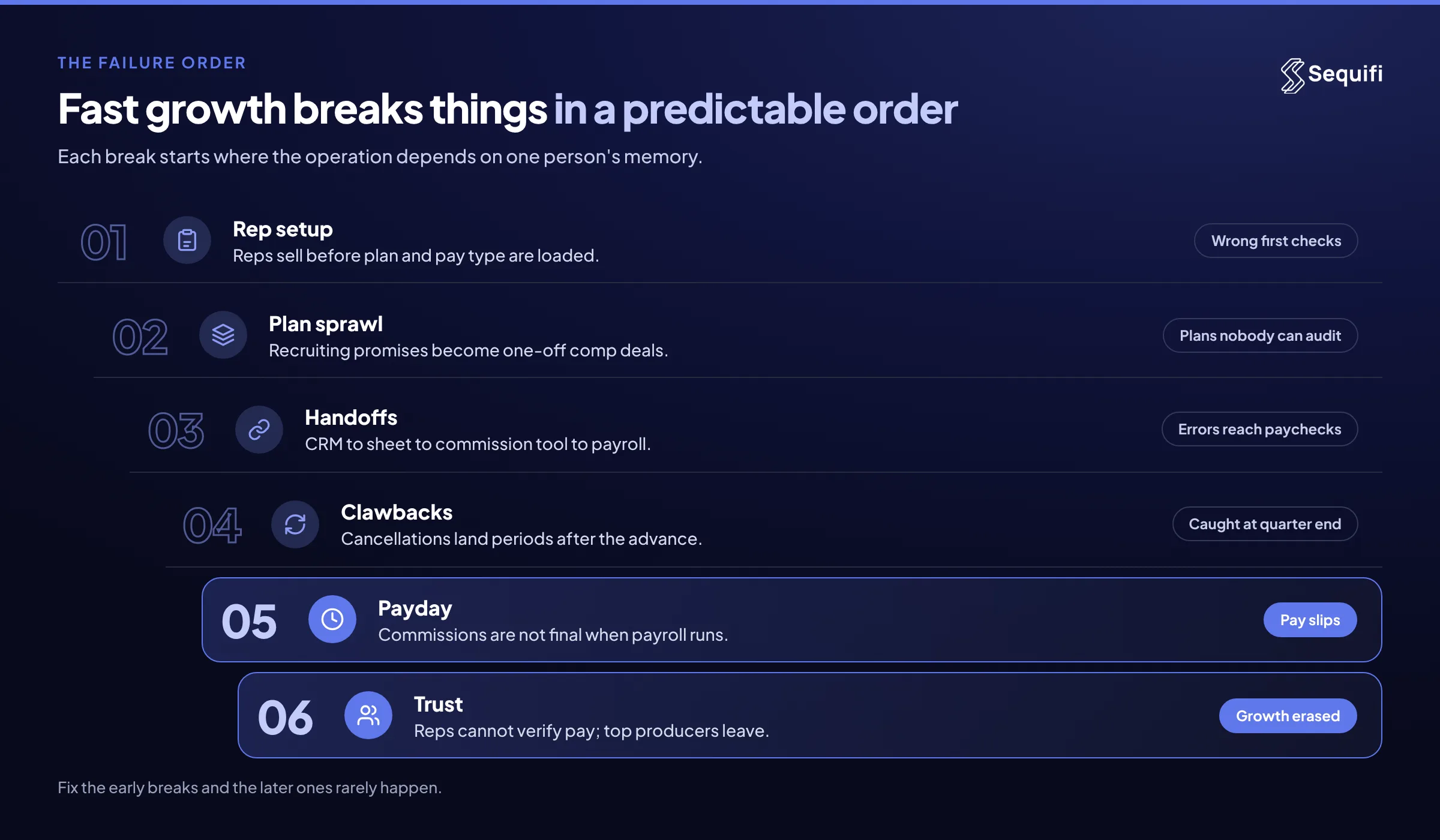
- Rep setup: new reps start selling before their plan, territory, and pay type are in the system.
- Plan sprawl: recruiting promises turn into one-off deals nobody can copy or audit.
- Pay accuracy: manual handoffs between deal data, commissions, and payroll multiply errors.
- Pay timing: payday slips because commissions are not final when payroll runs.
- Trust and retention: reps who cannot verify their pay stop believing it, and the best ones leave first.
- Management capacity: managers and ops spend hours on pay questions instead of coaching and hiring.
Deep Dive
Fast growth does not break everything at once. It breaks things in a predictable order, starting with the parts of the operation that depend on one person's memory.
Setup breaks before selling does. A recruit signs on Monday and is working leads or knocking doors by Wednesday. If their plan, override chain, and W2 or 1099 status are not in the system by then, their first deals get calculated on a default plan or not at all. The first paycheck is the one reps remember. Get it wrong and you spend the next month explaining it.
Plans fork under recruiting pressure. To win a rep from a competitor, a manager promises a higher split, a guaranteed draw, or a custom override. Each promise seems reasonable. Forty of them are a comp plan nobody can audit. Payroll now depends on remembering which rep got which deal, and the rules live in email threads.
Handoffs multiply with volume. Many teams move data from a CRM or field app to a spreadsheet, then to a commission tool, then to payroll. Each step is a chance to drop a deal, count one twice, or apply last month's rate. At low volume, a careful ops lead catches the errors. At high volume, errors reach paychecks.
Clawbacks and multi-trigger pay fall through the cracks. Solar pays on close and again on install. Fiber pays on sale and on activation. Pest control often pays on completed service, with chargebacks for cancellations. When a cancellation lands three pay periods after the advance, someone has to catch it. Under growth pressure, nobody does until the quarter-end reconciliation.
Classification gets decided by default. Fast-growing teams often mix W2 employees and 1099 contractors. Classification has to follow IRS guidance on employees versus independent contractors, and overtime rules for field reps depend on the Department of Labor's outside sales exemption. When onboarding is rushed, these calls get made by whoever fills out the form. Have counsel review each role. This is general information, not legal advice.
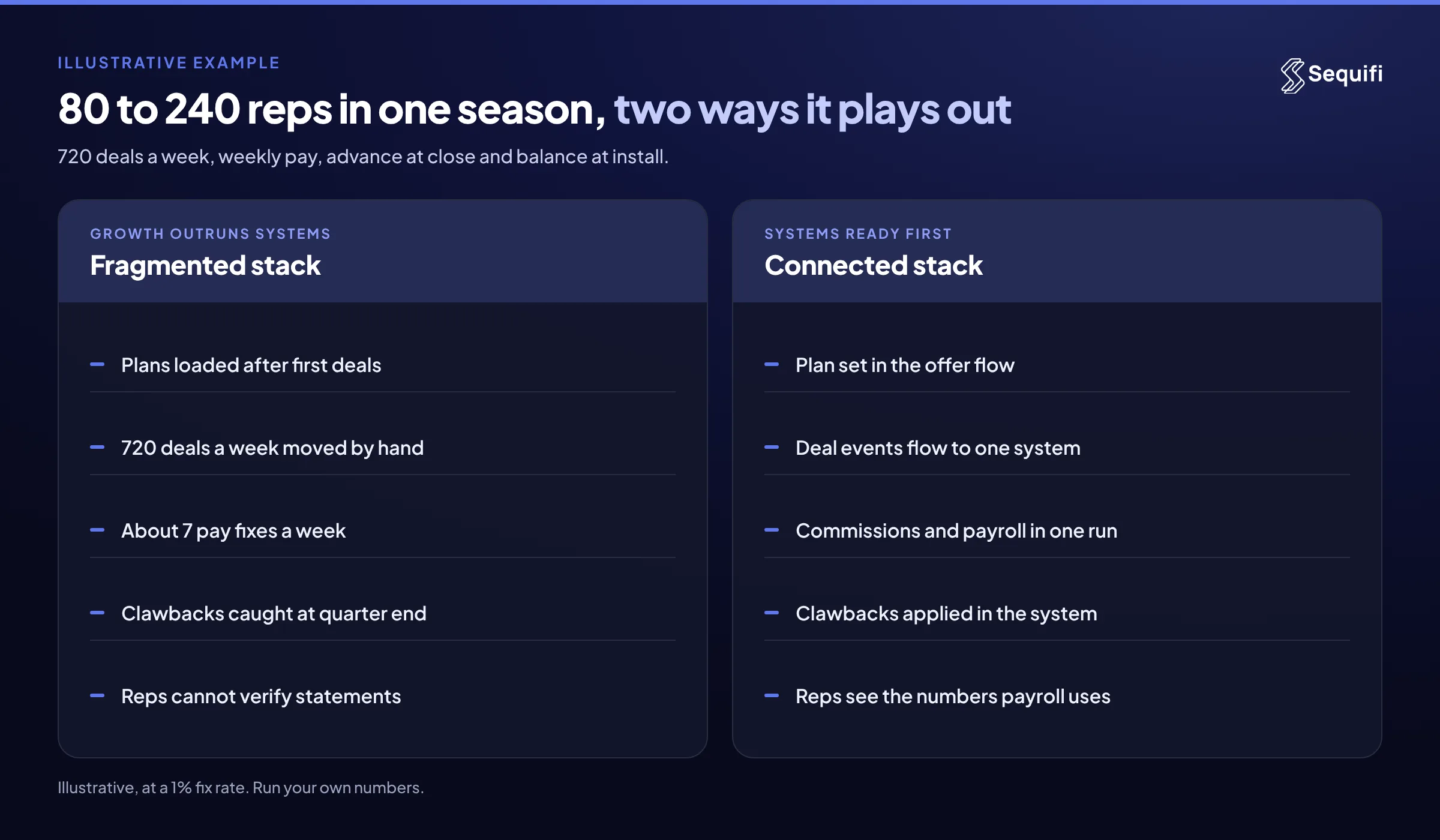
Worked example (illustrative). A team grows from 80 to 240 reps in one season. Each rep closes about 3 deals a week, so volume grows from 240 to 720 deals a week. Pay runs weekly, with an advance at close and the balance at install.
Assume 1% of deals need a manual pay fix in a fragmented stack, and each fix takes 30 minutes to find, explain, and correct. At 80 reps, that is about 2 fixes and 1 hour a week. At 240 reps, it is about 7 fixes and 3.5 hours a week, before counting missed clawbacks. Each fix is also a rep who questioned a paycheck. Add 40 new reps a month whose plans must be loaded before their first deal, and the ops lead who handled pay at 80 reps is underwater. These numbers are assumptions; run your own.
Trust breaks last, and costs the most. Reps check their pay against their own deal tally. When the two disagree, they ask a manager. When the answer takes a week, they take a call from another company's recruiter. Reps who cannot see why their commission is what it is assume the worst. The reps with the most options leave first, and they are usually your top producers.
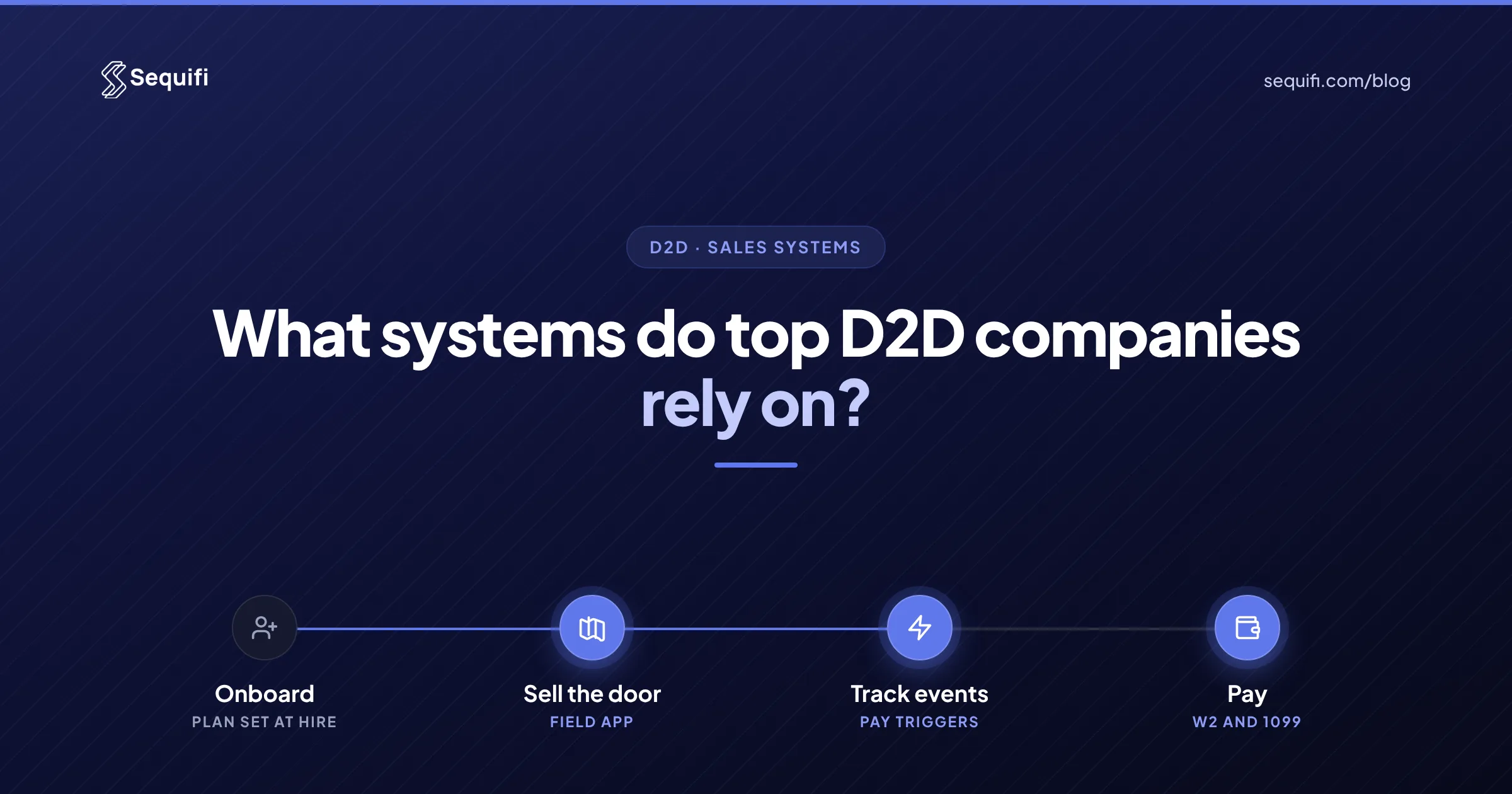
Reporting stops matching reality. Dashboards built on CRM data show one revenue number. Payroll shows another. Leadership can no longer tell which offices are profitable after commissions, overrides, and clawbacks. We map the systems that prevent this in what systems high-growth sales teams use.
What Breaks at Scale
At 50 reps, one ops lead holds it together. They know every plan, catch most errors, and fix the rest with a quick text. The system is a person.
At 200 reps, that person is the bottleneck. New reps start before their plans are loaded. Custom deals pile up. The commission spreadsheet and payroll disagree, and payday slips while someone reconciles. Managers field pay questions every day. We cover the payroll side in how to scale a sales team without payroll breaking.
At 500 reps across several states, small errors compound. Clawbacks cross pay periods and get missed. W2 and 1099 runs drift apart. Override chains change every time a manager is promoted. Reporting no longer matches paychecks, so leadership cannot trust office-level profit. Recruiting keeps adding reps while attrition removes them, and net headcount stalls. At that size, every manual step in pay is a weekly cost, not an occasional one.
How Sequifi Solves This
Sequifi is built for any high-velocity sales org with multi-trigger comp plans, including solar, fiber, pest control, mortgage, insurance, and home services. It addresses the failure points that show up first:
- Rapid rep onboarding. Sequifi is built to onboard hundreds of reps a month, with plan, pay type, and override chain set at hire, before the first deal.
- One commission engine with unified W2 and 1099 payroll. Closes, installs, activations, overrides, ramps, and clawbacks are calculated and paid in one system, with no export between commissions and payroll.
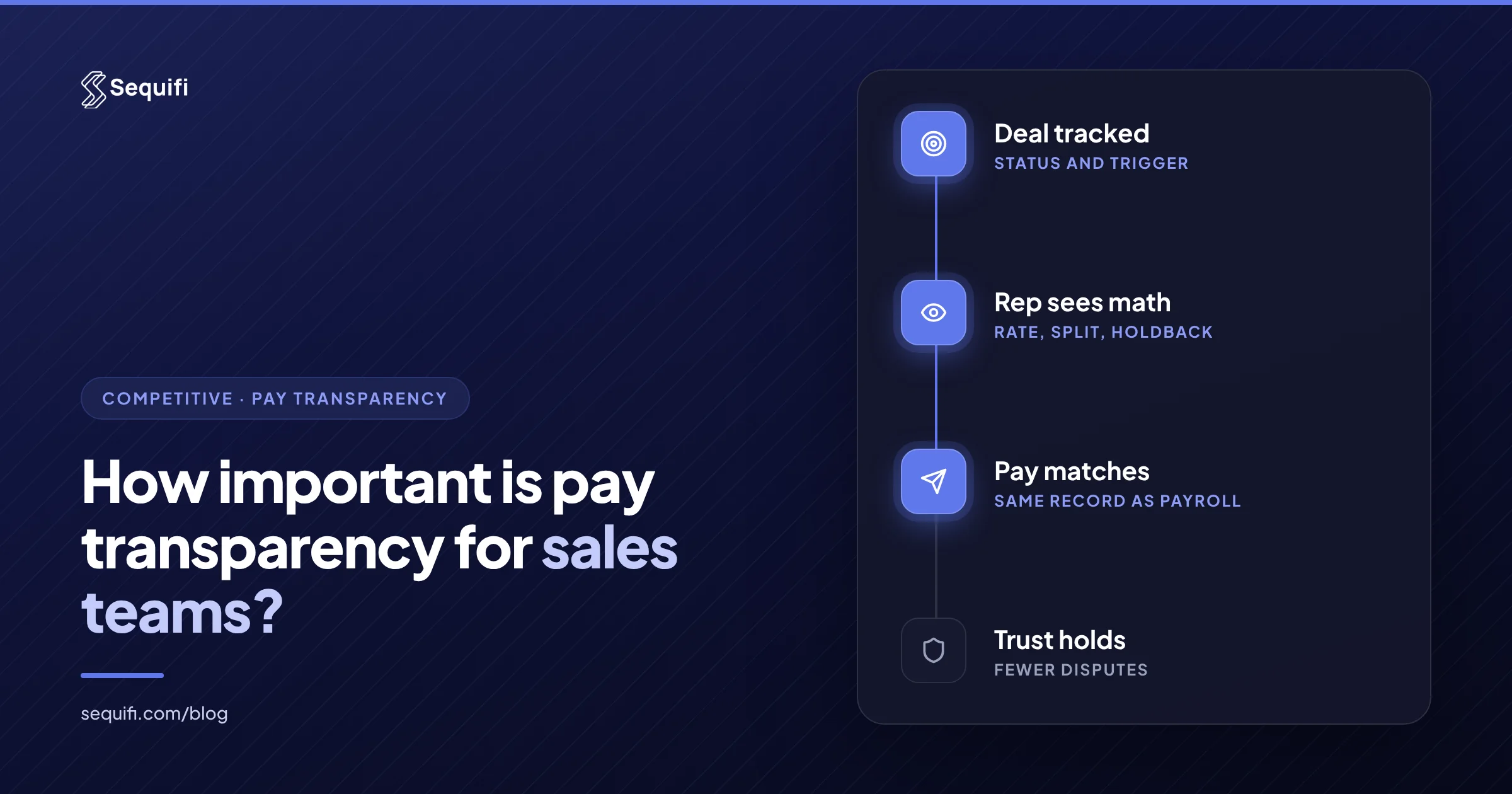
- Rep-facing pay transparency. Reps see each deal, its trigger status, and what is pending, from the same numbers payroll uses.
Frequently Asked Questions
What is the first thing to break when a sales team grows too fast?
Usually rep setup. New reps start selling before their plan, territory, and pay type are loaded, so their first deals are calculated wrong or not at all. That first wrong paycheck sets the tone for the rep's whole tenure. Fix setup by making plan assignment part of the offer flow, not a task ops handles after the rep starts.
How fast is too fast to grow a sales team?
There is no fixed number. Growth is too fast when hiring outpaces your ability to onboard, pay, and support reps accurately. Watch for four signals: payday slips, pay questions rise week over week, new reps get wrong first checks, and custom comp deals multiply. If two of these appear in the same quarter, slow hiring or fix the system first.
Why do top reps leave fast-growing companies?
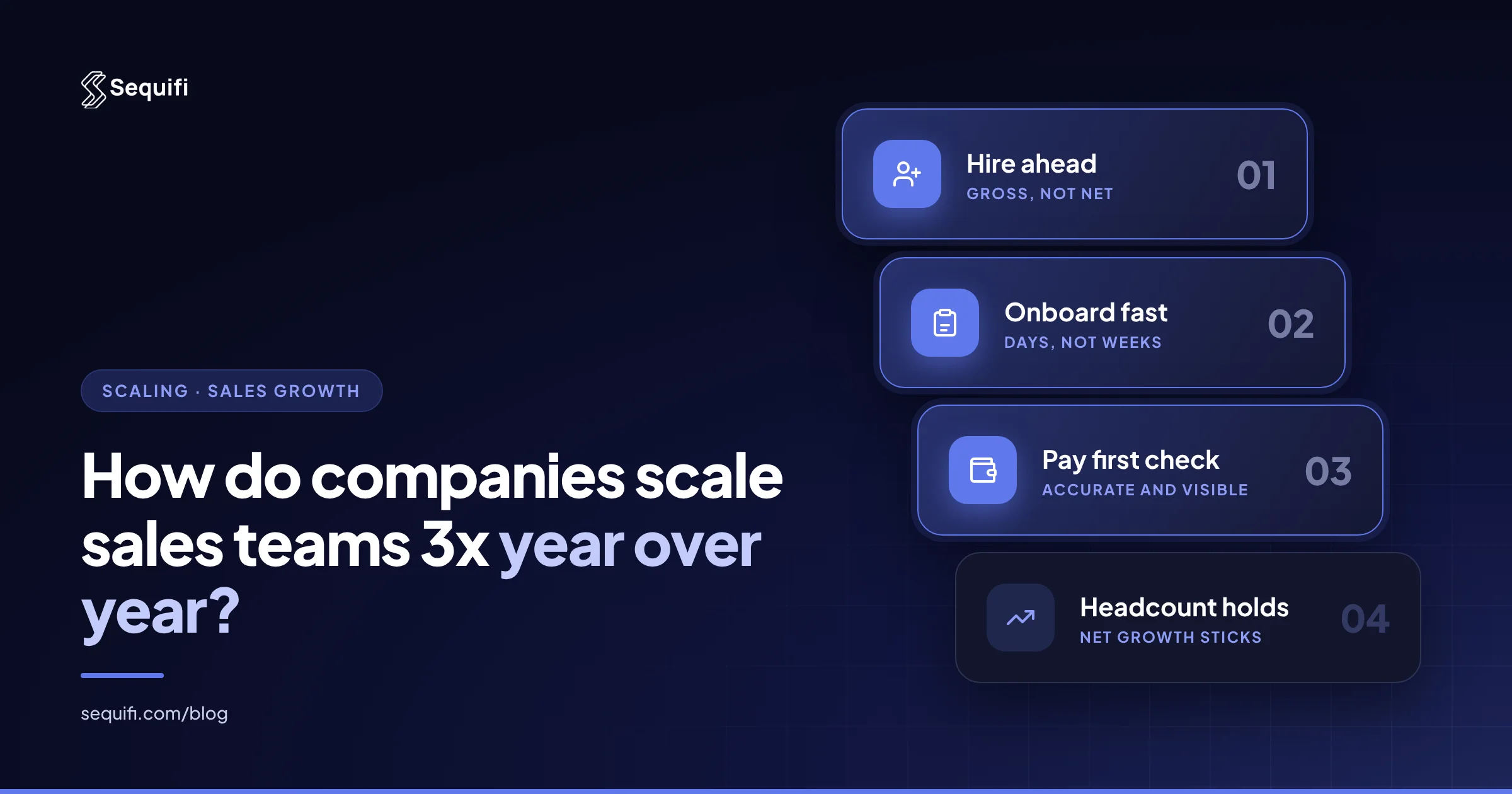
Top reps have the most options, so they are the first to act when pay feels unreliable. A missed override, a late clawback, or a statement they cannot verify tells them the company is not keeping up. Competitors recruit on pay speed and clarity. See how teams avoid this in how companies scale sales teams 3x year over year.
Can spreadsheets handle commissions during rapid growth?
For a short time, at low volume, with simple plans. Spreadsheets break when you add multiple pay triggers, overrides, clawbacks that cross pay periods, and dozens of new reps a month. Every formula edit and copy-paste is a chance for error, and there is no audit trail reps can see. Teams often feel the strain as they near 100 reps or add a second pay trigger.
How do you keep pay from breaking during a hiring surge?
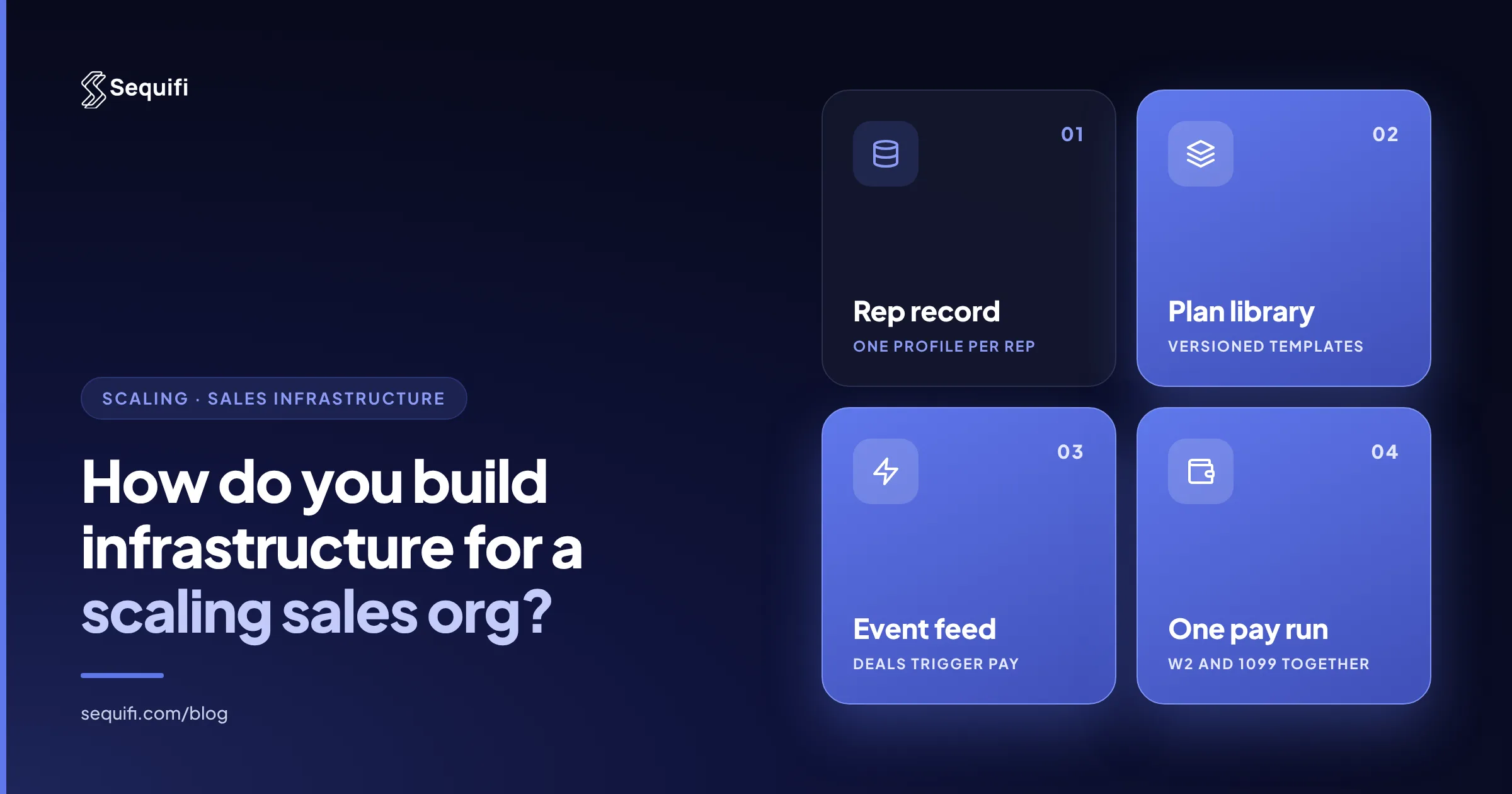
Fix the system before the surge, not during it. Standardize plans into a small set of versioned templates. Load plans at hire. Connect deal data to one system that calculates and pays commissions. Give reps a view of their deals and pending pay. Then run a test pay cycle at the new headcount. Our guide to onboarding sales reps quickly covers the setup steps.
Conclusion
When sales teams grow too fast, the first failures are rarely in selling. They are in setup, plans, and pay, and they show up as wrong first checks, missed clawbacks, slipping paydays, and reps who stop trusting their statements. Those failures turn hiring wins into attrition. As a next step, list every manual step a deal takes from close to paycheck, and fix the ones that depend on a single person before your next hiring push. To see how one system onboards reps, calculates commissions, and runs payroll together, visit Sequifi.
See Sequifi run your kind of pay.
Commissions, payroll and HR in one platform, built for teams where every paycheck is different.
Book a demo