How do you build infrastructure for a scaling sales org?
Build sales infrastructure in layers: rep records, versioned plans, automated deal events, one pay engine, controls, and visibility. See how Sequifi helps.
Direct Answer
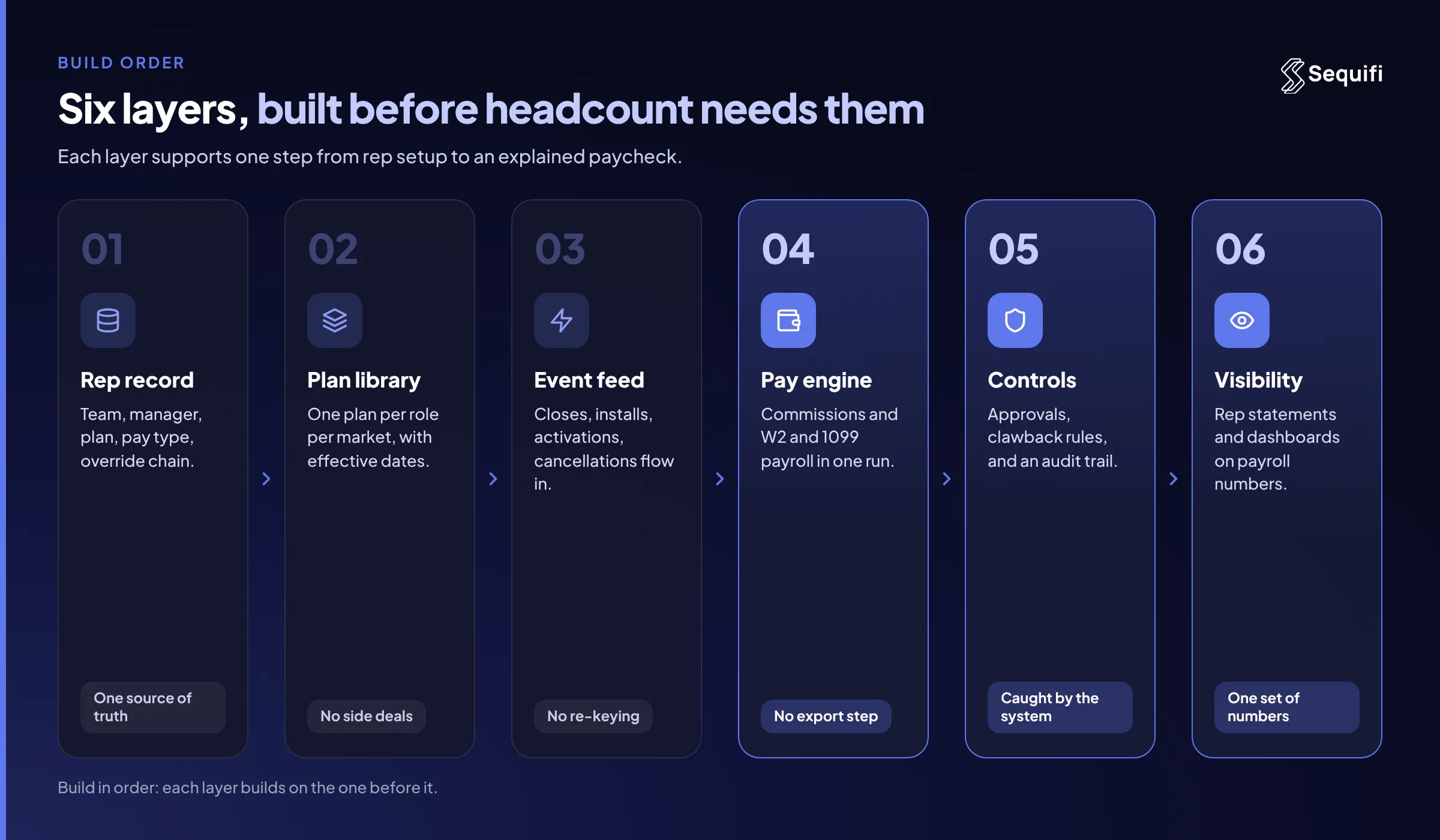
Build it in layers, in this order: one record for every rep, a library of versioned comp plans, an automated feed of deal events, one engine that calculates commissions and runs W2 and 1099 payroll, controls for approvals and clawbacks, and dashboards reps and leaders both trust. Build each layer before headcount needs it. Infrastructure that lags hiring by a quarter turns growth into pay errors, ops overtime, and attrition.
Breakdown
- Rep record: one profile per rep with team, manager, plan, pay type, override chain, and start date.
- Plan library: a short list of versioned comp templates with effective dates, not one-off side deals.
- Event feed: closes, installs, activations, and cancellations flow in from the CRM or field app without re-keying.
- Pay engine: commissions and payroll calculated and paid in one run, for W2 and 1099 reps.
- Controls: approval rules, clawback logic, and an audit trail for every change.
- Visibility: rep statements and leadership dashboards built on the same numbers payroll uses.
Deep Dive
Most sales orgs accumulate infrastructure: a CRM, a commission spreadsheet, a payroll provider, and a group text for pay questions. That works until hiring speeds up. Infrastructure is the set of systems and rules that let you add reps without adding ops people, errors, and pay questions at the same rate.
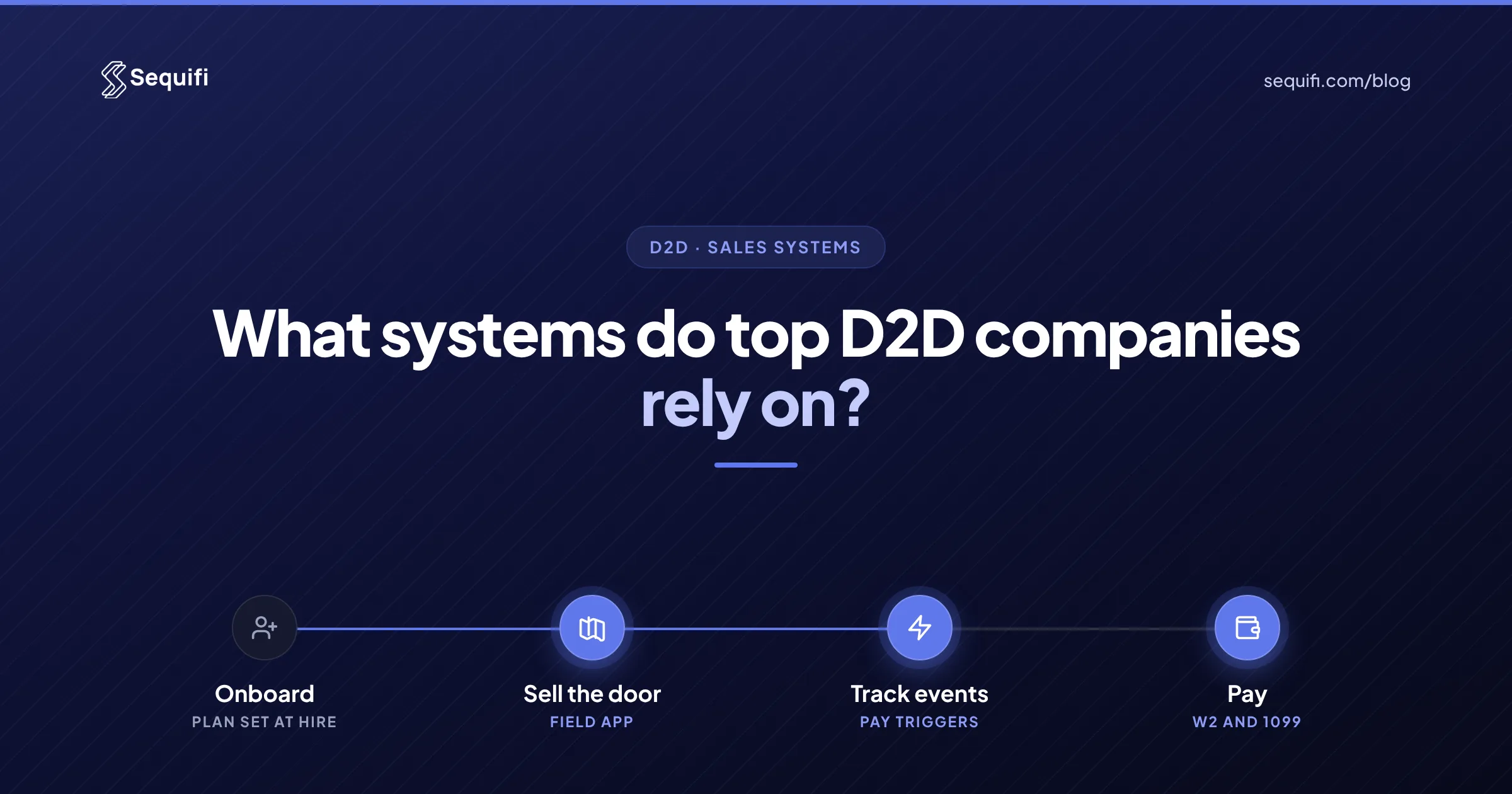
Think of it as one pipeline. A rep is set up, sells, and each deal triggers pay events. Pay is calculated, approved, paid, and explained. Every layer below supports one step of that pipeline.
Start with the rep record, not the dashboard. A dashboard is only as good as the records behind it. Each rep needs one profile that holds team, manager, plan, pay type, override chain, and start date, with history when any of them change. When a manager is promoted, the overrides above and below them change on a specific date. If that date lives in someone's head, every report after it is wrong. Classification belongs here too: W2 or 1099 status should follow IRS guidance on employees versus independent contractors, reviewed by counsel for each role. This is general information, not legal advice.
Turn comp plans into versioned templates. Scaling orgs rarely have too few plans. They have too many. Keep one plan per role per market, each with an effective date. A recruiting exception becomes a documented variant with an end date, not a side deal in an email thread. Our guide to setting up a commission structure for a sales team covers plan design.
Automate the event feed. Pay depends on events: a signed contract, a passed install inspection, a service activation, a cancellation. Map each event to its source system, name one owner per event, and let it flow without re-keying. Solar pays on close and on install. Fiber pays on sale and on activation. Insurance pays on issue, with chargebacks inside a cancellation window. Each trigger needs a clean source.
Put commissions and payroll in one run. The gap between the commission number and the paycheck is where most errors hide. When a commission file is exported, edited, and imported into payroll, nobody can trace a paycheck back to its deals. Employers also have to keep accurate pay and hours records under the Department of Labor's FLSA recordkeeping rules. One engine that calculates and pays both W2 and 1099 reps removes the handoff and keeps the record in one place.
Build controls before you need them. Define who approves adjustments and above what amount. Write clawback rules once, so a cancellation three pay periods later is caught by the system, not by a quarter-end audit. Log every change.
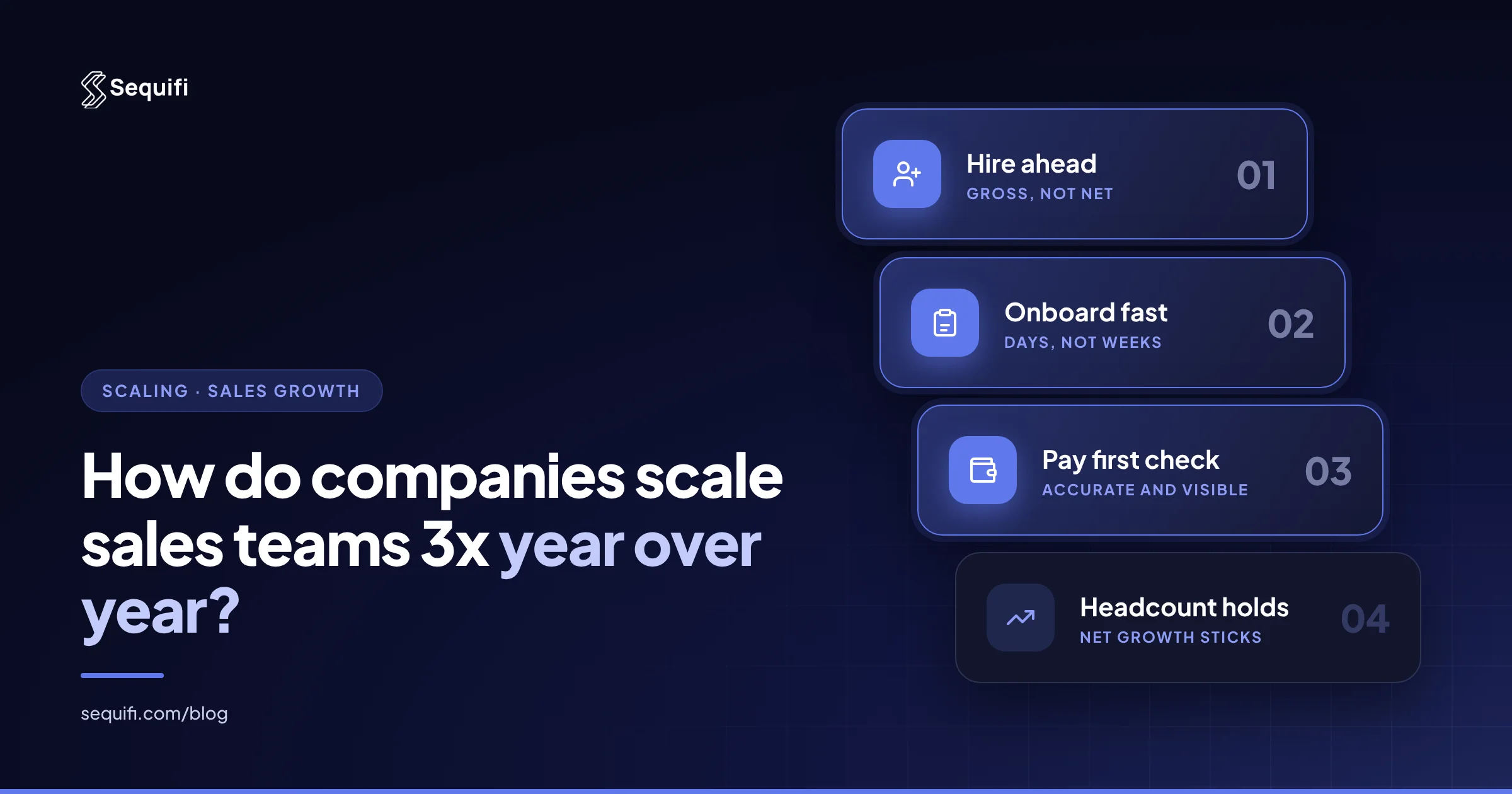
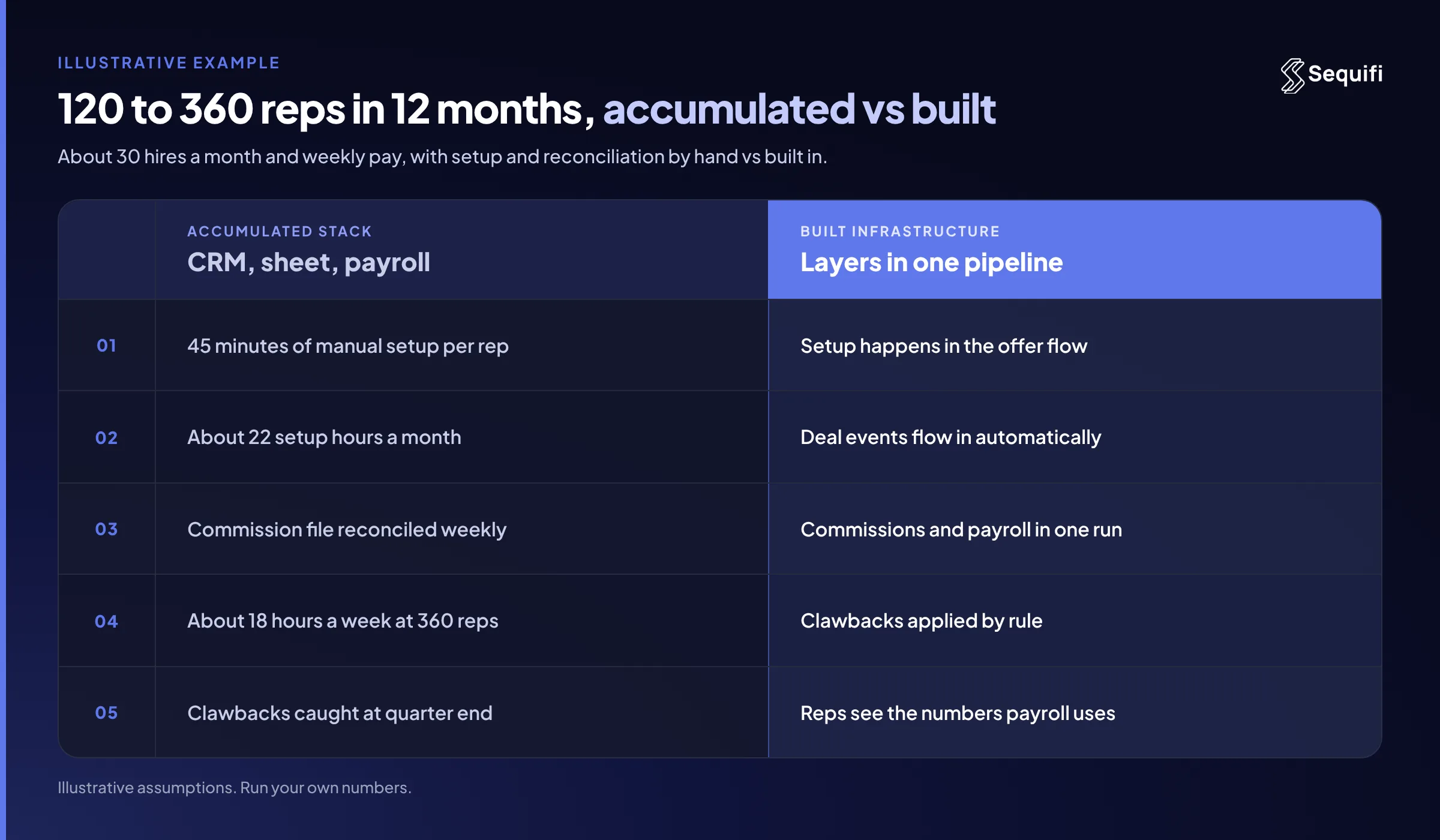
Worked example (illustrative). A home services company has 120 reps and plans to reach 360 in 12 months. That is 20 net adds a month. If 10 reps leave each month, it hires about 30. Assume manual setup takes 45 minutes per rep: profile, plan, pay type, and override chain. That is about 22 hours a month of setup alone. Now assume weekly pay, and reconciling the commission file with payroll takes 6 hours a week at 120 reps. If that work grows with headcount, it reaches about 18 hours a week at 360 reps, nearly half of one ops person, before any pay disputes. When setup happens in the offer flow and commissions and payroll run together, most of those hours go away. These numbers are assumptions; run your own.
We compare the tools themselves in what systems high-growth sales teams use.
What Breaks at Scale
At 50 reps, infrastructure is a person. One ops lead knows every plan, loads every rep, and fixes pay errors with a text. It works because volume is low and memory is enough.
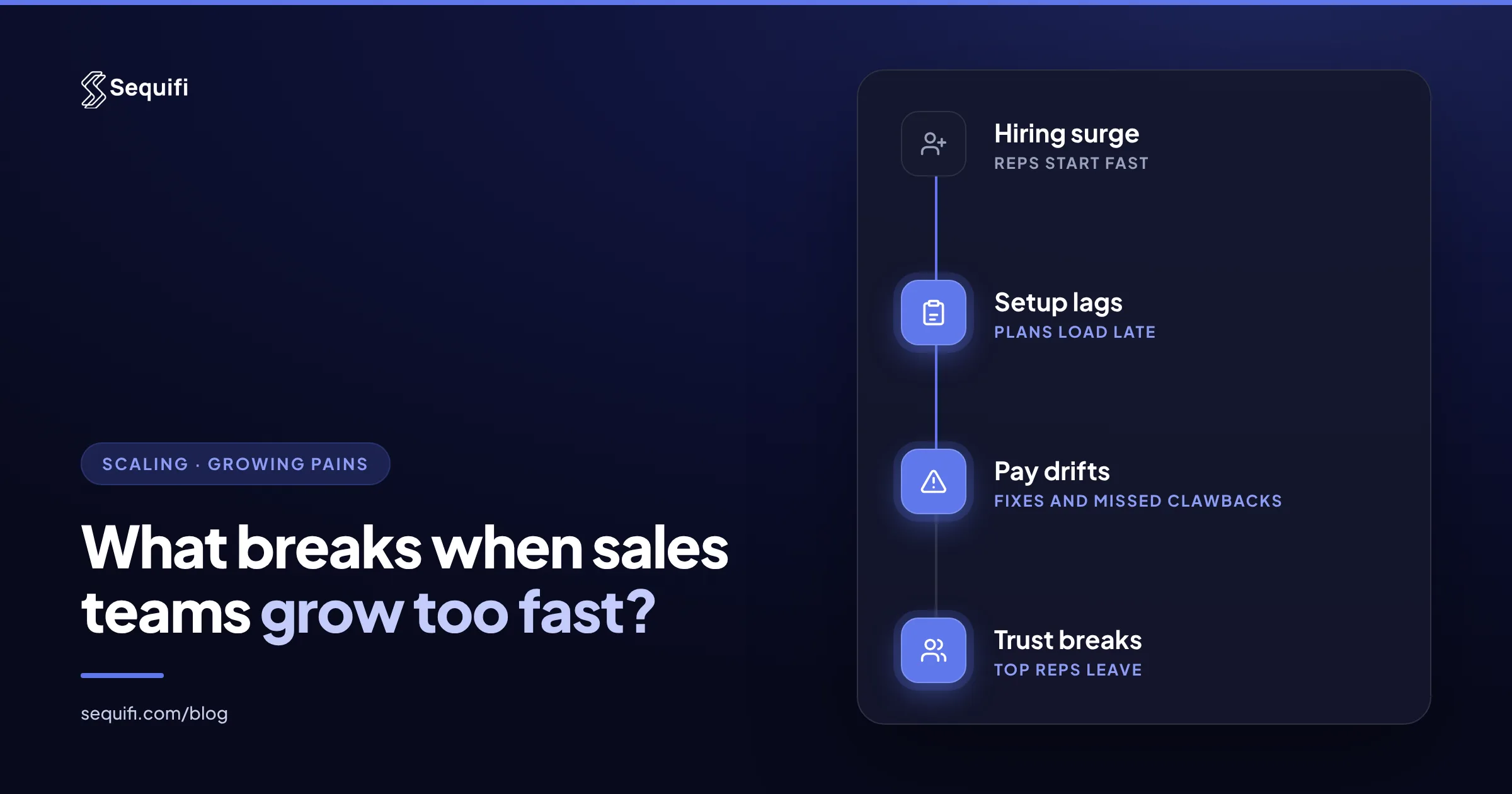
At 200 reps, the gaps become weekly costs. New reps start selling before their records are complete. Plan exceptions pile up. The commission file and payroll disagree, and payday slips while someone reconciles. Managers field pay questions instead of coaching. This is the stage where teams find out what breaks when they grow too fast.
At 500 reps across several states and teams, small gaps compound. Override chains change with every promotion. Clawbacks cross pay periods and get missed. W2 and 1099 runs drift apart. Reports no longer match paychecks, so leaders cannot see which offices are profitable after commissions. Every manual step now costs hours each week and erodes rep trust. We cover the payroll side in how to scale a sales team without payroll breaking.
How Sequifi Solves This
Sequifi is built for any high-velocity sales org with multi-trigger comp plans, including solar, fiber, pest control, mortgage, insurance, and home services. It covers several infrastructure layers in one system:
- One commission engine with unified W2 and 1099 payroll. Closes, installs, activations, overrides, ramps, and clawbacks are calculated and paid in one run, with no export between commissions and payroll.
- Rapid rep onboarding. Sequifi is built to onboard hundreds of reps a month, with plan, pay type, and override chain set at hire.
- Dashboards and rep-facing pay transparency. Leaders see performance, and reps see each deal and its pay status, from the same numbers payroll uses.
Frequently Asked Questions
When should a sales org start building infrastructure?
Before the hiring push, not during it. A practical trigger is when one person can no longer hold every plan and exception in their head, or when you add a second pay trigger such as install or activation. Many teams feel this between 50 and 100 reps. Building at that point costs weeks. Rebuilding at 300 reps, while paying them every week, costs months and trust.
Who should own sales infrastructure?
Give each layer one owner. Sales ops or RevOps usually owns rep records, plans, and the event feed. Finance or payroll owns pay runs, approvals, and tax compliance. Leadership owns plan changes. Write the ownership down, including who approves exceptions. When ownership is shared by default, errors sit between teams until a rep complains about a paycheck.
What is the difference between a tech stack and sales infrastructure?
A tech stack is the list of tools. Infrastructure is the tools plus the rules, data, and ownership that connect them. Two companies can run the same tools and get different results, because one has a single rep record, versioned plans, and automated events, and the other moves data by hand. Infrastructure is what makes the tools add up to accurate, on-time pay.
How many comp plans should a scaling sales org have?
As few as you can defend. A useful rule is one plan per role per market, with versioned changes and effective dates. Exceptions should be documented variants with an end date. If nobody can list every active plan from memory, or two reps in the same role are paid on different terms without a record of why, the library needs a cleanup before the next hiring wave.
How do you test sales infrastructure before scaling?
Run a parallel pay cycle. Take one week of real deals, add simulated deals at your target headcount, and run them through setup, calculation, approval, and payroll. Compare the result to what reps expect. Fix any step that needs manual work or a single person's knowledge. Then repeat once a quarter. Our guide to onboarding sales reps quickly covers the setup side.
Conclusion
Infrastructure for a scaling sales org is not one tool. It is a set of layers built in order: rep records, versioned plans, automated deal events, one engine for commissions and payroll, controls, and shared visibility. Build each layer before headcount needs it, and growth adds revenue instead of pay errors and attrition. As a next step, trace one deal from signed contract to paycheck, list every manual step and owner, and fix the steps that depend on one person before your next hiring push. To see how one system handles onboarding, commissions, and payroll together, visit Sequifi.
See Sequifi run your kind of pay.
Commissions, payroll and HR in one platform, built for teams where every paycheck is different.
Book a demo