Does faster pay help recruit better sales reps?
Faster pay helps recruit better sales reps when it is tied to verified deals and paid accurately. See how event-based pay with Sequifi attracts top producers.
Direct answer
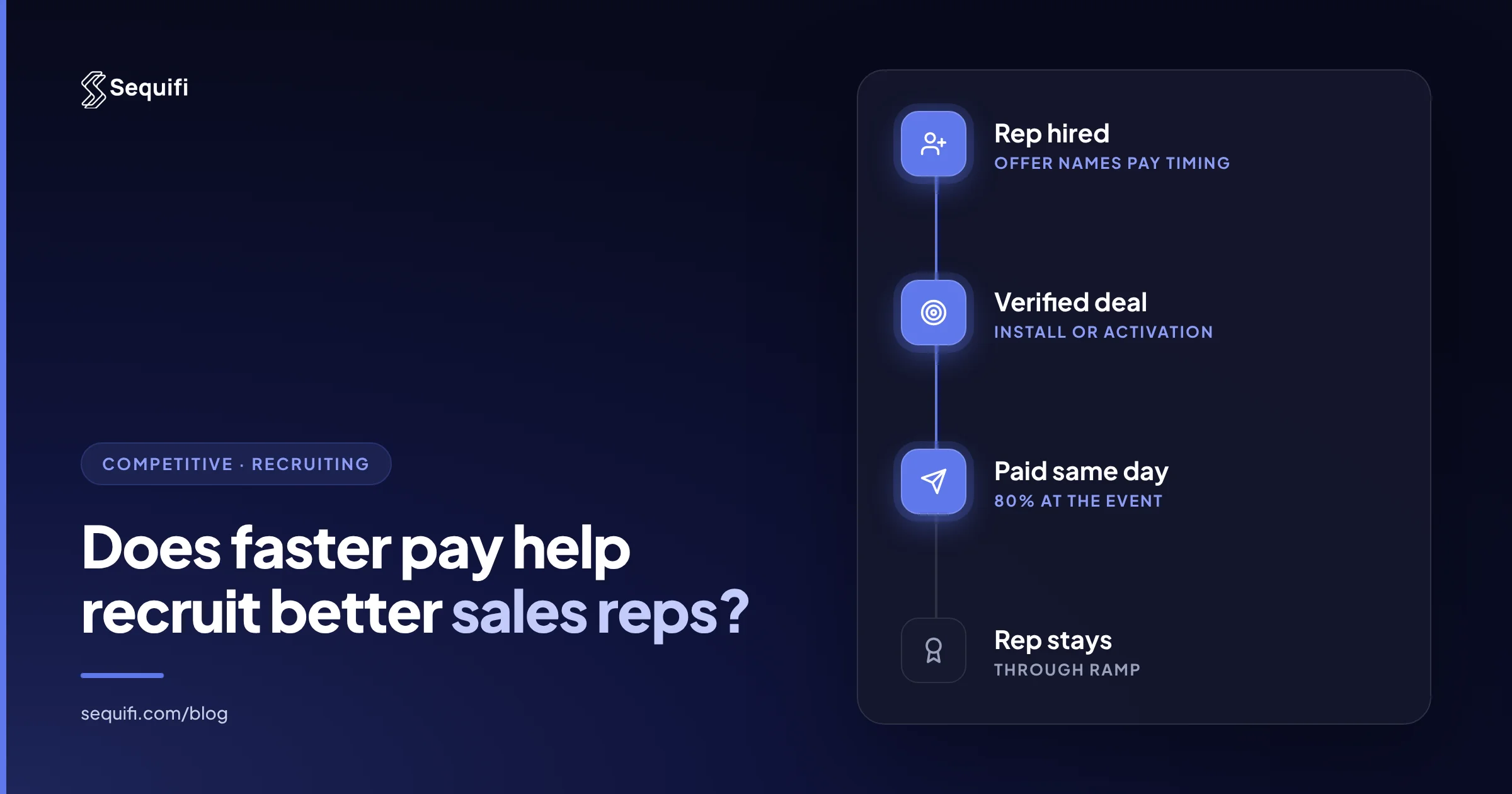
Yes, faster pay helps recruit better sales reps, but only when it is tied to verified deals and paid accurately. Speed widens the top of your hiring funnel because candidates compare when they get paid, not just how much. Quality comes from the design: pay fast on an event a system can verify, hold back part for cancellations, and show reps every dollar. Fast but wrong pay drives good reps away faster than slow pay.
Breakdown
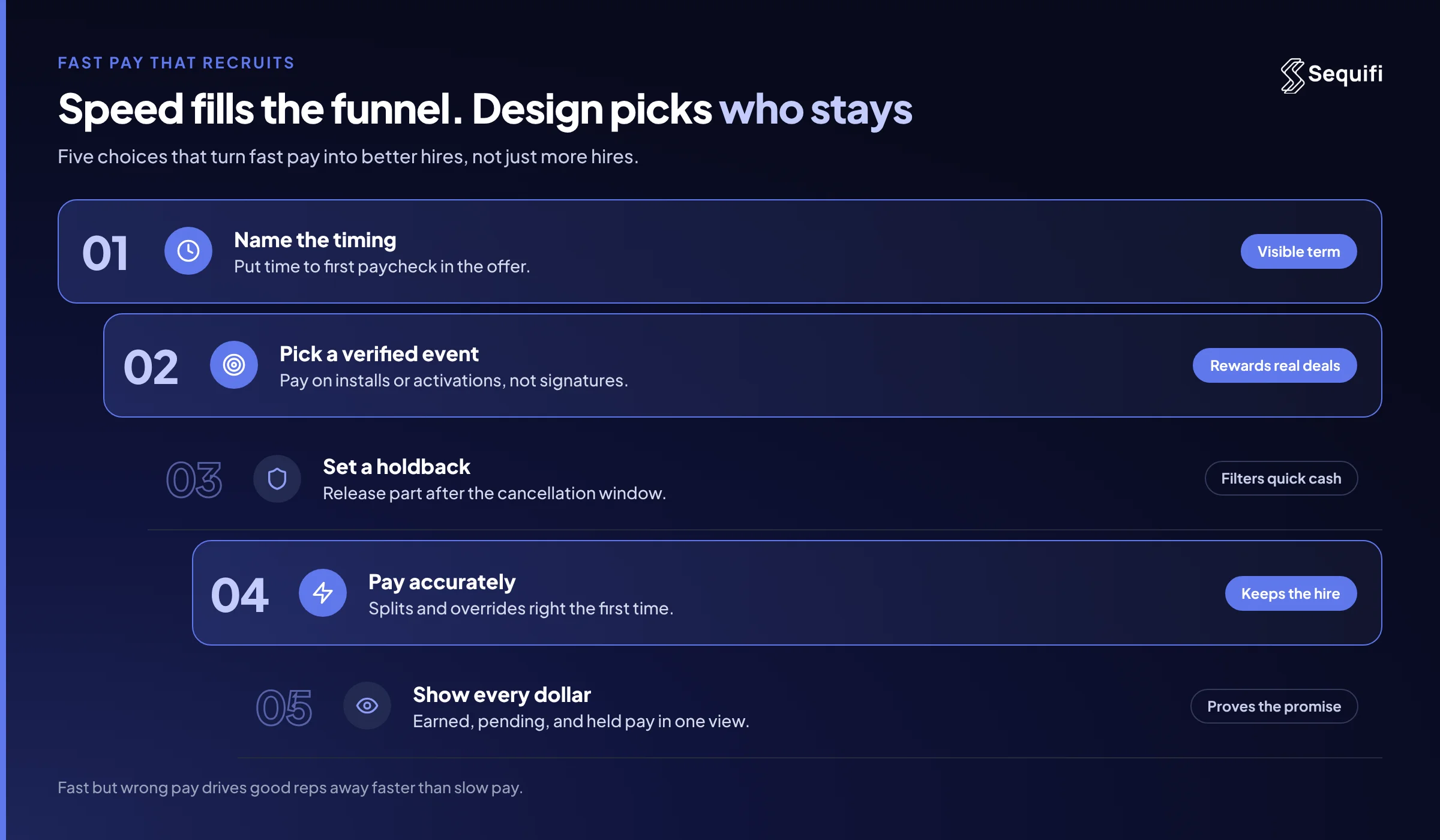
- Speed is a visible offer term: candidates compare time to first paycheck, not only commission rates.
- The trigger decides who you attract: paying on verified installs or activations rewards reps who close real deals.
- Accuracy keeps the hire: one wrong payout undoes the recruiting pitch.
- Holdbacks protect quality: releasing part of the commission later filters out reps chasing quick cash.
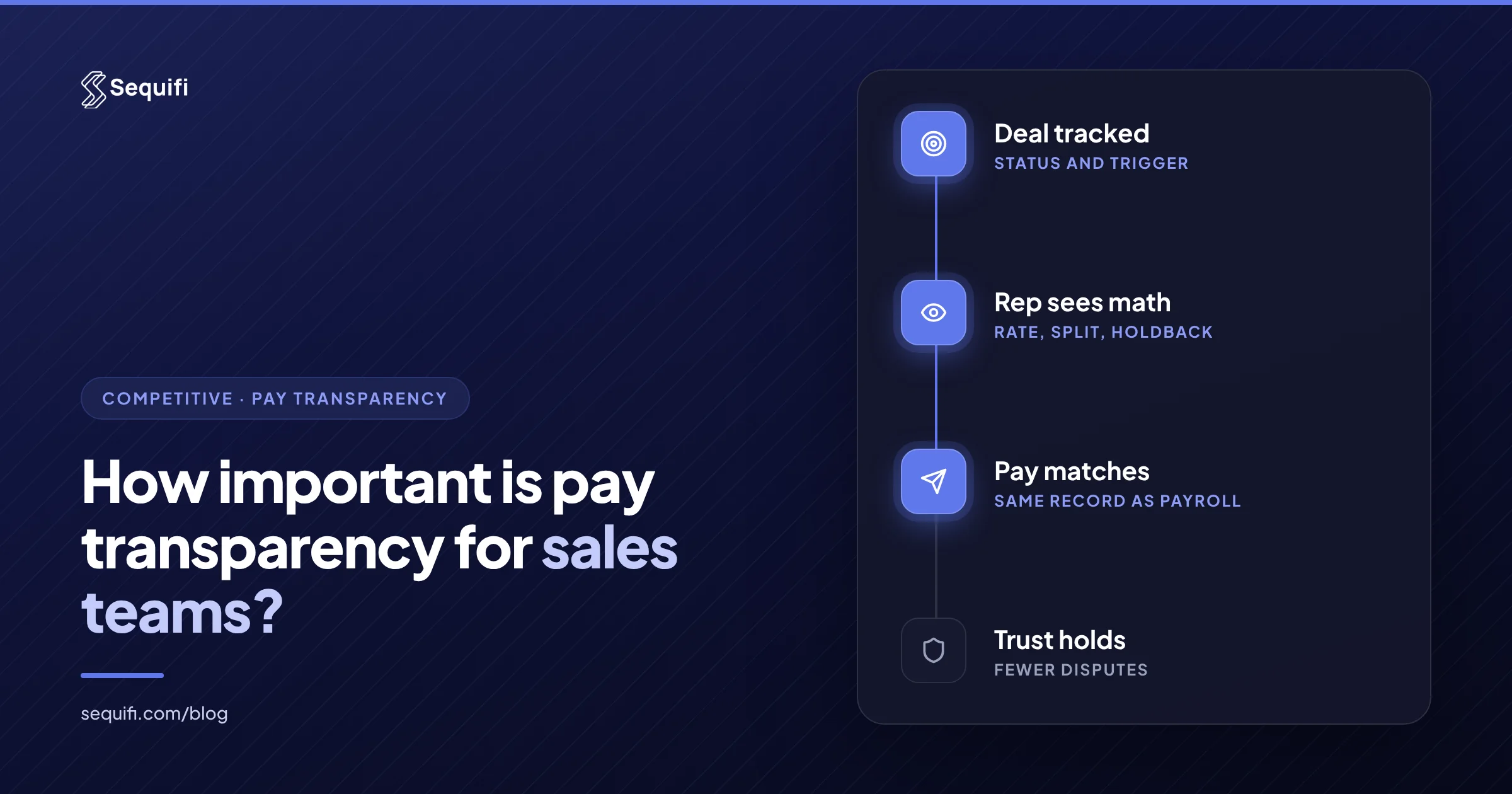
- Transparency proves the promise: reps who can see earned, pending, and held pay trust the offer.
- Time to first dollar drives early retention: new reps stay through ramp when money shows up early.
Deep dive
Most recruiting pitches in commission-heavy sales sound the same: uncapped earnings, top rates, great culture. What a candidate can verify, often by asking one current rep, is when the money actually lands.
That is why pay speed works as a recruiting lever: it is concrete and hard to fake for long.
Why speed matters to candidates. Many households run close to the edge. In the Federal Reserve's Survey of Household Economics and Decisionmaking, 63% of adults said they would cover a $400 emergency expense with cash or its equivalent. That leaves more than a third who would not. A rep switching companies often faces a gap of several weeks with no income. An offer that shortens that gap removes a real reason to say no.
Why speed alone does not get you better reps. Fast pay attracts everyone, including reps who want quick cash. The payout design decides who stays:
- Pay on signature, in full, fast. This attracts volume. It also attracts reps who write weak deals, collect, and move on before cancellations hit.
- Pay on a verified event, with a holdback. This attracts reps who close deals that stick. In solar, the event might be a verified install. In fiber, a confirmed activation. In pest control or home services, a completed first service.
The second setup tells candidates what you value. Strong closers like it; weak closers screen themselves out. For a detailed look at how to build the payout chain, see our guide on how companies offer same-day pay to sales reps.
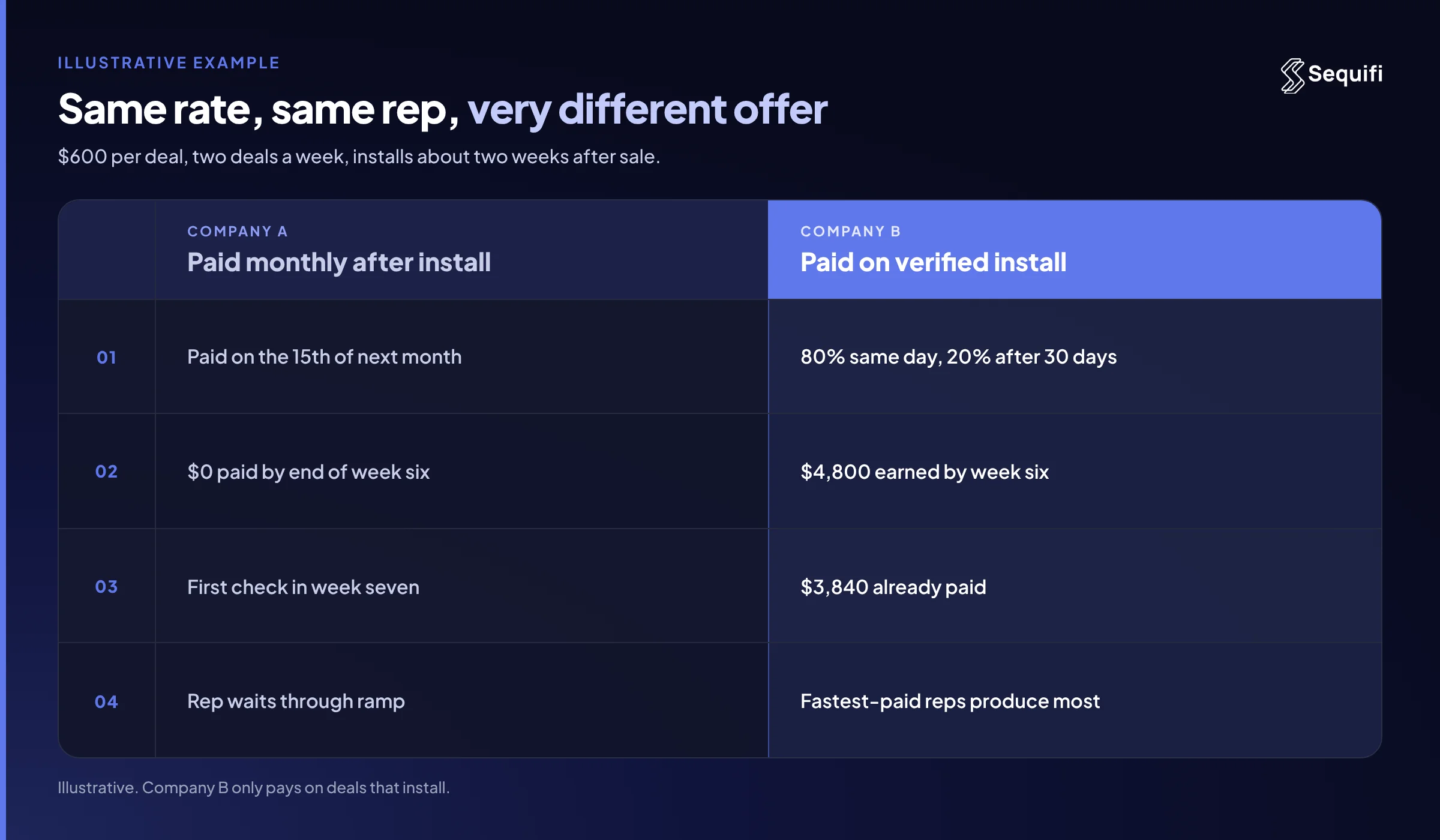
Worked example (illustrative). Two companies recruit the same experienced rep. Both pay $600 per deal. The rep closes two deals a week, and deals install about two weeks after the sale.
- Company A pays commissions monthly, on the 15th of the month after install. The rep starts on the 1st. By the end of week six, the rep has been paid $0. The first check arrives in week seven.
- Company B pays on verified install, releasing 80% the same day and 20% after a 30-day cancellation window. By the end of week six, deals sold in weeks one through four have installed. That is eight deals, or $4,800 earned, with $3,840 already paid.
Same rate, very different offer. And because Company B only pays on deals that install, its fastest-paid reps are its most productive ones.
Accuracy matters more than speed. A same-day payout that is wrong is worse than a monthly payout that is right. Reps forgive slow pay once, but not missing overrides or splits they cannot explain. Fix disputes first. Our breakdown of why sales reps don't trust their commissions covers the root causes.
Speed also supports retention, not just hiring. The first 60 days decide most early attrition. A new rep who sees money in week two has a reason to push through ramp. A rep who waits until week seven is quietly interviewing. With US quits running at about 3 million a month in the BLS Job Openings and Labor Turnover Survey, workers still move when a better offer appears. Every rep who leaves early takes recruiting and training cost with them; see the cost of losing a sales rep.
Stay inside the rules. State laws set the minimum pay frequency, not the maximum. The Department of Labor's state payday requirements table lists each state's rules. Paying W-2 reps faster is allowed, through an off-cycle payroll run with withholding. Paying 1099 reps faster is a contract decision. Either way, write the trigger, holdback, and clawback into the plan before you advertise fast pay.
What breaks at scale
At 50 reps, a founder or finance lead can deliver fast pay by hand. They check the CRM, run a spreadsheet, and send transfers. It works because one person keeps it true.
At 200 reps, the promise starts to slip. Payouts wait on approvals. Splits between setters and closers get missed. W-2 reps get paid like contractors because off-cycle payroll is a separate process. New hires hear "same day" in the interview and see "next week" in practice. Word spreads among reps faster than any job post.
At 500 reps, recruiting volume itself becomes the problem. You may onboard hundreds of reps a month across states and pay types. Each one needs a plan, a tax setup, and a payout path before the first deal. If onboarding and pay live in separate systems, fast pay quietly turns back into batch pay, and your best recruiting message becomes a source of complaints. The operating side of this is covered in our guide to D2D sales recruiting.
How Sequifi solves this
Sequifi is built for any high-velocity sales org with multi-trigger comp plans, including solar, fiber, pest control, mortgage, insurance, and home services. Three capabilities make fast pay a recruiting advantage you can keep:
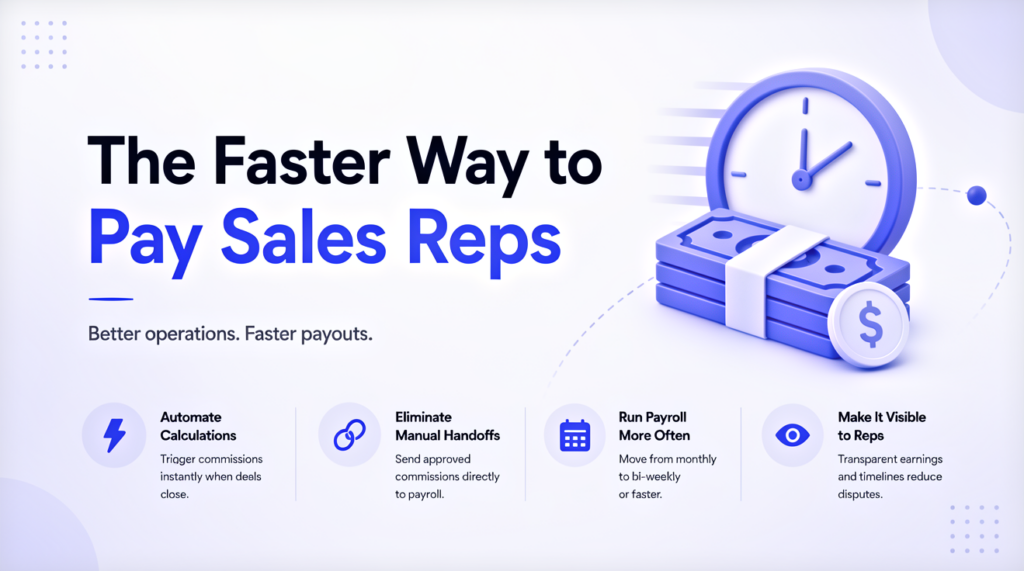
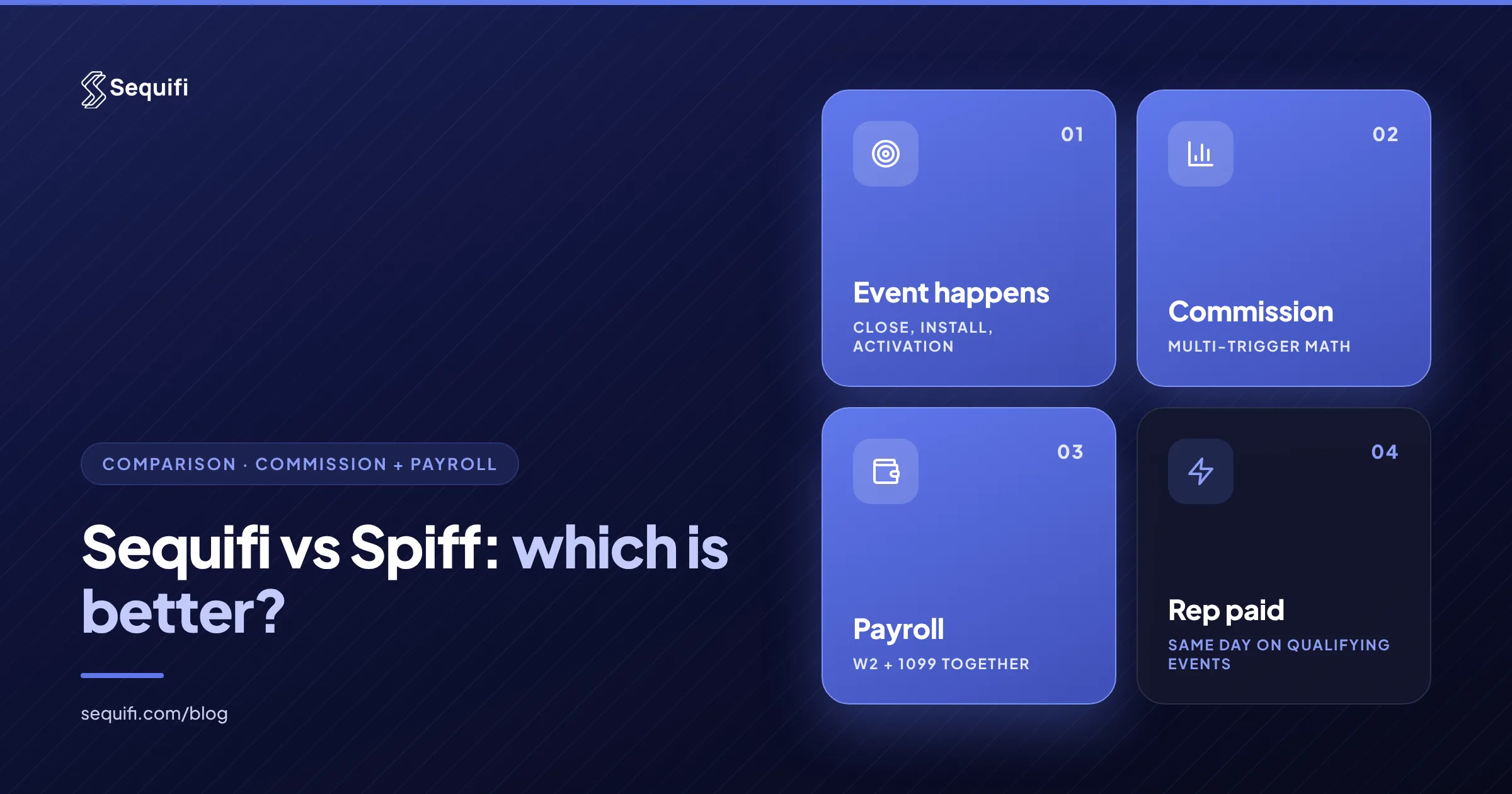
- Same-day and on-demand pay on qualifying events. Commissions become payable when the event you choose is verified, so speed and deal quality line up.
- Unified commission engine and W-2 and 1099 payroll. Closes, installs, overrides, holdbacks, and clawbacks calculate in the same system that pays reps, so the amount paid is the amount earned.
- Rapid onboarding and rep-facing pay transparency. New reps get set up in bulk and see earned, pending, and held pay from their first deal.
Frequently asked questions
Does faster pay attract lower-quality reps?
It can, if you pay fast on weak triggers. Paying in full on a signed contract draws reps who chase volume and leave before cancellations. Paying on a verified event, such as an install or activation, with a holdback, does the opposite. It rewards reps whose deals stick and makes the offer less appealing to reps looking for quick cash.
How fast is fast enough to make a difference in recruiting?
The biggest gain is shortening the time to first paycheck. Moving from monthly to weekly pay helps. Paying on the day a deal is verified helps more, because candidates can compare it directly to offers where the first check arrives weeks after the start date. Pick a speed you can deliver every time, then advertise it.
Is it legal to pay W-2 sales reps faster than the regular payroll schedule?
Yes. State laws set how often you must pay at minimum, not how fast you can pay. Commission paid outside the regular schedule to a W-2 rep is typically supplemental wages, run through an off-cycle payroll with withholding and a pay statement. Check each state where you have reps and have payroll counsel review the setup.
Should we advertise fast pay in job posts?
Yes, if it is true for every rep on day one. Be specific: name the trigger, the timing, and any holdback. "Paid the day your install is verified, 80% upfront" is credible. "Get paid fast" is not. If current reps tell candidates a different story, the claim will cost you more than it gains.
Does faster pay help keep reps after they are hired?
It helps most during ramp. New reps who see income in their first weeks have a reason to stay through the slow start. Over time, accuracy and transparency matter as much as speed, especially for experienced reps. Reps stay when they can check every payout against their own deals and the numbers match.
Conclusion
Faster pay does help recruit better sales reps, but the speed is only half the offer. The other half is the trigger, the holdback, and the accuracy behind it. Pay fast on events you can verify, show reps every dollar, and the offer attracts closers whose deals stick. As a next step, measure your current time to first paycheck for new hires, then pilot event-based pay with one team for a recruiting season. To see how that works in one system, see how Sequifi pays reps on verified events.
See Sequifi run your kind of pay.
Commissions, payroll and HR in one platform, built for teams where every paycheck is different.
Book a demo